
Frontex is developing two apps — “RRApp” and “Recapp” — to manage migrant “returns”. Critics warn the tools could enable mass deportations and covert movement tracking, mirroring controversial US immigration enforcement technology.
The US government under Donald Trump has reprogrammed an application introduced under his Democratic predecessor Joe Biden: the app originally developed as “CBP One” for the mandatory scheduling of asylum hearings has become “CBP Home”, which now serves primarily to facilitate declarations of so-called “self-deportations” and to monitor those affected. What was once an instrument for accessing the asylum procedure has thus become a tool for enforcing a harsher deportation policy.
The EU border agency Frontex is now also having an app developed through which migrants can obtain information about the respective return and reintegration programmes of EU member states and the locations of counselling centres. It is aimed at persons whose asylum application has been rejected and who have therefore received a demand to leave. If they do not comply, forced deportation may follow.
The application, planned under the name “Return and Reintegration App” (RRApp), is intended to be available for iOS and Android devices. Access via a website is also planned. Information will be provided on return assistance, such as counselling centres, opening hours or financial incentives for returning to the country of origin. Frontex is spending €500,000 on the project, which is designed to run for 56 months.
App as “alternative to detention”
The non-governmental organisation AlgorithmWatch has analysed documents that Frontex was required to provide in response to a freedom of information request. According to these, the app is also intended to answer complex questions about legal procedures via an AI-powered chatbot. Information is to be provided in several languages, including English, Arabic, Urdu and Pashto.
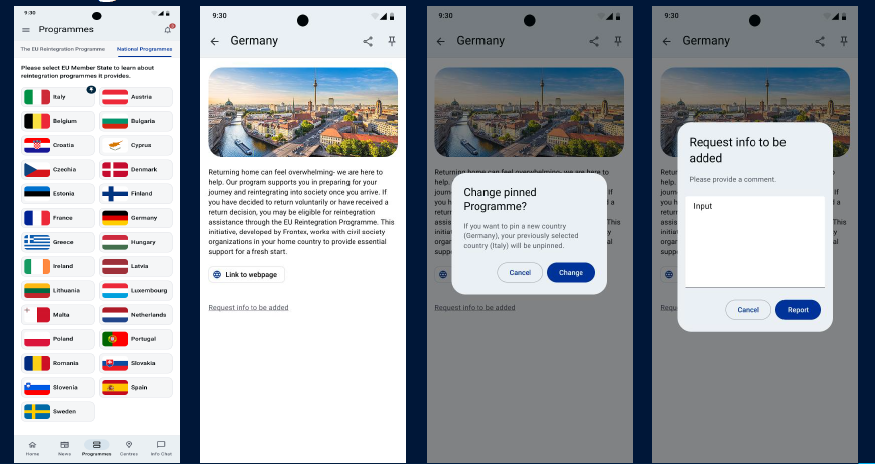
Draft of the German homepage of the “RRApp” (Frontex).
It is questionable whether use of the “RRApp” is even legally permissible. An internal legal review by Frontex, which AlgorithmWatch also obtained via a freedom of information request, found no “high-risk” artificial intelligence (AI) at work in the application. This would mean the app complies with the AI Act, through which the European Union aims to rule out automated profiling of individuals. However, a more in-depth fundamental rights impact assessment would be required in order to verify this.
Frontex has commissioned the Polish IT firm Fabrity to develop the “RRApp”. The project was presented, among others, by Frontex Deputy Director Lars Gerdes, who praised the mobile app as an “alternative to detention”. Critics are concerned by this, as it means the “RRApp” does in fact resemble the “self-deportation” that Trump is seeking to achieve in the US.
A further app for the “return process”
These concerns are fuelled by a further tool called “Recapp”, which Frontex intends to have developed for around €1 million. The agency describes it as an instrument to support procedural steps in the return process. Via “Recapp”, migrants are to be able to send messages to authorities and manage their documents from asylum proceedings. “Online counselling on return and reintegration” is also to be possible through it.
However, Frontex’s reply to a parliamentary question also refers to the use of location data — probably meaning users could, following the US model, also be monitored with the help of profiling their movement patterns. Particular focus is placed on third-country nationals and stateless persons who are required to “reside in locations in proximity to the external border or transit zones or other locations.”
This is reminiscent of electronic tags or bracelets that foreign nationals subject to a departure obligation must wear in the United Kingdom — where the practice is likewise described as an “alternative to detention”. In the US, the controversial Immigration and Customs Enforcement agency (ICE) has launched a similar mobile application for those required to leave: if those concerned are classified as a low risk to public safety, they may install “SmartLINK” on their telephone. The app also uses GPS data and selfies showing the faces of those affected in order to make their whereabouts traceable.
Sensitive location tracking
“Recapp” is also likely to be legally problematic. Although Frontex has not yet finalised the requirements for the application and refers to ongoing consultations with member states, the aforementioned location tracking in particular raises considerable data protection questions that require a thorough fundamental rights impact assessment.
The fact that Frontex is developing “RRApp” and “Recapp” in parallel, aligning both towards the same goal — namely as administrative instruments for “increasing the efficiency” of voluntary or forced returns — gives a sense of the direction of travel: the apps are the technical implementation of guidelines on “alternatives to detention”, as advocated in the US by the deportation enforcement agency ICE and in the EU by Frontex.
This is also the view of Özlem Demirel, to whom Frontex had replied with the parliamentary answer in question. The apps are intended to enable “deportations of vulnerable persons”, criticises the politician of the Left Party. Instead of supporting those seeking protection in a manner befitting human dignity, millions are being poured into the development of apps. “The only crime these unwanted individuals commit is seeking protection from persecution, displacement or torture,” Demirel told “nd”.
Published in German in „nd“.
Image: New “media centre” to illustrate technical tools at Frontex (Frontex).
Leave a Reply