Under the Military Service Act, the government in Germany classifies data on refusals as confidential on grounds of “national interest”. It became known nonetheless. The question was posed my a parlamentarian interpellation.
Around 3,000 people applied for conscientious objector (CO) status in 2024; in 2025 there were approximately 7,700 applications, of which around 2,000 were approved – more than half of them from reservists. The Left Party faction requests these figures on a regular basis. Since this year, however, they are no longer public: following the entry into force of the Military Service Modernisation Act on 1 January 2026, the Defence Ministry has classified the number of conscientious objector applications as confidential, marked “for official use only”. This emerges from the response to a minor interpellation by the Left Party faction, which has since been published on the Bundestag website. Only members of parliament, however, receive the classified portions of the response.
The federal government in Berlin justifies the secrecy on grounds of “national interest”. Withholding publication is intended to prevent unauthorised persons from drawing “putative conclusions about the Bundeswehr’s capacity to grow and its personnel planning.” Otherwise, it is claimed, the “defensive capability of the Federal Republic of Germany” would be at risk.
3,494 CO applications in 2026
The figures became known nonetheless: according to information obtained by nd, the number of applications for refusal has roughly doubled compared with the previous year. In the first quarter of 2026 the figure stands at 3,494. The vast majority – 3,193 applications – came from individuals who have never served, 61 from regular soldiers and 236 from reservists.
The ministry does at least provide public figures on rejections: in the current year 2026, around 110 refusal applications submitted prior to the medical assessment were rejected. This rate is considerably lower than in previous years: in 2023 there were around 130 rejections, in 2024 around 280, and in 2025 around 1,050.
New compulsory medical assessment from 2027
The law, in force since 1 January, has reintroduced elements of the compulsory military service suspended in 2011, including the universal registration and medical assessment of all men born after 31 December 2007. Assessment centres are located at Bundeswehr career centres in Berlin, Düsseldorf, Erfurt, Hanover, Mainz, Munich, Stuttgart and Wilhelmshaven.
The new conscription law has given rise to a new anti-militarist youth movement – which has in all likelihood also contributed to the rise in CO applications. Compulsory medical assessment does not take effect until 1 July 2027, however. Those who fail to comply can be brought in by police or assessed on the basis of their file alone.
Completing an online questionnaire is already mandatory, however – at least for the men who receive the letter: they are required to state their general willingness to perform military service.
€250 fine
According to the ministry, around 229,000 questionnaire requests were sent out in the first quarter of 2026, approximately half of them to male individuals. The response rate is reported to be above 90 per cent; 14 responses were submitted by post. The collection of information is running “fully automatically”.
Failure to complete the questionnaire carries a fine of €250. So far, however, no such notice has been issued, according to the Defence Ministry.
Those who refuse to pay and continue to decline to fill in the questionnaire can apply to the “Verweigert-Soli-Fonds” to have the fines covered. The fund was established by the German Peace Society – United War Resisters and the campaign “Rheinmetall disarm”.
More than half of those assessed must report for duty in 2026
Around 2,100 invitations to the medical assessment have already been sent to “interested individuals” – so states the non-public portion of the response. Around one third have already been “assessed as fit for military service”. Well over half are scheduled to begin service from 2026, according to the public portion.
The most recent minor interpellations were submitted by Desiree Becker. “We regard secrecy as neither plausible nor proportionate, given that comparable data were publicly accessible even during earlier periods of heightened security tension, such as the Cold War,” the MP told nd. The security justifications cited represented a troubling development. “In this context, one gets the impression that the threat from Russia is being instrumentalised to justify these restrictions.” What is needed instead is a public debate on conscription and refusals – otherwise trust in state action will be undermined.
Published in German in „nd“.
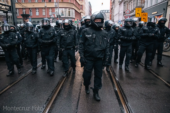
Image: The new conscription law has given rise to a new anti-militarist youth movement – and this is in all likelihood why CO applications have also risen (Montecruz Foto).