A Palestinian spent nearly two years fighting to force Berlin to restrict Israel’s use of two German-leased drones – and lost. The Higher Administrative Court in Münster confirmed a ruling by the Cologne Administrative Court, finding that the conditions for issuing the requested interim injunction were no longer met.
A Palestinian man living in the Gaza Strip has failed in his attempt to compel the German government to impose conditions on Israel’s use of two drones lent by Germany. The Higher Administrative Court of North Rhine-Westphalia in Münster confirmed a corresponding ruling by the Cologne Administrative Court, with no further appeal possible. The court ruled that the prerequisites for granting the requested interim injunction were not satisfied.
The case centred on the transfer of “Heron TP” drones by the German air force. After the attack by Hamas and other groups on 7 October 2023, the German government decided to temporarily hand back two of the five “Heron TP” drones then leased from Israel to the Israeli army.
The man had requested that the German and Israeli government contractually ensure that the drones, which are capable of being armed, are not used in combat operations in Gaza – in particular not for “extrajudicial killings”, of which the Israeli army has carried out thousands in the Gaza Strip. These are routinely justified on the grounds that those killed were members of Hamas. Due to Israel’s blockade of Gaza, this cannot be verified.
“No use against enemy combatants”
The Berlin Administrative Court had referred the application to Cologne, since courts there are responsible for matters concerning the Ministry of Defence. There, the application was largely rejected in March 2025, after the Federal Ministry of Defence officially stated that the drones in question had not been used by Israel since early 2025. The Higher Administrative Court in Münster has now upheld that decision.
The German government had concluded an agreement with Israel on 17 November 2023, under which the drones may only be used in accordance with international humanitarian law. Offensive missions, “the primary or sole purpose of which is to act against enemy combatants”, are explicitly prohibited under the agreement. However, the judges in Münster ruled that, following the return of the drones to the German air force, this Israeli assurance was no longer relevant to the decision.
Before the Berlin Administrative Court, the German government had still claimed that its drones were being used in combat operations against Hamas, explains the claimant’s lawyer, Beate Bahnweg. After the proceedings continued in Cologne, the Ministry of Defence stated instead that the German “Heron TP” drones had only ever flown over Israeli territory throughout the entire period they were on loan, and had never been armed.
“Like giving a murderer a weapon”
The Ministry of Defence had also informed the court that Israel had not used the two German “Heron TP” drones since early 2025. Bahnweg sees this as a possible success: “Perhaps the drones were brought back because of the pressure from the lawsuit”, the lawyer told “nd”.
The lawsuit was also rejected because the claimant was unable to credibly demonstrate that the Israeli assurance, on which the German government and the courts rely, had not been observed. However, requests to examine this information in court were rejected, according to Bahnweg. In doing so, the administrative courts had blatantly violated what is known as their duty to investigate the facts ex officio.
In any case, such an assurance from a state that, according to international courts and NGOs, permanently violates international law is not worth much, says Bahnweg: “It’s like giving a suspected murderer a weapon and having him confirm that he won’t kill anyone.”
A two-year “urgent ruling”
The Basic Law also does not give rise to a claim to ban the use of Bundeswehr weapons in Israel, the Higher Administrative Court explained, referring to a ruling by the Federal Constitutional Court of 3 February. In that case, a Palestinian living in the Gaza Strip had filed a constitutional complaint against approvals for German arms exports to Israel, which was not accepted for a decision: while the German state is indeed obliged to protect people living abroad as well, the German government has broad discretion in how it fulfils this responsibility. This had been implemented through the assurance obtained from Israel regarding the drones’ use in accordance with international law, according to the Higher Administrative Court in Münster – although that assurance was no longer decisive after the drones were returned.
On social media, Bahnweg also criticised the two-year duration of what was supposedly an urgent decision. “Let’s hope the judges in The Hague feel bound by international law when the case of Nicaragua versus Germany is heard”, the lawyer said.
In March 2024, Nicaragua filed a case against the Federal Republic of Germany at the International Court of Justice in The Hague, accusing it of violating the Genocide Convention and other obligations under international law by providing Israel with political, financial and military support and thereby enabling genocide against the Palestinian population in Gaza. The first public hearings on the matter are due to take place next week. The court will then decide whether Nicaragua’s case is admissible.
Editor’s note: This article has been updated to clarify the Higher Administrative Court’s (OVG) decision. The court confirmed a ruling by the Cologne Administrative Court, because the conditions for issuing the interim injunction were no longer met after the German government officially announced that Israel had not used the drones since early 2025. The assurance sought from Israel regarding the drones’ use in accordance with international law was therefore no longer decisive for the ruling.
Published in German in „nd“.
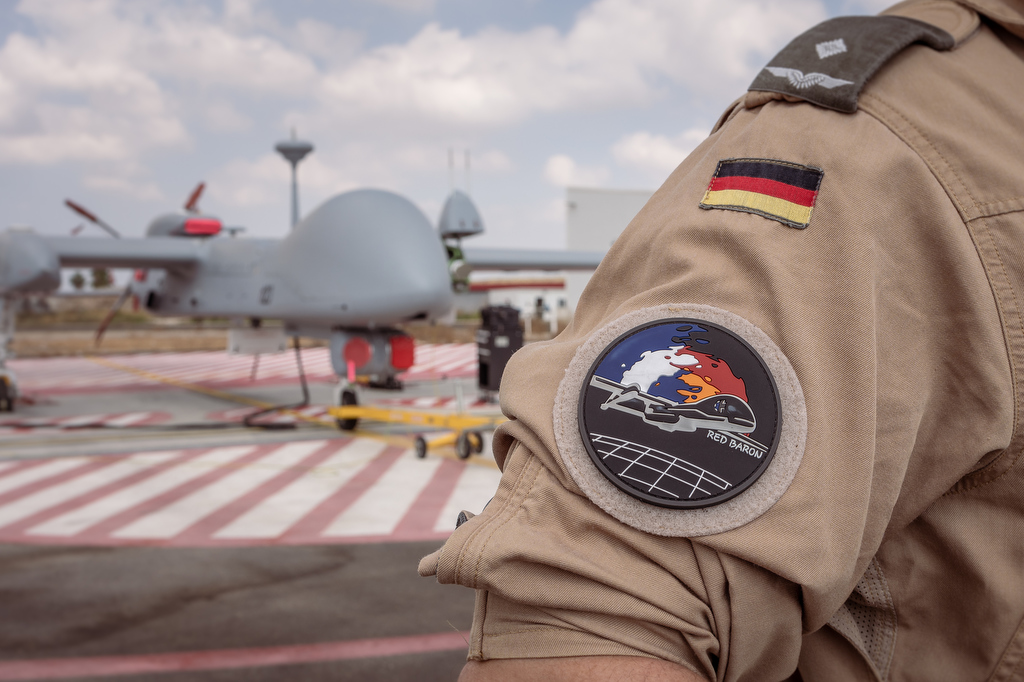
Image: A German Air Force soldier in front of a “Heron TP” while training at Tel Nof Air Force Base, Israel (Falk Bärwald/Bundeswehr).