An expert report by the Berlin-based organisation Forensis, presented by lawyers for the joint plaintiffs, argues that the fatal “hogtie” restraint used by police against Ibrahima Barry caused his death, as the trial against nine officers charged over his killing resumed this week.
On Thursday, the trial over the death of refugee Ibrahima Barry continued at Duisburg Regional Court. Four female and five male police officers are on trial for jointly committed dangerous bodily harm in office. They had repeatedly screamed at the then 23-year-old Guinean man in a demeaning manner in the so-called refugee village of Saarn in Mülheim an der Ruhr, tasered him twice and forcibly restrained him until his death.
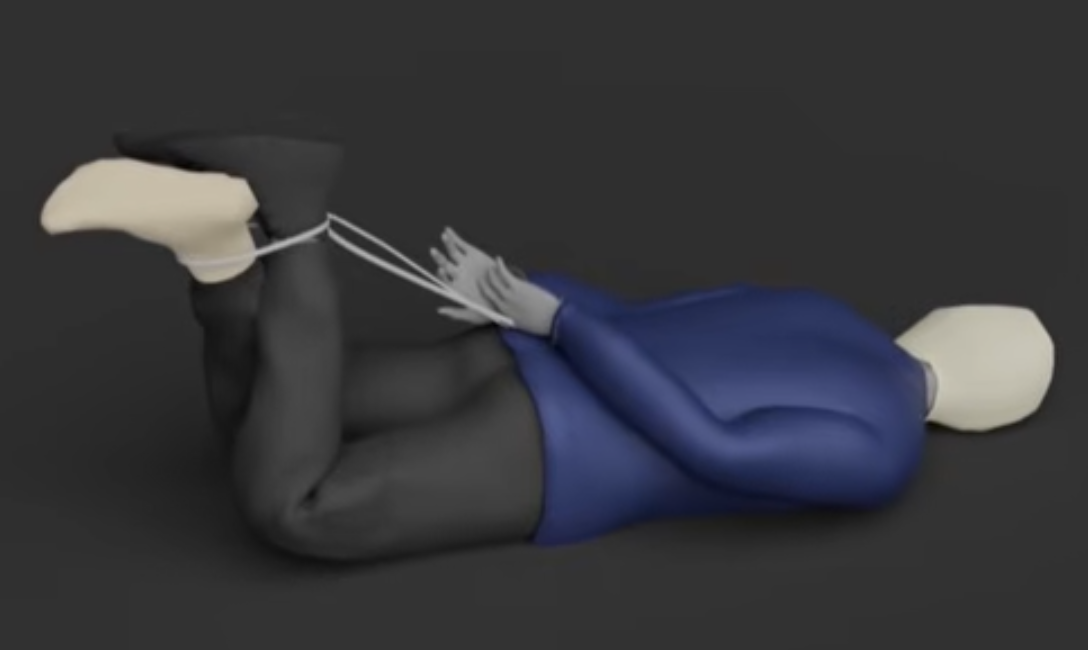
An expert report presented by joint plaintiff lawyers Anna Busl and Andrea Groß-Bölting at a press conference on Thursday evening is now intended to prove that this restraint was what caused Barry’s death. The police officers had restrained the whimpering young man for an extended period in the so-called “hogtie” position, binding his hands and feet together behind his back while he lay on his stomach.
The method originally refers to tying together all four legs of livestock and is known in German as “Schweinefessel” (pig tie). When applied to a person lying on their stomach, it prevents the chest from expanding sideways while breathing. Barry was in a state of psychological crisis during the ordeal and was under the influence of cocaine.
Report examines “hogtie” position
The report was presented by Robert Trafford, deputy director of Forensis. The Berlin-based non-profit association is an offshoot of the renowned Forensic Architecture institute, which is dedicated to investigating violence committed by state and corporate actors. Both Trafford and Michael Freeman, a physician with a doctorate who teaches in Maastricht, are now to be summoned as expert witnesses, the joint plaintiffs requested during Thursday’s hearing.
According to the official post-mortem report, Barry died of “positional asphyxia” combined with a recent heart attack. Freeman’s testimony is now intended to prove that it was the degrading, aggressive violence and the “hogtie” method — in other words, the actions of the officers — that caused the Guinean man’s death.
Trafford’s investigation is based on footage from two bodycams worn by the defendants, although there is a seven-minute gap in the recordings. According to the Forensis report, Barry stopped resisting from the very start of the second bodycam recording. Nevertheless, he was not moved into the recovery position.
Pressure with knee and foot
The analysis shows that the victim was handcuffed for almost 15 minutes and held face-down for at least twelve minutes and 27 seconds. The forensically analysed footage also documents how one of the accused female officers pressed her knee onto Barry’s back and right shoulder for more than ten minutes while he was in this “hogtie” position — even though a colleague told her to stop.
Another defendant placed a foot on the restrained man’s lower back for almost nine minutes, while his head was pressed to the ground. Another female officer pressed her knee on Barry’s bound feet for 41 seconds. For more than seven and a half minutes, he was also forced to wear a spit hood, which further worsened his breathing difficulties.
“They’re killing me” and “you’ve killed me”, Barry had repeatedly said in German and Fula — the officers did not react. From 8.53pm, nothing more can be heard from him on the recordings; shortly afterwards he died in the ambulance, which had just arrived. Even on the way there, he was carried on a stretcher in the “hogtie” position.
Restraint deviated from police standards
That the restraint practice deviated significantly from police training standards had already been set out two weeks earlier by a long-serving police trainer testifying as an expert witness. The 49-year-old described two options for an arrest: if the person offers no resistance, they can be led away standing up.
The second option is the prone position. In this case, the hands are fixed and cuffed behind the back. However, restraining the feet is not intended, since otherwise the person can only be brought to the police car with difficulty.
Linking bound arms and legs together likewise does not correspond to training standards, the witness said. If the person resists, the “restriction of movement” is increased by applying pressure with the shin or the flat of the hand to the opposite shoulder. However, the prone position should be maintained for as short a time as possible, and “the subject” should quickly be brought into a sitting position.
“Situation under control”, yet the “pig tie” remained
As long as the person is lying on their stomach, ongoing communication must ensure that they are still breathing, the trainer had explained. A guidance document does not specify a particular frequency, but does state that this breathing check must be carried out “continuously”. The defendants had dispensed with this as well.

A claimed situation of self-defence no longer existed at the latest from the moment one of the defendants radioed headquarters to report that the situation was under control. From that point on, according to standard teaching, Barry should have been brought into a sitting or side position.
Instead, the officers stood around him for more than ten minutes, as the bodycam footage shows — without reacting to his hyperventilation, his fading voice or his loss of bowel control. “He’s shat himself,” officers can be heard sniggering. Two of them then pull up Barry’s trousers. That such defecation indicates impending suffocation should have been known at least to the paramedics.
Was Barry’s death knowingly accepted?
The joint plaintiffs argue that the aggressive restraint and the prone position, maintained for more than ten minutes, caused his death.
“This also raises the question of whether the defendants at least knowingly accepted Barry’s death. After all, positional asphyxia is covered in training, and the dangers of restraint in the prone position are therefore known,” joint plaintiff lawyer Busl told “nd”.
In addition, the joint plaintiffs see grounds for dangerous bodily harm in the case of one of the defendants, over two blows to Barry’s head with a taser. By that point, he was no longer capable of any resistance.
Relatives demand justice
At Thursday’s press conference, the Justice for Ibrahima solidarity network and the Hamburg-based Black Community Coalition for Justice & Self-Defense also spoke, the latter calling for a German “Ibrahima Barry Act” for independent oversight of the police. Among other things, this would oblige the state to support relatives of victims of fatal police violence when they take part in trials as joint plaintiffs. The Black people killed by police in recent years were not isolated cases, but pointed to structural racist state violence, said the Coalition’s spokesperson.
Also present were Fatoumata Binta Diallo and Harouna Barry, Ibrahima’s parents. His mother lamented in tears that none of the officers had even tried to speak to her son properly. Barry’s sister Dardaye, who was also present, spoke of her grief and demanded that her brother be given back his dignity through a fair trial, so that he could finally rest — the perpetrators, she said, must take responsibility. His father, too, expressed hope for justice regarding the trial.
The statements from the defendants on their actions, which had been announced for this week, did not materialise. The court did not initially want to rule on the request to summon Trafford and Freeman. The police officers’ defence was permitted to review the request in order to comment on it. A decision on the expert witnesses is now expected next Wednesday.
Published in German in „nd“.
Image: Ibrahima Barry in the analysis of bodycam footage. This type of restraint is known as a “hogtie” (Forensis e.V.).