The peace process launched in Turkey with the PKK’s self-dissolution is historic. In Germany, however, the will to prosecute the Kurdistan Workers’ Party remains unbroken.
On Monday, the Turkish parliament passed far-reaching amnesty provisions for members of the Kurdistan Workers’ Party (PKK): guerrilla members can submit an application to the Public Prosecutor’s Office under which investigations into alleged offences would be suspended. First, however, Turkey’s National Security Council must officially confirm the dissolution and disarmament of the PKK. This had been announced by the organisation’s founder, Abdullah Öcalan, in February 2025. According to this, all activities under the name PKK would be discontinued.
The peace process thereby launched in Turkey and Kurdistan is historic. Germany, too, could take part in it. However, the government currently in office continues to refuse to scale back the persecution of Kurdish activists in Germany, which has now lasted almost 33 years. This was confirmed by the Federal Ministry of the Interior in response to an enquiry from “nd”.
By way of justification, the Ministry, under Alexander Dobrindt (Christian Social Union), points to the Federal Office for the Protection of the Constitution’s current annual report. In its introductory remarks on the PKK, the report states that the Kurdistan Workers’ Party continues its activities in Germany “for the most part in the usual manner, despite the peace process initiated with Turkey”.
Past rulings cited as grounds for new repression
As evidence for its assessment, the domestic intelligence service cites the German judiciary’s continuing will to prosecute: it had, “as in previous years, sentenced leading PKK functionaries to several years in prison for membership of a foreign terrorist organisation”. In addition, in 2025 the PKK had “once again held numerous events, some with several thousand participants”.
Germany has had a so-called PKK activity ban in place since 1993, issued under association law by the then Federal Minister of the Interior, Manfred Kanther (Christian Democratic Party). Following a 2010 ruling by the Federal Court of Justice, the Workers’ Party and 35 sub-organisations are also classified as a “foreign terrorist organisation”, with membership prosecuted under Section 129b of the Criminal Code.
Ongoing lawsuit in Berlin
Asked about efforts to ease or even lift this repression, the Federal Ministry of the Interior declined to answer, citing an ongoing lawsuit. This concerns an application by the PKK to have the activity ban lifted. Federal Minister of the Interior Nancy Faeser (Social Democratic Party) had, however, rejected the request, originally filed in 2022, in May 2024. It had been submitted by the executive council of the Kurdistan Communities Union, an umbrella organisation of the PKK and sister organisations in Kurdistan and the diaspora.
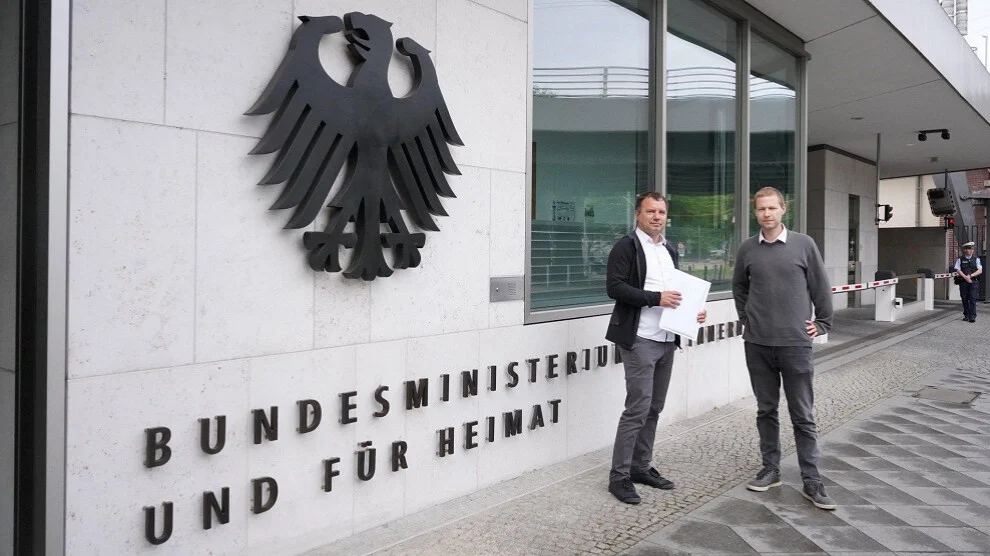
Against this rejection, the union, represented by Berlin lawyers Lukas Theune and Peer Stolle, filed a lawsuit with the Berlin Administrative Court: following Abdullah Öcalan’s call for the peace initiative, the PKK had credibly and permanently distanced itself from violent activities, the argument states. It remains unclear when the Administrative Court will take up the matter — a ruling is not expected before this year at the earliest.
Left Party demands amnesty for Germany too
“With its rigid, counterfactual stance, the German government is torpedoing the ongoing peace process that was launched by the declaration of the PKK’s self-dissolution,” lawyer Stolle told “nd”. Developments in Turkey and Kurdistan showed that the PKK ban was outdated in Germany too.
Last week, the Left Party also put the decriminalisation of the PKK on the agenda: Bundestag Vice-President Bodo Ramelow called on the German government to follow Turkey’s example and introduce far-reaching, swift amnesty provisions for Kurdish activists in Germany. On Wednesday, the party followed up with a statement. “The German government can now make a very concrete contribution to peace,” said Federal Managing Director Janis Ehling. Kurds must once again be allowed to organise in Germany. In this way, the peace process could “also take root here in Germany, home to the largest Kurdish diaspora from Turkey,” Ehling explained.
Before decriminalisation could take place in Germany, however, the PKK would also need to be removed from the so-called EU terror list — it is this listing that enforces and legitimises the persecution across the 27 member states. The listing there is likely to have been significantly encouraged by the German government. The coalition currently in office could forgo the application, which must be renewed every six months — or even call on the other EU states to end the repression of the PKK in stages, in keeping with the spirit of the peace process.
Published in German in „nd“.
Image: The lawyers Lukas Theune and Peer Stolle who filed the lawsuit to have the PKK activity ban lifted (ANF News).