
An ‘internal’ handout from the Buchenwald Memorial wrongly categorises several Palestinian symbols as ‘anti-Israel’. The document was also sent to court presidents in German states.
The German debate about allegedly anti-Semitic depictions in Palestine solidarity has taken another turn: Two months ago, the Thuringian memorial to the former Buchenwald concentration camp produced a guide that classifies the kufiya named the ‘Palestinian scarf’ and the call for a ceasefire in the Gaza war as ‘anti-Israel’ and therefore anti-Semitic – despite the fact that the Palestinian kufiya is recognised as a Unesco intangible cultural heritage, and even the German government is in favour of a ceasefire agreement between Israel and Hamas.
Excerpts from the 57-page document were heavily criticised on social media on Monday. In response, the state-funded Buchenwald and Mittelbau-Dora Memorials Foundation explained that it was an ‘in-house handout for employees of the education department and security’. It is therefore intended to help recognise codes and symbols that spread racism, anti-Semitism or other misanthropic ideologies. If such ideologies are detected in the memorial centre, this can lead to people being excluded.
It is not an official document, a spokesperson explained to ‘nd’, which is ‘not authorised by the management’. Some formulations are also ‘not as they should be’. The spokesperson did not want to say which ones.
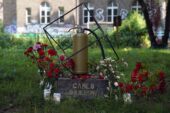
The paper also places the symbol of the watermelon ‘as a substitute for the Palestinian flag’ in an anti-Semitic context. The same applies to the accusation of apartheid in the territories occupied by Israel in violation of international law and the opinion that the Israeli military is committing genocide in Gaza – an accusation that the International Court of Justice also considers plausible. According to the Thuringian Memorial Foundation, anyone who also wears the symbol of an olive branch is advocating the right of return of Palestinian refugees, which is enshrined in international law (but written in inverted commas by the foundation), and is therefore ‘questioning the existence of Israel’.
The handout also contains the assertion that anyone using the symbol of bloodstained hands, which has been widespread in the peace movement for decades, wants to praise the murder of two Israeli soldiers a quarter of a century ago – a constructed conspiracy narrative, as ‘nd’ was recently able to show.
Foundation director Jens-Christian Wagner did not respond to the widely expressed indignation, but reported on Platform X that employees were ‘savagely abused’ after the handout became public. This went as far as death threats, Wagner told ‘nd’. There had been ‘several dozen’ emails – including ‘several messages of solidarity’. According to Wagner, comments on social media also ‘agitated’ against private individuals working for the foundation.
The staff at the Nazi memorials are ‘very aware that codes and symbols must always be interpreted in the context of their use’, according to Monday’s statement. The ‘handout’ should also not be understood in isolation from the context of its creation: to protect the former Buchenwald concentration camp ‘from current instrumentalisation and targeted provocations’. However, the history of the site also includes the fact that Buchenwald was initially intended primarily for political opponents of fascism. Other groups of inmates were added later, but political persecution remained a dominant feature.
The ‘handout’, which was only created in May, is now to be revised, said memorial director Wagner to ‘nd’. This has ‘already begun’.
However, it has also been distributed beyond Thuringia: Research by ‘nd’ shows that in Schleswig-Holstein, for example, the document was sent out a fortnight ago via at least four judicial distribution lists of the higher regional court. It not only reached all judges, but also secretariats and probation officers – the false allegations about ‘anti-Semitic codes and symbols’ could therefore be included in judgements or probation conditions. The sender of the email is a judge who, according to the email, claims to have done so ‘at the suggestion’ of its president Dirk Bahrenfuss.
The Public Prosecutor General’s Office of Schleswig-Holstein told ‘nd’ that the guidelines were sent to the participants of a conference of Higher Regional Court presidents in Weimar (in Thuringia) at the end of May after a visit to a memorial site and were distributed from there ‘for information purposes’ – without the internal nature of the guidelines being pointed out. Subsequently – at least in Holstein – this is now to be emphasised by another e-mail.
The subsequent categorisation of the handout as ‘internal’ may also have to take place in other federal states: According to the Buchenwald Memorial, the document was sent to all participants of the nationwide conference of Highr Court presidents.
It remains to be seen what added value the judiciary in Schleswig-Holstein or other federal states see in sending out the Thuringian ‘handout’. This is because the State Office of Criminal Investigation and the Public Prosecutor General’s Office there have drawn up such a guide themselves – although it is to remain secret. All state police authorities and public prosecutors’ offices have been working with it since 15 January 2024, the Prosecutor General of the northernmost federal state confirmed to ‘nd’. The anti-Semitism commissioner helped to draw up the guidelines, which were modelled on similar handbooks from other federal states.
In Berlin, Rhineland-Palatinate and Lower Saxony, existing guidelines for the police and judiciary have been published. In some federal states, the controversial Research and Information Centre on Anti-Semitism (Rias) was also involved. The organisation categorises ‘Israel-related anti-Semitism’ according to a ‘3D rule’, according to which the state is demonised or delegitimised and double standards are applied, as certain human rights violations in Israel are criticised while comparable acts in other countries are ignored.
The Thuringian ‘handout’ adds another “D” to this with ‘derealisation’. This refers to a distortion of reality as a central feature of alleged anti-Semitic criticism of Israel. This accusation applies to groups and individuals who do not want to view Israel’s devastating Gaza war as ‘self-defence’.
Published in German in „nd“.
Image: A red rag for the Thuringian Memorials Foundation: the motif of the water melon is considered an indication of ‘hostility towards Israel’.



Leave a Reply