The Trump administration is planning an international summit to counter “Antifa” and other left-wing groups, Reuters reported, citing three sources. The conference, set for June or July, will bring together government officials to discuss strategies.
The Trump administration is planning an international summit to combat “Antifa” and other left-wing groups. Reuters reported this on Tuesday, citing three sources familiar with the matter. The conference is scheduled for June or July this year. It is aimed at government representatives from various countries to discuss strategies against “Antifa”.
Spokespersons for the White House and the State Department never tire of describing “Antifa” as a central security problem. State Department spokesperson Tommy Pigott stated: “The anarchists, Marxists, and violent extremists of antifa have waged a terror campaign in the United States and across the Western world for decades, carrying out bombings, beatings, shootings, and riots in service of their extreme agenda.”
Last December, the FBI officially classified “Antifa” as a domestic terrorism threat. Shortly before that, the US State Department had listed a German “Antifa Ost”, the Italian “Informal Anarchist Federation/International Revolutionary Front” as well as the Greek groups “Armed Proletarian Justice” and “Self-Defence of the Revolutionary Class” as alleged foreign terrorist organisations.
Europe’s governments on guest list
Formal invitations to the US conference in the summer had not yet been sent out as of Tuesday. According to Reuters, European governments in particular are on the guest list. Among others, Hungary’s Prime Minister Viktor Orbán is unlikely to miss the opportunity, as he pursues a similar policy at national level with his Fidesz party: by government decree, Orbán placed “Antifa”, the German network known as the “Hammer gang” referred to as “Antifa Ost”, the “Vulkangruppe”, also active in Germany, and most recently the “Earthquake Faction” on Hungary’s terror list.
It is also conceivable that Orbán and Trump will call for “Antifa” or individual well-known groups to be added to the EU terror list – and accordingly to be pursued with financial sanctions and further repressive measures. To this end, members of the governing Fidesz party, together with other right-wing and far-right parties – including the right-wing party AfD – have already submitted several motions in the European Parliament. In October, a resolution was introduced but has so far had no consequences.
However, the decision on inclusion in the EU terror list lies with governments: one or more EU states nominate an entry, which takes effect if no other state vetoes it.
Antifa without leadership
Anyone who seriously engages with Antifa politics knows that “Antifa” is better understood as an ideology than as a coherent organisation. It lacks a clear structure, chain of command or leadership required of an organisation. This has also been pointed out by former FBI director responsible for political extremism, Christopher Wray. However, Trump replaced him when he took office. His successor is the lawyer Kashyap Pramod “Kash” Patel.
Reuters also cites current and former officials expressing concerns about Trump’s planned Antifa summit. Michael Jacobson, former head of strategy at the State Department’s counterterrorism office, said: “I am just skeptical that now, with everything going on, when you see the number of plots being put together by Iran and Hezbollah, that there really is a compelling need to spend limited counterterrorism resources on the antifa threat right now.” Jacobson is now a Senior Fellow at the Washington Institute for Near East Policy.
However, Europol has also warned that the Middle East conflict has “immediate effects” on security in the European Union and that the risk of terrorism on the continent has therefore increased. However, the EU police agency was referring to attacks by networks such as HAYI, which attacked numerous Jewish institutions in Europe in March. The arson attack carried out by the left-wing “Earthquake Faction” on a drone factory in the Czech Republic, meanwhile, referred to violations of international law by Israel.
USA wants to “crush” Antifa
Under the pretext of prosecuting “Antifa”, a landmark ruling was recently handed down in Texas: for the first time, a US federal court found nine activists guilty under terrorism provisions – in connection with a protest on 4 July last year in front of the ICE deportation detention centre Prairieland, during which fireworks were set off, cars were vandalised and shots were fired at ICE personnel. A police officer was seriously injured by a gunshot to the neck.
The Public Prosecutor’s Office argued that merely wearing uniform black clothing – the so-called black bloc tactic – constituted support for terrorism as a typical Antifa characteristic. The shooter described as the “leader” faces life imprisonment. US Attorney General Pamela Bondi stated that the Trump administration “systematically dismantles Antifa and finally halts their violence on America’s streets”.
German government responds vaguely
How the federal government in Berlin will position itself regarding an invitation to Trump’s planned anti-Antifa event is currently unclear – in the past it has also commented only vaguely on the issue.
In response to an inquiry by the right-wing party AfD as to whether the Foreign Office had sought information in the US regarding the classification of “the German ‘Antifa Ost’ as a terrorist group”, the reply stated that the “competent federal authorities exchange information continuously with their international counterparts. In this context, the topic of the ‘Antifa Ost network’ is also discussed where necessary”. Conversely, the Federal Criminal Police Office had not received such an inquiry from the US, it was said in early March.
The right-wing party AfD had also asked about “practical effects” of the Antifa designation by the US and “other EU states”. There are currently none, the Interior Ministry explained in January. When several German banks then closed the accounts of left-wing radical groups, the right-wing party AfD responded with another parliamentary inquiry. The federal government in Berlin is “in exchange with the US government on relevant topics and issues”, was the usual vague response. However, the federal government in Berlin “fundamentally rejects” the extraterritorial application of sanctions, such as those now imposed by the US against “Antifa”.
Published in German in „nd“.
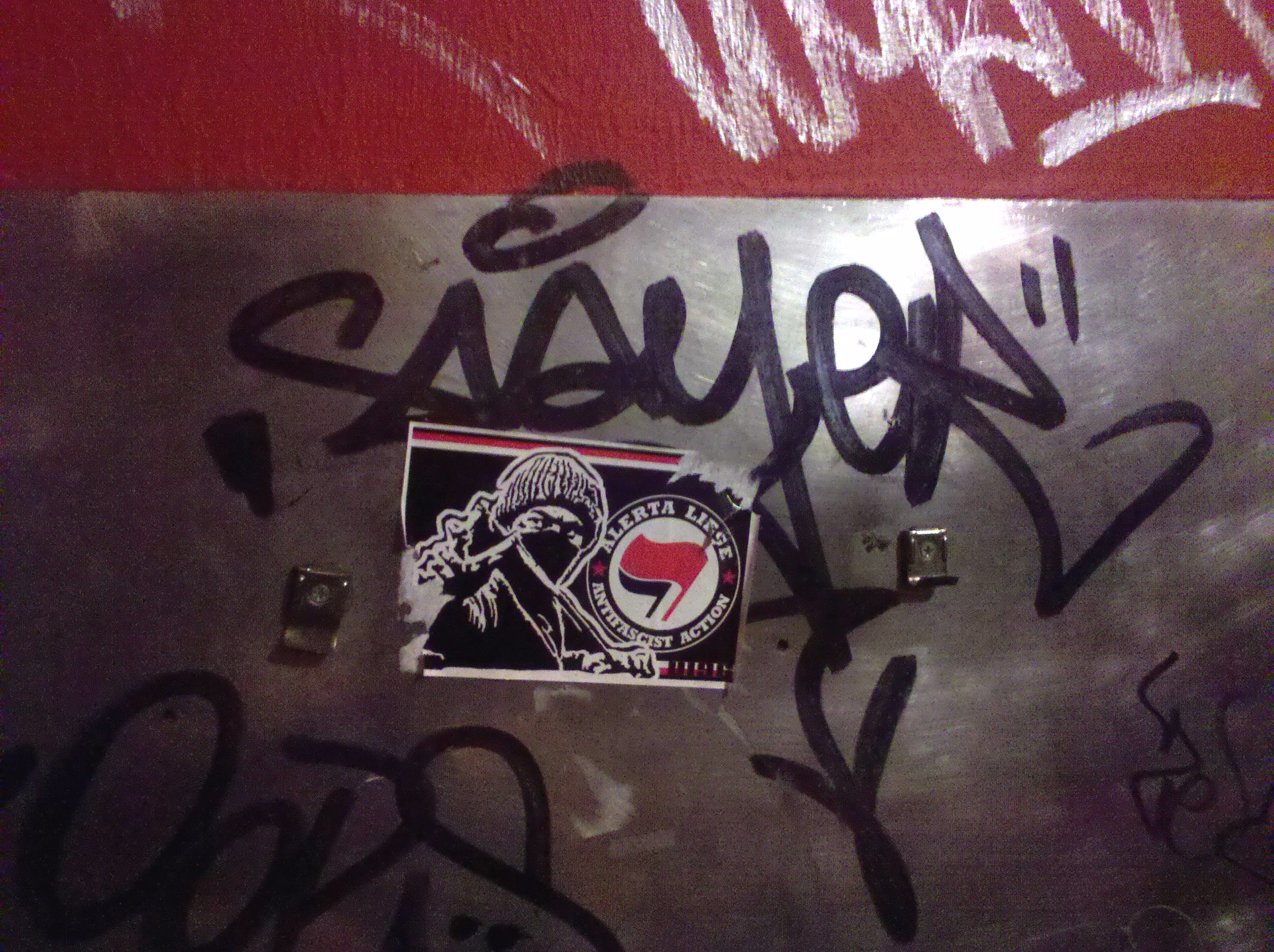
Image: Antifa sticker @ KK, Flickr, CC BY-SA 2.0.