
The Verden regional court has sentenced 67-year-old to 13 years in prison. The defence had already announced an appeal during the proceedings.
The regional court in the German Lower Saxon town of Verden convicted Daniela Klette on Wednesday of armed robbery and sentenced her to 13 years in prison. The 67-year-old was found guilty of, among other charges, aggravated robbery in six cases, in proceedings attended by around 50 spectators. According to the prosecution, she is alleged to have committed the offences between 1999 and 2016 together with the fugitives Burkhard Garweg and Ernst-Volker Staub, in order to finance their life underground. The targets were said to have been cash-in-transit vehicles and cash offices at large supermarkets; the total proceeds, according to the indictment, amounted to €2.4 million.
Klette was specifically convicted of aggravated kidnapping for ransom and the attempt thereof, aggravated armed extortion, and violations of weapons laws. The offences are said to have been committed in Lower Saxony, North Rhine-Westphalia and Schleswig-Holstein. Five further counts involving eight robberies and proceeds of around €2 million were not pursued further during the trial.
An attack on a cash-in-transit driver, which the prosecution had characterised as attempted murder, does not feature in the verdict – the presiding judge had already cast doubt on this charge during proceedings. Klette’s lawyer Lukas Theune described it as a partial victory on Wednesday that this act was considered only as attempted aggravated robbery.
Prosecution demanded 15 years
Daniela Klette, arrested in February 2024 at her Berlin flat, had according to police concealed weapons, ammunition, a dummy rocket launcher, forged identity documents, wigs, gold and €240,000 in cash on the premises. The prosecutor had demanded 15 years for attempted murder, aggravated gang robbery and weapons offences. The defence, however, saw no evidence of Klette’s involvement in armed robberies and called for at most a suspended sentence for the weapons possession, along with her immediate release.
In the event of a conviction, the defence had applied as a precautionary measure for an image-comparison report on photographs of Ernst-Volker Staub. This was intended to demonstrate that the wanted man had not – as claimed by the prosecution – been present in Klette’s flat or purchased vehicles used in the offences. Since Staub has been in hiding for years, his precise appearance remains unclear.
As a secondary application, Klette’s lawyers requested the examination of a witness who was to demonstrate that the cash found in her possession did not originate from the robberies with which she was charged. Whether the chamber rejected these applications in the verdict remained unclear on Wednesday.
Special proceedings in a converted riding hall
In the eyes of the judiciary, Klette is a “RAF terrorist”, even though membership of the armed group or politically motivated acts committed in that context formed no part of the charges.
Politically charged, however, were the closing statements that Klette delivered before the court in Verden the week before last – first alone, and then together with her lawyers Undine Weyers and Lukas Theune. In them, they called the “special political trial” as a whole into question.
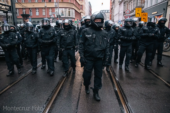
The surrounding circumstances gave weight to their argument: the venue was a riding hall specially hired and converted for the purpose, secured with NATO wire and guarded by armed police officers carrying submachine guns and sniffer dogs trained to detect explosives.
Artificial intelligence as investigator
The defence also took a critical view of the use of the IT platform “Cellebrite Pathfinder” to analyse over 18 terabytes of digital data, which police processed with the assistance of artificial intelligence. The software had independently pre-filtered relevant evidence without the defence being able to follow or verify that process – a violation, the closing statement argued, of the principle of equality of arms between prosecution and defence.
According to Theune and Weyers, there were further serious violations of the so-called principles of orality and immediacy, as expert reports and investigative documents were introduced via a self-reading procedure – that is, without being heard orally at the trial hearings. Expert witnesses, in particular a DNA analyst, had likewise not been examined during the main hearing.
The defence expressed its conviction in the closing statement that these errors would make it unavoidable for the Federal Court of Justice to overturn the verdict. Whether that course of action would be pursued remained open on Wednesday.
“Defensive position of resistance”
Equally remarkable politically was Daniela Klette’s own closing statement, which at around 55,000 characters is the length of a substantial master’s dissertation. In it, she places her life in a broad historical and political context, with her resistance to the system at its centre: from her political radicalisation in the 1970s against the backdrop of the Vietnam War, the emergence of the RAF and the June 2nd Movement, and international liberation struggles, to periods spent in Palestine, South Africa and Nicaragua.
Klette does not romanticise life underground as an adventure, but describes it as a “defensive position of resistance” – a way of evading state repression and the threatened “rituals of conviction”. Before the regional court, she emphasised on several occasions that there had been no plan to use violence to escape that situation. In this context, Klette called for the search for Burkhard Garweg and Volker Staub to be discontinued.
“Any traumatisation is to be regretted”
Many observers were surprised by Klette’s remarks addressed directly to the victims of the robberies with which she was charged. The defendant stated that she was “deeply sorry” for the severe psychological injuries suffered by individual victims, such as the cash-in-transit driver Mirko K. or a cashier from Bochum.
Klette aligned herself with a statement by Burkhard Garweg, which read: “Any traumatisation of employees at cash offices or in cash-in-transit vehicles is to be regretted.” This appears in a letter he sent in December 2024 to the newspaper “wochentaz” under the title “Greetings from illegality”. In it, Garweg – like Klette in Verden – did not address the robberies attributed to him directly, but stated that it had been “out of the question for us” to kill or injure people in order to obtain money.
Klette qualified these personal traumatisations to some extent by pointing to the structural context behind them – namely the precarious working conditions in the cash-in-transit industry, including the absence or inadequacy of psychological aftercare following robberies. In her closing statement, Klette went on to address what she described as an inhumane operational instruction: a cash-in-transit driver had reportedly been told that in the event of a robbery, he should prioritise saving the money rather than helping a threatened colleague outside the vehicle.
Higher regional court to decide on follow-up trial
Klette concluded her closing statement with a sweeping critique of capitalism and a utopian vision of a world without prisons, in which all people could be free, ending with the words: “We can only truly be free when everyone is free.”
At what advanced age Klette will actually be free is currently impossible to foresee. Two months ago, the Federal Public Prosecutor’s Office brought separate charges against Klette for complicity in three RAF attacks carried out between 1990 and 1993. Alleged membership of the RAF is statute-barred, but the specific acts are considered by the judiciary to still be prosecutable. The state security panel of the Frankfurt Higher Regional Court must now rule on these charges.
Before that second, politically even more sensitive trial against Klette can proceed, however, the Federal Court of Justice must first rule on the appeal that the defence had announced before the verdict was even delivered.
Published in German in „nd“.
Image: Solidarity group.


Leave a Reply