Six antifascists on trial in Düsseldorf over attacks on neo-Nazis in Budapest have broken their silence, denying any intent to kill while framing their actions politically. Their statements could pile pressure on other defendants who have refused to testify in related “Antifa Ost” trials.
“The so-called ‘Day of Honour’ is the largest Nazi gathering in Europe in recent years. Under the guise of historical commemoration, it is primarily about claiming territory and networking within the militant neo-Nazi far-right scene. I had to resolutely oppose that.”
With these and similar words, the six antifascist activists charged with attempted murder broke their silence on Tuesday at the Düsseldorf Higher Regional Court (OLG). In individual statements, they each confirmed that they were the people seen on 2023 CCTV footage from Budapest. Among other things, the Public Prosecutor’s Office intends to use this footage to prove that the six attacked right-wing extremists in the Hungarian capital with blunt weapons and pepper spray, seriously injuring some of them.
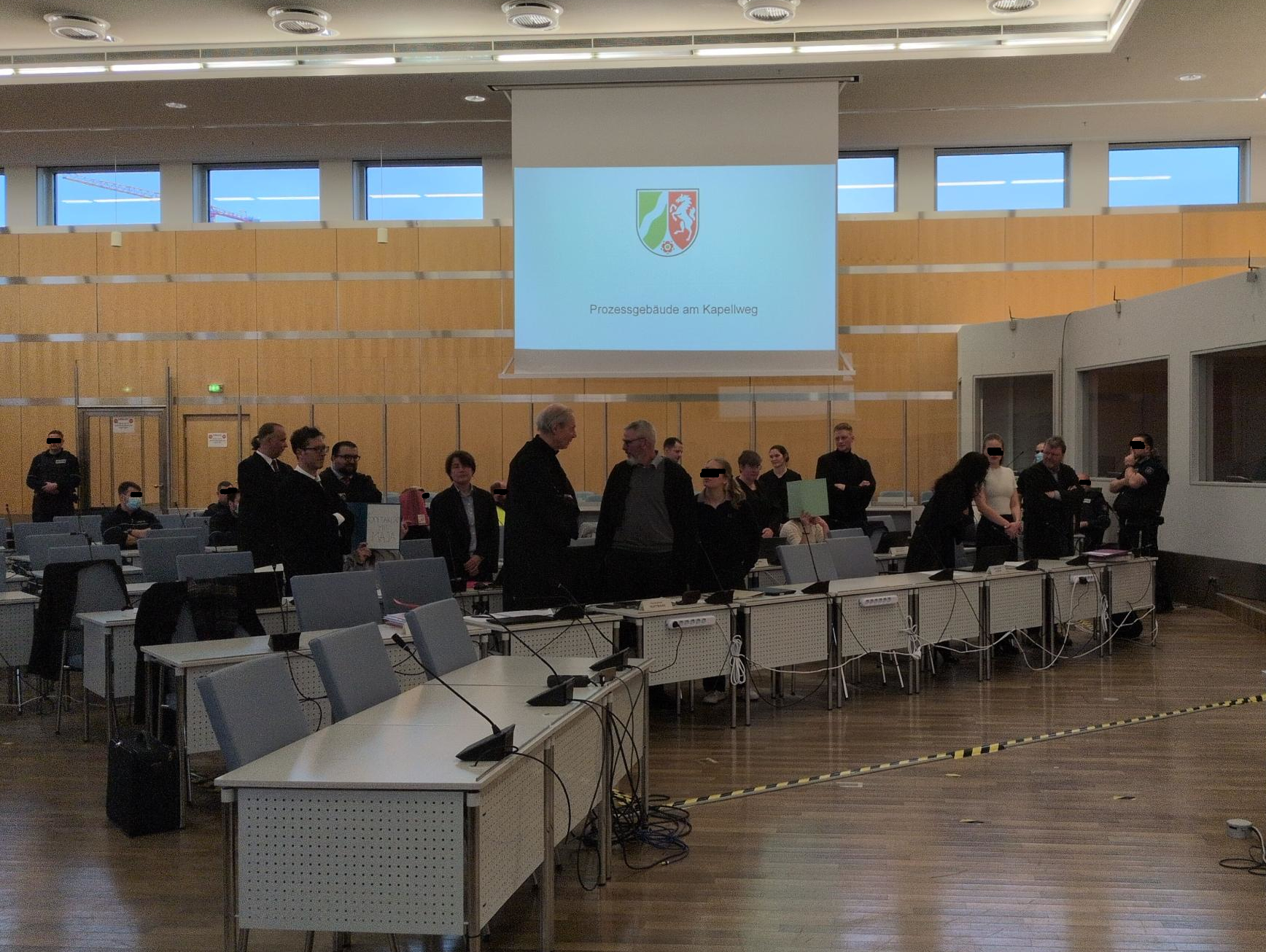
The background to the criminal proceedings in the high-security courtroom of the OLG is an annual meeting of the European neo-Nazi scene held in Budapest. For years, left-wing initiatives from Germany, Austria and other countries have organised protests against it. In 2023, organised and militant resistance took place at the “Day of Honour” for the first time. The defendants are therefore accused of grievous bodily harm and membership of a criminal organisation. The Düsseldorf proceedings also cover two charges of attempted murder.
Charges of attempted murder
The defendants Nele A., Paula P., Emilie D. and Luca S. from Jena, along with Clara W. from Hamburg and Moritz S. from Leipzig, had gone into hiding along with other wanted antifascists. Five of them turned themselves in eighteen months ago; police later took Emilie D. into custody as well. They are between 23 and 25 years old and are said to belong to the so-called Antifa Ost, which the Federal Prosecutor General is pursuing as a left-wing extremist organisation in a separate trial in Dresden. Seven activists are standing trial there before the Higher Regional Court.
In Munich last September, the OLG also sentenced Hanna S. from Nuremberg to five years in prison. Also as part of the so-called Budapest complex, a court in the Hungarian capital sentenced Maja T. to eight years in prison in February. The German non-binary person had been unlawfully extradited to Budapest by Saxon police and has since been held in custody under degrading conditions.
Tobias E. is also said to belong to “Antifa Ost” and has already served time in prison in Budapest over the attacks at the “Day of Honour”. His sentence was reduced to one year and ten months after he pleaded guilty to being a member of a criminal organisation. He is now on trial again in Dresden on similar charges.
Solidarity group publishes statements
The decision by the Düsseldorf Six to break their silence appears to have been coordinated and prepared with solidarity networks. A trial-monitoring group published extracts of their statements on Tuesday on its website. These are largely political in nature: “Antifascism is not terrorism but a consistent and necessary confrontation with the resurgence of fascist structures and the everyday threat posed by neo-Nazis,” it states, among other things.
On the substance of the case, all the Düsseldorf defendants vehemently denied any intent to kill on Tuesday. The accusation is absurd and reveals the political motivation of the Federal Public Prosecutor’s Office, Moritz S. explained. “I considered it completely out of the question that fatal injuries could occur,” said defendant Nele A., who had lived in Budapest for a time owing to family ties. Killing people, she said, contradicted her convictions. Nazis had murdered Jewish family members of hers at the time, A. told the court, whose names are now inscribed at the Yad Vashem Holocaust memorial in Israel. This was why she had campaigned against the resurgence of right-wing extremism in Thuringia.
According to “Taz”, only Paula P. refrained from political framing on Tuesday, though she too admitted to being visible on the Budapest CCTV footage. She was recently the only one of the six to be released from prison under conditions. One of the Düsseldorf defendants also stated that she had taken part in one of several attacks on right-wing extremists in Budapest.
The decision had certainly not been easy for the defendants, and the panel would take that into account, presiding judge Bachler said after the statements.
“I am very relieved”
“I am very relieved,” Hermann W., Clara’s father, told “nd”. Something had shifted in the Düsseldorf trial as a result of the move. “This will certainly spark a debate about refusing to testify,” W. suspects. This refers to the principle, firmly rooted in the German radical left, of “Anna and Arthur keep their mouths shut”. Solidarity organisations such as Rote Hilfe only support defendants or the accused if they adhere to the principle of refusing to testify. Rote Hilfe regularly comments on the trials in the “Budapest complex”, but there has so far been no statement on the six defendants’ remarks on Tuesday.
“What happened on Tuesday at the Düsseldorf OLG appears to be an attempt, after three years of judicial pursuit, of going underground and then remand custody, to reclaim the role of active agents – just as several of those who had gone underground did in early 2025, when they turned themselves in to police in a coordinated action,” according to a text posted on Tuesday on the online platform “Indymedia” that seeks to foster understanding for the defendants’ move.
“Personal solidarity with the antifascists is a matter of course – even after this Tuesday,” the anonymous posting assures. Decisions in such proceedings are “inevitably always made under pressure that is difficult to assess from outside”. Nor, it argues, do the statements amount to confessions that could lead to investigations against other defendants.
Coercive detention – for refusing to testify
That may be true for the antifascists on trial in Düsseldorf. However, it could put Hanna S. and Maja T. under pressure: neither made any statements or comments in their trials – and neither accepted their verdicts. It is now possible that the six’s broken silence will feed into the appeals proceedings brought by the convicted S. and T. in Germany and Hungary.
“Moreover, antifascist trials never affect only the defendants themselves. For investigating authorities, they always also serve to probe relationships and destroy the trust that is so essential to any form of political struggle,” “Indymedia” also states on the subject of refusing to testify. The ongoing “Antifa Ost” trial in Dresden could also be affected by this: in 2023, the OLG there sentenced Lina E. and three other young adults to prison terms of up to five years and three months over a series of attacks in Saxony and Thuringia.
E. was recently released under conditions, but in the new Dresden trial against the seven defendants she was taken into coercive detention along with another activist – for sticking to the left-wing principle of refusing to testify.
Published in German in „nd“.
Image: The court case starting in Düsseldorf (Radio Dreyeckland).