With the former cultural diplomat Andreas Görgen, the German Thyssenkrupp subsidiary TKMS is expanding its submarine business worldwide. Meanwhile, an Israeli commission investigating corruption allegations is due to question Benjamin Netanyahu for the first time this autumn.
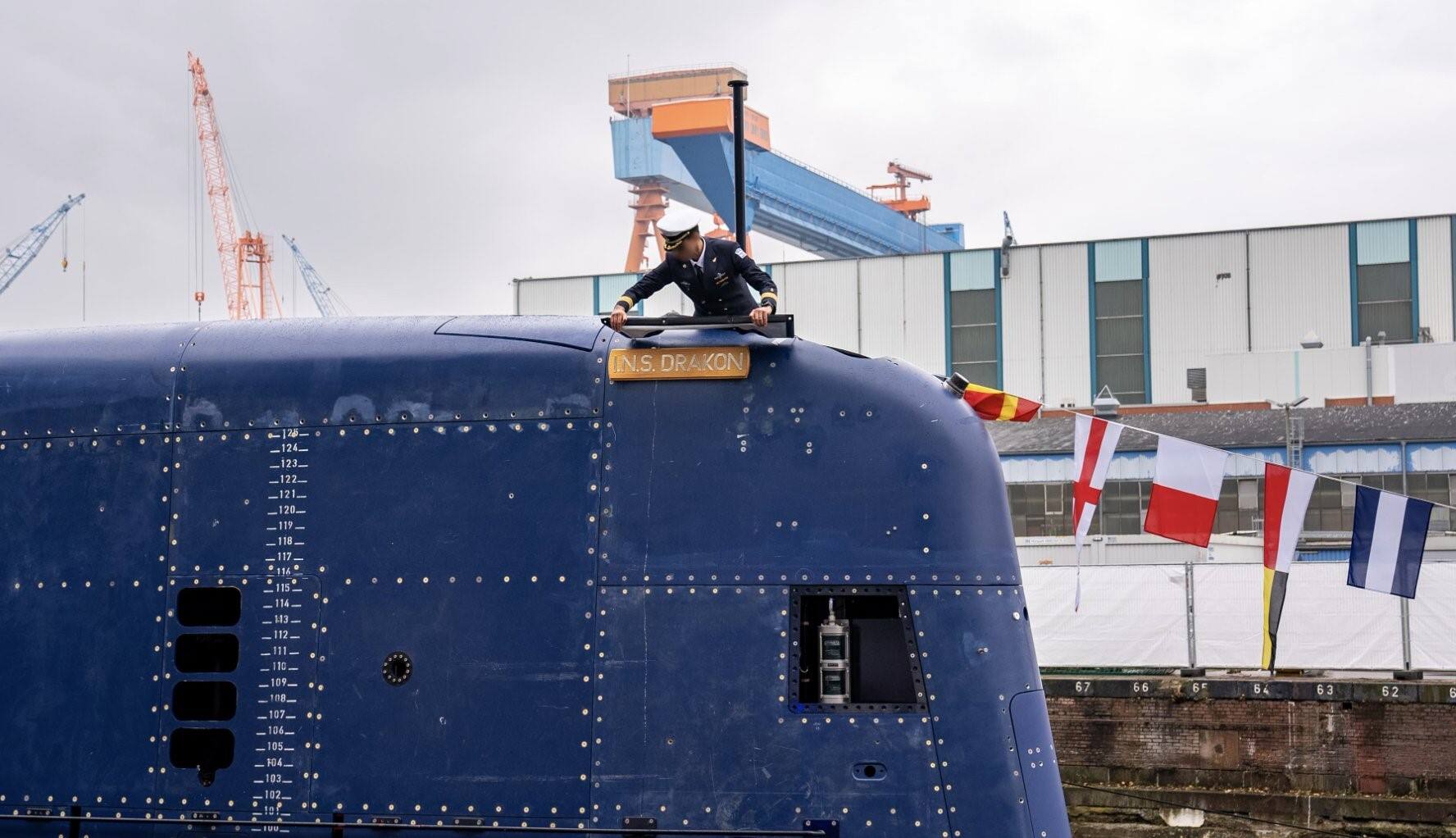
Last week, the Kiel-based shipyard Thyssenkrupp Marine Systems (TKMS) handed over another submarine, the “Drakon”, to the Israeli Navy. It is the last boat of the Dolphin II class, of which the Israeli Navy had already received five predecessor models from Germany. Neither TKMS nor the Israeli Ministry of Defence are said to have announced the ceremony.
According to the “Kieler Zeitung”, the “Drakon” undertook a test ride in the Baltic Sea on the very first day after the handover. After further trainings, it is expected to set off for its home port in Haifa.
As usual, TKMS provides no details on the scope of the order, the armament or the size of the crew. According to various sources, the “Drakon” is said to have cost between €500 and €700 million. A third of this is once again being financed from the federal budget as military aid for Israel.
Submarines said to be nuclear-capable
In May, the German Ministry for Economic Affairs is reported to have approved the export of the “Drakon”. This pushed the total value of approved weapons exports to Israel for the first five months of 2026 to almost €800 million – more than in the previous 20 months combined. This, at least, is how the Foreign Office’s response to an inquiry from the right-wing party can be understood, according to which over 60 percent of the approved value relates to “a major project in the maritime armaments sector”.
From Israel’s perspective, the six submarines equipped with air-independent propulsion are a key element of deterrence against Iran. Military experts suspect that the Dolphin boats can be fitted with nuclear weapons, giving Israel a sea-based nuclear second-strike capability.
The “Drakon” is reported to have been ordered as early as March 2012 for delivery in 2016. According to media reports, construction was delayed by Israeli requests for changes: the hull grew from 68 to 74 metres, and the conning tower was fitted with additional launch tubes, apparently capable of firing missiles. This means the “Drakon” anticipates technical features of the future Dakar class, of which Israel has also ordered three units. These are due to be delivered from 2031 and will gradually replace the Dolphin boats, which will then be more than 30 years old.
Israeli commission examines corruption
The submarine deal with TKMS has occupied a judicial commission of inquiry in Israel for years; witnesses are expected to be heard for the first time in November and December. This also concerns the purchase of Sa’ar 6 corvettes from TKMS during Benjamin Netanyahu’s second term as Prime Minister, from 2009 to 2021.
The commission accuses Netanyahu of having disregarded security policy requirements when awarding the contract to TKMS. Also under suspicion are former Israeli Deputy Chief of Navy Vice Admiral Ram Rothberg, former Israeli Defence Minister Moshe Ya’alon, former Mossad Director Yossi Cohen, and Avner Simchoni, a former senior official of the National Security Council.
The investigation also focuses on Netanyahu’s alleged approval of a sale of naval vessels by TKMS to Egypt. The Prime Minister is said to have bypassed the responsible government and military officials in making this political decision.
Canada also orders twelve submarines from TKMS
Ahead of the NATO summit in Ankara in the first week of July, Canada also ordered up to twelve submarines from TKMS – the largest order in the company’s history; the German shipyard prevailed over a South Korean competitor. The Type 212CD boats will be built in Kiel and in Wismar, Mecklenburg-Vorpommern.
“CD” stands for “Common Design”. Germany and Norway jointly developed the model in order to cut costs and simplify cooperation when each procuring six submarines. Canada is joining this project as a third partner. The Federal Ministry of Defence stated that cooperation between the three NATO states should particularly strengthen deterrence capability against the Russian Northern Fleet.
Following the Canada order, TKMS now also expects a submarine deal with India, whose finance ministry has reportedly already approved the budget. According to TKMS chief executive Oliver Burkhard, the contract for six submarines should be ready for signature by the end of this year, with an option for three more.
TKMS promotes a European “Seabus”
In order to broker deals such as those with Canada and India, TKMS appointed former cultural diplomat Andreas Görgen as a board member and “Chief Operations Officer” in the spring. Until 2024, he was head of office to the German government’s Commissioner for Culture and the Media, and was considered one of the closest confidants of Green Minister of State Claudia Roth. At TKMS, he is expected to expand international networking.
According to TKMS chief executive Burkhard, this is now being extended to Spain. The Thyssenkrupp subsidiary has already entered into a strategic partnership with the company Navantia; parts of submarines could now also be manufactured at its sites. However, any such outsourcing to Spain would require the agreement of the respective customers.
Burkhard proposes networking other European shipbuilding groups more closely, following the example of Airbus. “Perhaps we’ll make a start with Navantia, and at some point further partners will join our alliance,” Burkhard told “Handelsblatt”, describing the cooperation as “a kind of Seabus”. An Israeli arms company would then also be on board: shortly after Görgen’s new appointment, TKMS signed a letter of intent with Elbit Systems, under which the German firm intends to integrate Israeli electronic, sensor and weapons systems into its products.
Published in German in „nd“.
Image: The “Drakon” at its christening in 2024 at TKMS in Kiel (Israeli military).




Leave a Reply