More injuries and still many deaths from police shootings, along with more taser deployments: Current figures from Germany show a significant increase in police use of police weapons. This undermines the arguments of taser advocates.
Police forces in Germany’s 16 federal states once again used firearms more frequently last year. In the past year, officers fired at people in 77 incidents (2024: 74, 2023: 65, 2022: 60). In 51 cases, people were injured; in 2024 there were 37 injuries, and 33 the year before. Most shots fired at people were officially classified as self-defence situations; in second place was “preventing escape where a serious crime or equivalent offence is suspected”. The number of warning shots also continued to rise, reaching 50 cases.
However, the number of people killed during police operations declined again – albeit only to the usual level: according to the official count, a total of 16 people died in 2025. In 2024, police authorities shot and killed 21 people, that was the highest figure since official nationwide recording of police shootings began in 1984.
The figures come from the latest statistics on “Cases of police use of firearms”, maintained by the German Police University (DhPol) in Münster. Responsibility lies with the DhPol’s Police Technology Institute. The annual statistics were commissioned by the Conference of Interior Ministers (IMK) of Germany and the federal states. They are presented there each year at the spring meeting.
Until two years ago, the annual statistics were only accessible through press enquiries or requests under freedom of information legislation. They are now published by the IMK on its website, and since last week the 2025 figures have also been available there.
Alternative documentation provides additional details
Since 1976, the German journal “CILIP – Civil Liberties & Police” has also maintained a chronology of fatal police shootings. It records a total of 17 fatalities for 2025. The discrepancy with the authorities’ figures may be due to a death investigation still being ongoing.
It can happen that a person is struck by a police bullet but ultimately dies from other injuries. This is difficult to verify from the outside: unlike CILIP, DhPol publishes no details behind its bare figures.
According to DhPol, almost all of the 93 fatal and non-fatal shots fired at people in 2025, with the exception of seven cases, were classified as “self-defence/defence of others”. According to the statistics, there was a “danger to life and limb” in each case. This classification follows the assessment of the responsible Public Prosecutor’s Offices. Once death investigations are concluded, these cases do not result in charges – unless victims or their relatives attempt to compel this through the courts.
New category: “Shots fired at people in vehicles”
The DhPol statistics also contain figures on police shootings at “objects”. Their number rose sharply again, reaching 113 cases in 2025. In 2024 there were 80, and only 23 the year before. From the authorities’ perspective, “objects” also include animals, although these are counted separately: police shot animals 17,023 times last year, for example after wildlife collisions or in suspected rabies cases. Since the 1990s, this figure has increased roughly tenfold.
Vehicles are also regarded as “objects” at which police fire. However, if people are inside them, such incidents must be classified as shots fired at persons. Over the past two years there have been several such operations involving injuries and, in the case of an excavator driver, one fatality. In this year’s statistics, DhPol has for the first time introduced the category “Use of firearms against persons in vehicles”. It records 38 cases.
Sharp increase in mental health crises
Many police shootings involve people experiencing mental health crises. According to an analysis by CILIP, their share of the total number of people killed by police shootings has risen significantly over recent decades. Between 1976 and 1980, the figure was less than six percent. Between 2019 and 2023, it had already reached 47 percent.
The phenomenon is also known to the Conference of Interior Ministers. In the minutes of its spring meeting, the 2022 record states that “particularly serious violent offences are increasingly being committed by persons with mental illnesses”. This had created “pressure to act for the authorities involved regarding how these people are dealt with”. Nevertheless, no dedicated category was introduced in the annual firearms statistics.
DhPol also counts “unintentional discharges” as “cases of police use of firearms”. Their number roughly doubled compared with the previous year. In 16 cases, police officers pointed their weapon at themselves. These incidents are recorded in the statistics as “suicide/suicide attempt”.
More and more taser deployments in Germany
In addition to firearms use, the journal CILIP also documents fatal taser deployments. Since 2018, eleven such cases have been recorded. According to official accounts and post-mortem reports, however, the conducted energy weapon was not the direct cause of death in any of these cases: those affected generally died instead from cardiac arrest or circulatory failure.
More and more federal states are deploying tasers not only in specialist units but also in regular patrol service. Early adopters included Rhineland-Palatinate, North Rhine-Westphalia, Brandenburg, Schleswig-Holstein, Bremen – though there only in Bremerhaven – and Saarland. Tasers have since become standard equipment in Hesse and Berlin as well.
Taser statistics once again kept under wraps
Since 2020, DhPol has also maintained a taser deployment database at the request of the IMK. It contains considerably more information than the firearms statistics, including the age of those affected. CILIP obtained these annual reports for the years 2020 to 2023 through freedom of information requests. For subsequent years, however, the data were classified as restricted after one or more federal states wanted information relating to specialist units to be treated as “confidential”.
Following several freedom of information and press requests by CILIP and the newspaper “nd”, figures for 2024 and 2025 are now available. Here too, a significant increase can be seen: in 2025, the federal states recorded a total of 1,321 taser deployments – although this also includes merely drawing the weapon, not only discharging it. According to state police forces, 1,118 of all incidents were successful.
Most taser deployments last year again occurred in North Rhine-Westphalia (2025: 347, 2024: 217), Rhineland-Palatinate (2025: 253, 2024: 100) and Brandenburg (2025: 178, 2024: 207). In almost half of all incidents, the federal states recorded injuries; however, these were mostly superficial skin burns caused by the electrode barbs, as well as abrasions.
Tasers are not an alternative
Interior ministers and police unions justify the widespread rollout of tasers across more and more federal states, as well as within the Federal Police, by claiming that they are an alternative to the use of firearms. For this reason, Baden-Württemberg approved a two-year trial at the beginning of the year. In March, the state parliament of Saxony-Anhalt also agreed to introduce them as an additional tool for patrol officers – including for operations involving crowds.
However, according to investigations by CILIP and “nd”, tasers are not such an alternative – quite the opposite. The continued increase in firearms deployments, with more and more injuries and still many fatalities, alongside rising taser use, suggests instead that ever more police officers have access to an additional weapon that can also be lethal. People experiencing mental health crises are particularly affected.
Tasers are also frequently used against unarmed individuals. This disproves another argument advanced by supporters: according to this claim, the conducted energy weapon should help more people survive police encounters when they are handling blunt or bladed weapons. Yet in 57 percent of deployments nationwide last year, tasers were used against unarmed people.
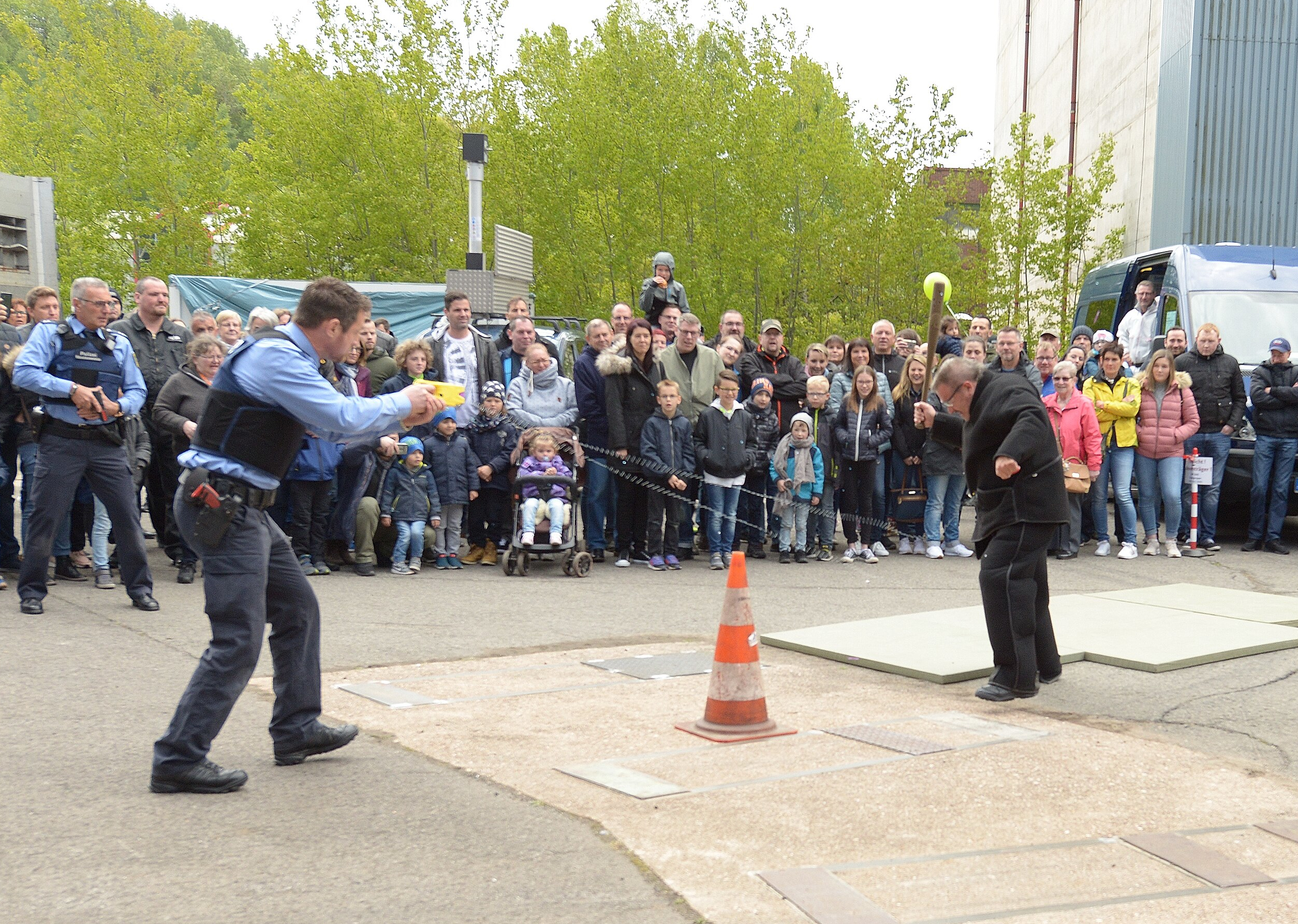
Image: Simon Mannweiler, CC BY-SA 4.0, Tag der offenen Tür Polizei SL 2019-05-05 (001), Crop by Matthias Monroy.



Leave a Reply