
Jackie Andres on the policy of the Israeli arms company, the campaign ‘Shut Elbit Down Germany’ and criticism of it
Why are there protests again this week in front of Elbit Systems in Ulm?
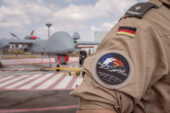
Because Elbit Systems is one of the main producers for the Israeli military. Around 80 percent of the drones used there come from them, as well as a large share of artillery, electronic warfare and ammunition. Elbit Systems thus enables the genocide in Gaza.
Where are the company’s sites in Germany?
There are two production sites in Ulm, where the German headquarters is also located. There are also offices in Berlin and Koblenz. Since August there has been another branch in northern Germany, reportedly in Wilhelmshaven, where Elbit aims to expand its contracts in the maritime sector.
Is it known where Elbit products are used?
The main markets are Israel, the US and Europe, where Elbit also profits from the wave of rearmament following the war in Ukraine. The company’s border surveillance systems are in operation in the US, particularly on the border with Mexico. Its drones have been used by the air forces of Azerbaijan, Morocco and India, including in Kashmir.
With whom does Elbit Systems cooperate internationally?
It is a strategy of many arms companies – and of Elbit Systems – to work with major corporations in other countries in order to gain easier access to contracts and markets. In Germany this includes Airbus and Diehl, for example in the field of laser-based defence systems for military aircraft, as well as Rheinmetall on automated self-propelled howitzers. In Italy Elbit works with Leonardo, in France with Thales, in Sweden with Saab and in Britain with BAE Systems. Elbit also buys companies in order to acquire their expertise and market position.
In Britain sites were closed. What happened there?
Four branches of Elbit Systems, in Oldham, London, Tamworth and Bristol, had to shut down after intensive campaigning and repeated blockades. Involved were, among others, the British network Palestine Action, local peace groups and in Oldham also the Kashmiri community. There were also repeated acts of sabotage.
Is Palestine Action now also active in Germany? Activists carried that name during a sabotage action last week in Ulm. Five of them were arrested.
There are people acting under the name ‘Palestine Action Germany’. They describe themselves as an autonomous movement and network of activists who engage in direct action against colonialism and imperialism. They apparently adopted the name deliberately in order to link up with the British movement.
Such direct actions are quite new in Germany, I know them more from Italy or the US …
I am not aware of any other example in Germany where activists deliberately enter arms companies, cause damage and then let themselves be arrested without resistance. That is probably inspired here by Palestine Action UK.
Are there solidarity structures for the five arrested, who apparently remain in pre-trial detention?
We ourselves are not part of Palestine Action Germany and therefore have no direct insight. But we stand in explicit solidarity with those affected and try to generate attention and political backing. There are solidarity appeals and fundraising campaigns to support them after arrests. There have also already been networking talks with groups engaged in anti-repression work. We expect that over time more stable structures will develop, as we know them from other movements.
There were also protests against Elbit Systems in other countries. What impact did that have on the company’s balance sheets?
There were protests not only in Britain but also in Sweden, Switzerland, Austria, Japan, Brazil, Australia and the US. In Japan this led to the termination of cooperation with the trading giant Itochu. In Britain they lost contracts, with two government projects not going to Elbit. Officially this is not attributed to the protests, but internal quarterly reports repeatedly refer to the ‘negative impact of ongoing protests worldwide’. This shows that the pressure also has economic consequences – even if Elbit Systems does not admit this publicly.
Since when has the German campaign ‘Shut Elbit Down’ existed?
Our campaign emerged in December 2023 from a global day of action against Elbit. At first it was a spontaneous demonstration, from which a continuous structure developed, supported by a growing circle of activists. We regularly protest on weekdays at the Ulm site and organised monthly demonstrations. Last April there was a camp with blockades, followed by another in August.
How does the workforce at Elbit Systems react to your protests and actions?
There is hardly any contact. Usually shutters are lowered or we are filmed. One employee testified in court that he was tasked with documenting our actions and passing the recordings on to company management.
What was that court case about?
A fellow activist had sprayed chalk on the ground. The case was closed after payment of a fine.
You write that the tents at the camp were also intended to refer to Gaza. What do you mean by that?
Because Elbit Systems bears responsibility for forcing displaced people in Gaza into tents. Our camp in front of Elbit is also a symbol of that.
How does the city of Ulm respond?
Part of the population shows support. For example, banners against the company and against the genocide in Gaza were hung from a flat directly opposite Elbit Systems. Passers-by often speak to us during our actions. At the same time, of course, there is indifference or rejection, but overall we notice that the protests are being seen and arousing interest. Criticism came from the German-Israeli Society. The authorities and the police continue to try to restrict us. For example, we were initially told we could only put up two symbolic tents. With legal assistance we were able to enforce the right to erect all 150 registered tents.
What criticism came from the German-Israeli Society?
They called us antisemitic because we once protested on 27 January – Holocaust Memorial Day. We had chosen the date for practical reasons and only later realised its significance. But we then found it very fitting to link our protest against the ongoing genocide in Gaza with the remembrance of the Holocaust, especially since Telefunken, the company in Ulm acquired by Elbit, played an important role during National Socialism.
How do you respond to accusation like ‘boycott-type protests such as yours are antisemitic’?
So far this accusation has hardly been made directly against us. We see it as our human duty to respond to the calls from Gaza for practical solidarity and for action against the arms industry that produces the deadly weaponry used there. We are also in solidarity with the campaign ‘Boycott–Divestment–Sanctions’ (BDS). That campaign points to the example of South Africa: the boycott campaign against apartheid was directed against a discriminatory regime, not against a religion. It is the same here: it is not about Jews but about the Israeli government, its illegal policy of occupation and the discrimination against Palestinians. Jewish-Israeli groups also ask people to support BDS, because external pressure is necessary.
Jackie Andres is part of the campaign ‘Shut Elbit Down Germany’. She is also active at the Information Centre on Militarisation (IMI) in Tübingen.
Published in German in ‘nd’.
Image: Blockade in Ulm 8th August (Shut Elbit down).


Leave a Reply