US sanctions against an “Antifa Ost” group are not supposed to apply in Europe, says the German Ministry of Finance – yet they do. This has now also been criticised by two ICC judges at an EU JHA meeting.
Despite an EU-wide prohibition on extraterritorial US sanctions, the German government sees no way to prevent national banks from closing accounts of politically unwelcome organisations for this. This refers to the 1996 EU Blocking Regulation, which forbids companies based in the Union from complying with third-country sanctions. In its response to a parlamentarian inquiry by the Left Party, the Federal Ministry of Finance declared itself powerless in the face of the de facto dominance of the US financial system.
The background of the inquiry were cases that caused protests nationwide, involving the left-wing legal aid association Rote Hilfe and other organisations, whose accounts were closed by GLS Bank and the Sparkasse. The trigger for this “debanking” of Rote Hilfe was reportedly a fundraising appeal for court costs in the so-called “Antifa Ost” case. These involve investigations and proceedings by the Public Prosecutor’s Office against dozens of mostly young activists accused of attacking neo-Nazis in Germany and Hungary.
After Hungary classified “the Antifa” as a terrorist organisation last September, the US Treasury Department placed “Antifa Ost” on a national sanctions list two months later. This is likely what caused the far-reaching consequences for Rote Hilfe, based in Göttingen – which had explicitly requested the words “Antifa Ost” as the purpose for the donations.
GLS Bank withdrew its closure after public pressure and now explains to its left-wing clients how they can assist the bank in risk mitigation. The Sparkasse was prohibited by the Göttingen Regional Court from closing the account via a preliminary injunction.
The Sparkasse’s lawyer argued that the debanking had occurred out of fear of being excluded from the international but US-dominated payment system Swift. A higher risk assessment of the client Rote Hilfe had led to enhanced due diligence obligations under the Money Laundering Act. The Sparkasse now has to check each individual transaction – an effort deemed too high. The bank is now appealing the Regional Court’s ruling.
In its response to the Left Party inquiry, the Ministry of Finance emphasises that US sanctions “only have legal effect within US jurisdiction”. However, it also notes: “Where European credit institutions have links to US jurisdiction, there may be business policy reasons for these companies to observe US sanctions measures.”
Compliance with obligations under the Money Laundering Act is supervised by the Federal Financial Supervisory Authority (BaFin). In the specific case of Rote Hilfe, the authority received and reviewed several third-party tips. In the past, BaFin has already “followed up on comparable case constellations”. From a supervisory perspective, “there were no systematic violations”.
The newspaper “Taz” reported, however, that BaFin conducts more special audits at cooperative banks. According to a lawyer, these transmit the pressure. The phenomenon is described as “over-compliance”, meaning exceeding existing regulatory requirements.
In Germany, the Financial Intelligence Unit (FIU) at the Customs Criminal Office is responsible for detecting and prosecuting money laundering. It also pursues breaches of sanctions – but only according to current EU lists and UN Security Council lists. “Pure third-country lists”, such as those issued by the US against “Antifa Ost” or other left-wing radical groups, are “not legally binding” for the FIU, the Ministry of Finance explains.
However, the authority maintains a catalogue of indicators with 124 possible reporting reasons for banks and credit institutions – including vague terms such as “suspicious customer behaviour”. This could also lead to anticipatory over-compliance.
Asked whether the Federal Office for the Protection of the Constitution – Germanys’ domestic secret service – contributed to the banks’ account closures, the government answered succinctly: “No, such powers do not exist.” Nevertheless, the authority could have played an indirect role, since it classifies Rote Hilfe or “Antifa Ost” as “left-wing extremist”.
Currently, around 15,000 people are on US sanctions lists. Particularly severe is the EU’s powerlessness in the face of the extraterritorial reach of these measures against eight judges of the International Criminal Court (ICC) in The Hague. The affected persons and their families are not allowed to travel to the US or use services from US-based companies. The US Treasury cites ICC investigations against members of the Israeli government as the reason for the sanctions. This significantly impedes the prosecution of international law violations in the Gaza conflict.
The EU Blocking Regulation does not apply in the case of the judges: powerful US sanctions enforcers such as Facebook, Amazon, Apple, Visa, Paypal, Netflix or Airbnb are not based in Europe. Therefore, the EU lacks an instrument to counter the sidelining of politically undesirable international organisations by the Washington government.
EU justice ministers have probably also recognised this problem. Last week at their meeting in Brussels, they invited two ICC judges to report on the consequences of US sanctions. The Minister of Justice Stefanie Hubig (Social Democratic Party) participated on behalf of Germany.
Asked whether the EU Blocking Regulation suffers from a “structural enforcement deficit”, the Ministry of Finance replied to the Left Party with a concise “No”. The Bundestag member posing the question sees it differently: the regulation is unsuitable for protecting civil society “from the consequences of arbitrary sanctions”, Lisa Schubert told “nd”. Companies implement it due to economic concerns. But it is also the pressure from German authorities that leads to account closures in Germany.
Published in German in „nd“.
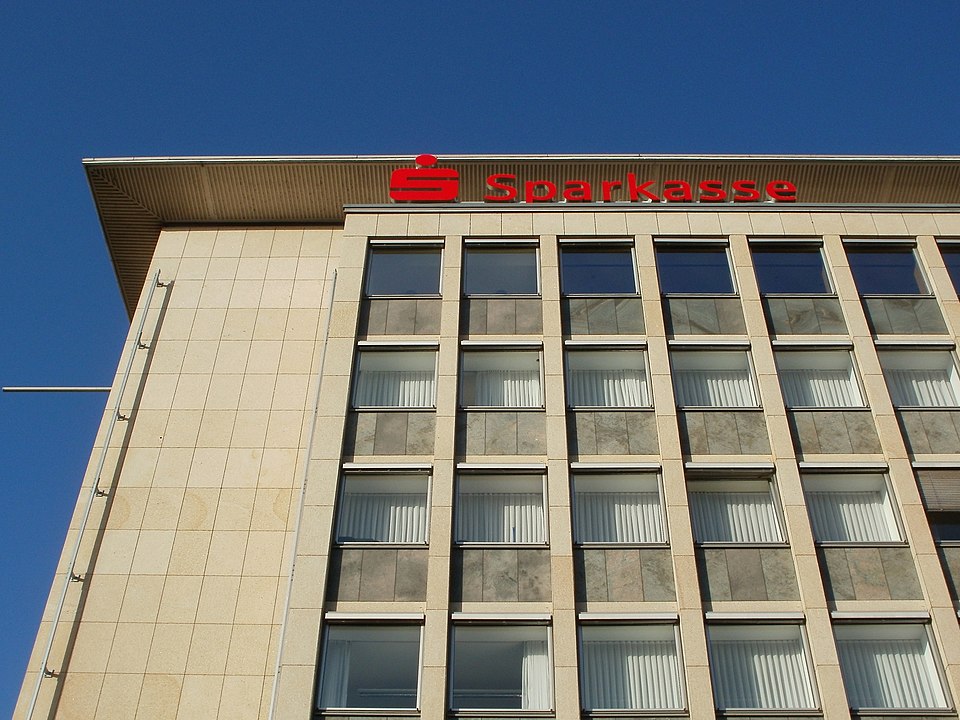
Image: A Sparkasse building in Germany (AnRo0002, 20111230Sparkasse Saarbruecken4, CC0 1.0).



Leave a Reply