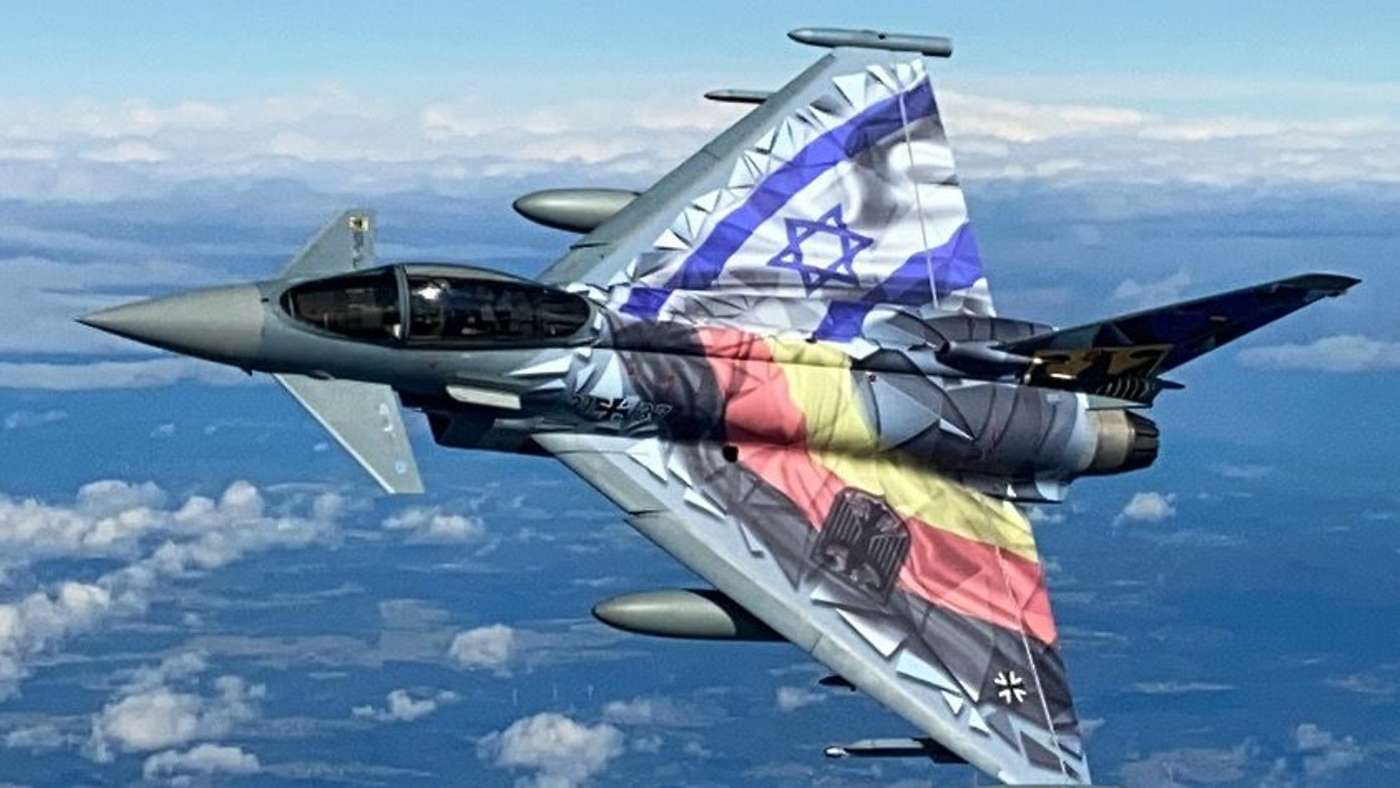
While Israel regularly violates international law, Germany is backing the country. This includes agreements involving several ministries. The Ministry for Economic Affairs is interested in Israeli start-ups.
Israel is annexing further parts of the West Bank and advancing into Lebanon. Despite a ceasefire agreement, after two years of war the army is once again bombing the Gaza Strip. Together with the USA, Israel has ultimately also attacked Iran – unprovoked. Amid these violations of international law, the German government has signed several cooperation agreements with Israel.
Closer security cooperation with Israel had already been announced in May 2022 by then Federal Minister of the Interior Nancy Faeser (Social Democratic Party). This would be “close and based on trust”, the ministry told “nd”. However, concrete details remained scarce. Last June, the new Federal Minister of the Interior Alexander Dobrindt (Christian Democratic Party) met Israel’s Prime Minister Benjamin Netanyahu, Foreign Minister Gideon Sa’ar, Defence Minister Israel Katz and Minister for Strategic Affairs Ron Dermer. A few months later, Israel’s police chief Daniel Levy paid a return visit to the Joint Counter-Terrorism Centre at the Federal Criminal Police Office (BKA) in Berlin-Treptow.
In January, the Interior Ministry then reported completion: the “cyber and security pact” that had been planned for months had been agreed, a “structured partnership that combines prevention, detection and response – from protecting cyberspace and the use of AI against cybercrime to drone defence as well as civil and population protection”.
In response to a minor interpellation by the parliamentary group Die Linke, the Interior Ministry clarified that this was merely “a political declaration of intent”. Full publication of the text is not planned. On the German side, those involved include the BKA, the Federal Police, the Central Office for Information Technology in the Security Sector responsible for surveillance technology, and the Federal Office for Information Security. On the Israeli side, partners include the “National Cyber Security Authority” and the police. Further information on the “security pact” remains scarce.
It is known, however, that the German government is also pushing into structures for controlling Palestinian territories. To this end, the Federal Ministry of the Interior is participating in the US-led Office of the Security Coordinator (OSC) in Jerusalem – founded by Washington in 2005 as a mission to build up the police in the West Bank – which is now also set to become active in Gaza. Some 3,000 police officers are to be trained in the Gaza Strip by German units. Dobrindt aims to “take on a leadership role” within the OSC; GSG 9 veteran Olaf Lindner is to be deployed for this purpose. The German special unit is also to train “more closely” with the Israeli elite unit Yamam, which in turn operates alongside the military and intelligence services.
Cooperation between air forces
At the end of February, Lieutenant General Christian Freuding, commander of the army, also concluded an official visit to the Israeli armed forces. During the visit, both sides signed a cooperation agreement on joint “capability development”. There are also to be exchange programmes for soldiers and joint exercises, with an initial date set for the autumn. The Bundeswehr stated that it aims to gain insights into the mobilisation of reservists and the integration of women into combat units.
Until now, military cooperation between Germany and Israel had been limited to the air forces. Since 2017, the Bundeswehr has participated in the multinational air combat exercise “Blue Flag”, which Israel hosts every two years in the Negev desert – but the event has been suspended since the start of the Gaza war in 2023.
Soldiers from both countries also take part in each other’s training courses; there are joint exercises involving airborne troops, helicopter crews and medical personnel. The most visible – and most expensive – expression of military cooperation is the commissioning of the Israeli Arrow 3 missile defence system in Saxony-Anhalt last November. It costs €3.6 billion and is expected to be fully operational by 2030.
Since 2019, the joint programme “Red Baron” has been running: under this nickname for the First World War fighter pilot Manfred von Richthofen, the German air force trains in Israel to fly Israeli combat and reconnaissance drones. Training takes place at a base that Israel also uses for the Gaza war. Significant parts of “Red Baron” have now been relocated to Jagel in Schleswig-Holstein.
Klöckner sightseeing in Gaza
With the newly agreed cooperation measures, the German government aims to “further strengthen German-Israeli friendship”, Freuding said. During his visit, the Lieutenant General took part in a reconnaissance flight around the Gaza Strip. A direct overflight could have been interpreted as recognition of the occupation. The German government has so far refrained from such signals – and ran into difficulties in 2017 when then Justice Minister Heiko Maas (Social Democratic Party) flew by helicopter over parts of the West Bank with Israeli Justice Minister Ayelet Shaked.
Bundestag President Julia Klöckner (Christian Democratic Party) also disregarded diplomatic conventions on not legitimising the occupation when she recently visited Israel at the invitation of the Knesset Speaker. Despite warnings from the Foreign Office and the German embassy in Tel Aviv, she took part in a tour of the Gaza Strip led by the Israeli army. Klöckner thus became the first high-ranking European politician to visit this largely destroyed Palestinian territory – Israel excluded media representatives from the visit.
Reiche for cooperation with start-ups
Most recently, Federal Minister for Economic Affairs Katherina Reiche has backed Israel’s government by agreeing to deepen cooperation. According to “Welt am Sonntag”, the Christian Democratic Party politician agreed in February during a video conference with her Israeli counterpart Nir Barkat to establish a regular German-Israeli economic forum.
Reiche also announced cooperation in the security and defence industries as well as between Israeli start-ups and German companies. As with Dobrindt’s “cyber and security pact”, details remain unclear – but Israeli start-ups are notorious for their military and intelligence-related software and hardware, which are being tested and refined using artificial intelligence in the Gaza war and now also in the war with Iran.
With its civil-military cooperation, the German government does not, in any case, represent the population. In a survey by the Hamburg-based think tank Giga, a narrow majority of German citizens supported suspending security policy cooperation with Israel.
“Especially in difficult times, it is important that friends stand together and further expand their cooperation”, “Welt” reports from Reiche’s ministry. Trade with Israel reached a volume of €8.8 billion last year. 11 per cent of all German arms exports go to Israel. From Israel’s perspective, Germany has also been its second most important supplier since 2021: 31 per cent of its arms imports before and during its multi-front war came from Germany.
Published in German in „nd“.
Image: In the military sphere, cooperation has primarily taken place between the air forces of Israel and Germany, here during an exercise in the Negev desert (Bundeswehr).


Leave a Reply