Ankara is expanding its military and security role in Libya as the EU seeks to extend its own migration-control infrastructure to the country’s east. New drone operations in the Mediterranean highlight the growing rivalry.
Frontex, the EU border agency, currently has ten aircraft and two large drones stationed in the Mediterranean. Their flights serve the outsourced enforcement of migration controls: boats carrying migrants departing from Libya, Tunisia and Algeria on their way to Europe are reported to the coast guards there, with the aim of having the people brought back.
The EU surveillance service in the North African search and rescue zones is now being expanded again: from June to November, Italy is contributing another long-range drone, Frontex confirms. In July, the US company Shield AI also conducted a pilot project with two ship-based, vertically take-off-and-landing drones for Frontex and the Italian Coast Guard. Frontex now wants to examine how the US devices can serve the EU member states in future operations.
Not included in this list are assets that member states make available to Frontex. Across all EU maritime external borders, 84 coastal patrol boats, nine coastal patrol vessels and 43 offshore patrol vessels were deployed throughout the year, according to an annual report. In the Mediterranean, this is primarily Italy. The efforts are paying off for the EU: according to new Frontex figures, crossings in the eastern Mediterranean fell by 28 per cent compared with the previous year, in the western Mediterranean by 37 per cent and in the central Mediterranean by as much as 55 per cent.
Turkish drones in Libyan search and rescue zone
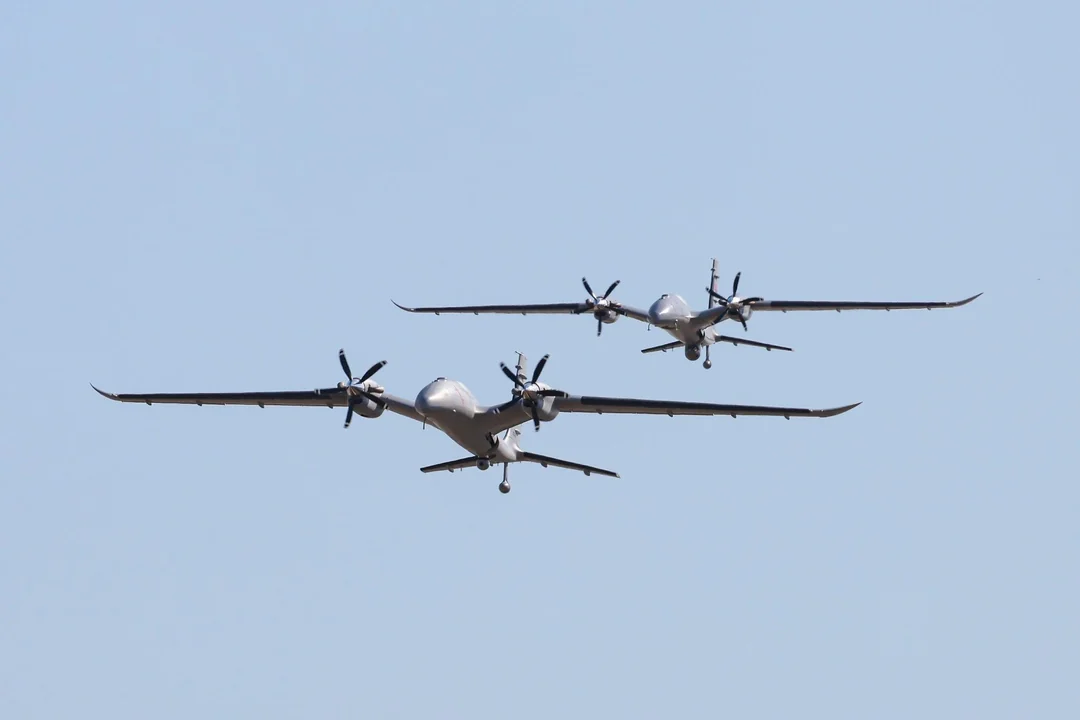
This outsourced EU migration enforcement is now facing competition: last week, two long-range drones took off from Tripoli for the first time into the zone for which Libya is responsible for search and rescue operations. They were found with their call signs by the London-based researcher Sasha Milonova on a flight-tracking website. According to this service ADS-B Exchange, the drones come from the Turkish company Baykar – at least, they were test-flown for periods of several weeks at the company’s premises in 2024 and 2025.
Baykar has two models in its programme for such operations: the “Bayraktar TB2”, which has been manufactured for ten years, or the newer and considerably larger successor, the “Akıncı”. It is not possible to determine which of the two flew over the Mediterranean last week.
It also remains unclear who was responsible for the drone flights and whether they were carried out with weapons. The Libyan Coast Guard, which is part of the military, has not responded to an enquiry from “nd”. The flights may have been patrols in the search and rescue zone or merely test flights. They could have been controlled by the Turkish military or by Libyan units. It is also unclear whether the drone flights are intended to be permanent.
Deal with Italy and Qatar
The activities fit with a new “Quadrilateral Mechanism”, which Libya, Turkey, Italy and Qatar reportedly agreed in Rome in May for the “fight against irregular migration and smuggling networks”. Libya and Turkey want to establish a “Joint Operations Centre” for coast guards in Tripoli, run by Libyan authorities and supported by liaison officers from the three partner countries. The pilot phase of the centre is said to have officially begun in June.
Turkish drones could then be deployed from both sides of the Mediterranean: Baykar, the manufacturer of the “TB2” and the “Akıncı”, has agreed with Leonardo to produce these and other models in future at a facility near Trieste airport. The Italian Navy is also planning to procure them.
Ankara’s own “One Libya policy”
The new Turkish drone flights from Tripoli began on 6 August, with the most recent taking place on 11 August – the day Turkish Foreign Minister Hakan Fidan officially visited Libya, among other things to discuss cooperation in the field of “defence and security”. In western Libya, he met Prime Minister Abdul Hamid Dbeibeh and his security adviser Ibrahim Dbeibeh. The main subject was Turkey’s “One Libya policy”. Fidan then travelled on to Benghazi, where he met, among others, military commander Khalifa Haftar as well as his son and deputy Saddam Haftar.
Fidan’s visit was likely a response to EU efforts, as the EU is also pursuing a new “One Libya policy” for its outsourced migration enforcement: since 2017, western Libya has received equipment, training and a control centre for the Coast Guard; Brussels now wants to transfer this system to the east. Responsibility for this lies with the EU Mediterranean mission Irini, which is to establish a control centre in Benghazi and a surveillance tower on the coast in Tobruk together with the Haftar administration. The United Nations Office on Drugs and Crime is also involved.
The EU’s official partner in eastern Libya is a unified, but imaginary, Libyan Coast Guard which, from the perspective of the Commission in Brussels, is responsible for both parts of the country in the spirit of “One Libya”. This, however, does not correspond to reality: even in the west, there are maritime militias that do not belong to the apparatus controlled by Tripoli. And eastern Libya would not tolerate western units conducting maritime patrols there.
A signal to Frontex
That Fidan’s visit to Libya was also a signal to the EU and that Turkey wants a say in migration control is also evident from the daily changing call signs used by the Turkish drones stationed in Tripoli in recent weeks. They always began with “Eagle”, namely the call sign normally carried by Frontex aircraft in the Mediterranean.
It would not be the first time that the Turkish military has been active in the Libyan search and rescue zone. In 2020 and 2021, the country’s frigates repeatedly picked up migrant boats off the Libyan coast and handed those rescued over to the Libyan Coast Guard.
At the time, the Turkish Air Force fought on the side of the western Libyan government, among other things with TB2 drones, against Haftar’s forces in eastern Libya and contributed significantly to the military turning point when Haftar’s forces were besieging Tripoli. Haftar’s air force, in turn, bombed Turkish bases in Libya with Chinese combat drones and destroyed several drones – including in Tripoli, from whose international airport TB2 drones have now, five years later, taken off again.
One-sided boarding policy of the EU military mission
The fact that Turkey is once again becoming more strongly militarily present in Libya is also being facilitated by a reconfiguration of the EU military mission Irini. It is intended to detect arms smuggling to Libya and inspect vessels suspected of violating the UN sanctions regime. But this mainly affected arms shipments heading to western Libya, while Haftar’s forces also received their equipment overland via Egypt.
The vessels suspected by Irini often came from Turkey, repeatedly leading to diplomatic conflicts. For example, in November 2020, when the German frigate “Hamburg”, as part of Irini, stopped and searched the Turkish freighter “Roseline A” north-east of Benghazi. Ankara protested and succeeded in having the inspection terminated.
A similar incident had already escalated in June 2020, when a Greek Irini frigate sought to inspect the freighter “Çirkin”, which was escorted by Turkish warships and was likewise suspected of transporting weapons to western Libya.
Turkey moves into Irini’s niche
As part of their new “One Libya policy”, the EU states restricted the military mission’s mandate in May: Irini is no longer permitted to inspect suspicious vessels on the high seas, but only to “systematically document relevant information”, a spokesperson confirmed to “nd”. Turkey may have interpreted this as a free pass to pursue its own “One Libya policy” and outmanoeuvre the EU.
Sooner or later, Irini will probably completely abandon the pursuit of Libyan embargo violations – or the United Nations will lift the relevant resolution. The EU Mediterranean mission could then turn to new tasks. This is also suggested by a new “technical arrangement” that Irini recently signed with the Italian Navy to protect critical maritime infrastructure.
This concerns the surveillance of undersea cables and pipelines – an area that once again encroaches particularly heavily on Turkish interests and a maritime agreement concluded with Tripoli in 2019. This controversial treaty, in turn, defines a corridor for Turkish claims to the continental shelf and exclusive economic zone of Greece. New conflicts with Turkey are therefore also inevitable under the new Irini mandate.
Published in German in „nd“.
Image: The “Akıncı” will soon be produced in Italy. Last week, Turkish drones also flew in the Libyan search and rescue zone. In doing so, they are competing with Frontex’s aerial surveillance.

Leave a Reply