With protests across Europe, international left-wing radicals wanted to build on Seattle and Prague in 2001. In Genoa this escalated into unprecedented police violence
Buoyed by the momentum of the large and militant protests against the WTO summit in Seattle in 1999 and the IMF congress in Prague in 2000, anti-racist, anti-capitalist and autonomist networks from Europe and elsewhere called for a “Summer of Resistance” in 2001 against neoliberal globalisation policy.
The series began in March against an OECD meeting in Naples, with around 10,000 people taking part. Police used batons and tear gas against demonstrators trying to reach the cordoned-off summit zone. Around 100 of them were temporarily arrested, and numerous others injured. The operation was seen as a foretaste of the police strategy at the G8 summit in Genoa.
Around 30,000 demonstrators travelled from across Europe to the EU summit in Gothenburg in mid-June. Fierce clashes broke out in the city centre, and for the first time since 1931 Swedish police used live ammunition against demonstrators. Three people were injured by gunfire, and around 900 were taken into custody. Repression continued after the summit: numerous activists, including Germans, were sentenced to prison terms of several years for “violent rioting”.
The Tute bianche (Italian for “white overalls”) were an Italian protest movement that first appeared in Milan in September 1994. They became known for their white protective suits, a symbol of precarious labour (in contrast to the classic blue overalls of industrial workers). Activists wore helmets and protected their bodies with foam or air-cushioning in order to break through police lines using their own bodies, but without violence. As radical opponents of neoliberal globalisation, they campaigned for social rights, freedom of movement and against precarious working conditions. They also drew on the example of the Mexican Zapatistas. The movement dissolved after the bloody crushing of the protests at the 2001 G8 summit in Genoa. Many activists soon regrouped under the name Disobbedienti (“The Disobedient Ones”). (Cyrus Salimi-Asl)
The high point of the mobilisation came with the protests under the slogan “Your G8, our 6 billion” on the third weekend of July, with around 300,000 people in Genoa. After the opening on 19 July had passed largely peacefully, Carabinieri brutally attacked a large demonstration organised by the Social Centres in Via Tolemaide the following day, against their own operational orders.
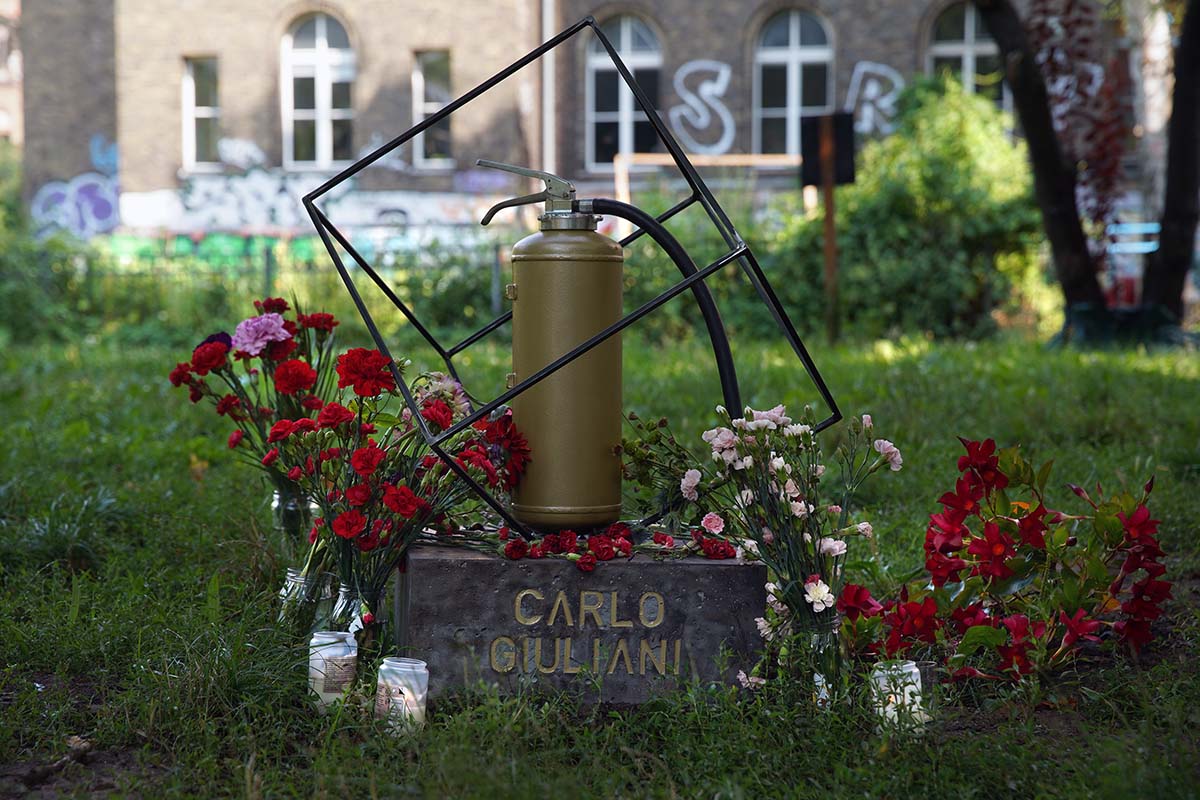
In the clashes that followed, 23-year-old Carlo Giuliani was shot dead. The next day, police once again attacked a large demonstration on the edge of the “Red Zone” with unprecedented violence. In the evening, riot units stormed a sleeping quarters for activists at the Diaz school. More than 60 people were taken to hospital, some with serious injuries. Many of the roughly 300 people arrested across the two days were badly mistreated at the Bolzaneto barracks and at police stations.
The wider toll: police, Carabinieri and the finance police fired 6,200 tear-gas cartridges, at least 20 shots were fired from service weapons, and around 1,200 people were injured by security forces. The shooting of Carlo Giuliani was ruled to have been in self-defence, a decision upheld by the European Court of Human Rights in 2011.
In the trial over the attack on the Diaz school, 16 senior police officers were given final sentences of up to five years in prison eleven years later, but did not have to serve them owing to an amnesty. Former police chief Gianni De Gennaro was also finally acquitted in 2012 of incitement to perjury over the Diaz raid. In the trial over mistreatment and torture at Bolzaneto, after cases lapsed under the statute of limitations and acquittals, seven final convictions remained, with prison sentences of up to three years and two months – these too were not enforced.
By contrast, ten activists from the anarchist spectrum were given final sentences of between 6 and 15 years in the trial over “devastation and looting” in 2012, and some served them. A trial against 13 activists linked to the Social Centres over an alleged “political conspiracy” had already ended in full acquittals in 2008.
The “Summer of Resistance” concluded at the end of August with the sixth anti-racist border camp in Frankfurt am Main. Around 2,000 activists organised demonstrations and direct actions, including at Frankfurt Airport and at deportation authorities. Police temporarily arrested around 200 people over the course of the week of action.
Already in June, the “Deportation.Class” campaign had organised the first major virtual protest action of its kind in Germany, with an online demonstration against Lufthansa’s deportation practices. Around 13,000 people took part in the action, many of them downloading software that brought down the Lufthansa website. Several activists identified by police as responsible were charged with “coercion” and ultimately acquitted.
Published in German in „nd“.
Image: Monument in “Carlo Giuliani Park” at Bethanien in Berlin-Kreuzberg, July 2021 (reclaim your city).
Leave a Reply