
The German Interventionist Left has outed an informant who allegedly spied on left-wing structures in Bremen for more than eight years. Despite the man’s known depression, the domestic secret service is said to have repeatedly extended his deployment.
At the beginning of January, the nationwide active Interventionist Left (IL) exposed an informant of the Office for the Protection of the Constitution (Germany’s domestic secret service) who for years collected information on structures and actions of left-wing groups and individuals in Bremen and passed it on to the state authority. After this initially became public through an indiscretion by a Bremen journalist, the IL published a detailed text on the outing on Thursday. It names the apparently Kurdish first name of the man and provides details and a photo about him.
According to its own description, the IL is an anti-capitalist and anti-fascist organisation with groups in more than 20 cities. The Bremen local group accordingly received a tip about the suspicion of an informant “by chance”. In a confrontation meeting, the man admitted that he had been working as an informant for the Bremen Office for the Protection of the Constitution since 2017. From the beginning of 2018, his main target had been the Interventionist Left, which he approached via an open meeting on climate policy at the University of Bremen.
During his activity, the informant is said to have conducted sexual and romantic relationships within the IL. He lived in shared flats whose residents he spied on. Due to depression and an anxiety disorder – possibly triggered by his “double life” – he was undergoing therapeutic treatment, while IL members took on “care work”. Despite knowledge of these illnesses, the Office for the Protection of the Constitution allegedly continued to use the man as an informant.
The IL suspects that the direct targets of the surveillance also included the nationwide campaigns Ende Gelände against climate destruction and Defend Kurdistan, as well as a migrant, anti-racist group in Bremen. As far as can be reconstructed, the intelligence gathering also “indirectly” affected the Bremen Refugee Council, the party Die Linke, and Bremen alliances against the right. A year ago, the informant was also involved in actions to defend church asylum in Bremen, the IL explains.
In the confrontation, the informant is said to have provided details about the collection and transmission of information. According to this, he met with the secret service every two to four weeks for discussions that often lasted several hours. The IL does not know the exact amount of his remuneration, but assumes “that it amounted to at least €500 per month, and probably to higher sums”. He allegedly financed his livelihood largely from this income.
According to the Bremen Law on the Protection of the Constitution, however, this should be excluded: “cash or material benefits” for the activity as an informant must “not permanently constitute the sole basis of livelihood”. The law also stipulates that it must be excluded that the “person to be deployed decisively determines either the objectives or the activities of the object of observation”. This provision also appears to have been violated: in the Interventionist Left, all decisions are taken jointly in assemblies, the group writes. The informant actively participated in these over many years.
Contrary to a demand by Bremen’s Senator for the Interior Eva Högl (Social Democratic Party) following the emergence of the outing plans, the IL did not refrain from them but went public with details. Högl had told “nd” that this would put the man in danger.
His life is not being destroyed by his exposure, the IL writes, but by the authorities. “Responsibility for this lies with the former Senator for the Interior Ulrich Mäurer, the head of the Office for the Protection of the Constitution in Bremen Thorge Köhler, the former head Dierk Schittkowski, and the secret service itself”, as they recruited the informant and “used” him – even when he was already visibly suffering from the psychological consequences of his double life.
The use of informants serves to intimidate political activists, spread mistrust and stigmatise them as “extremists”, the IL explains. In this way, the authority becomes a political actor and should be abolished.
Published in German in „nd“.
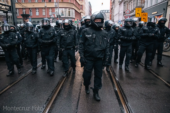
Image: Among the direct targets of the surveillance are said to have been the nationwide campaign Ende Gelände (Manuellopez.ch, CC BY-SA 4.0).


Leave a Reply