The EU border agency’s “Standing Corps” Category 1 has reached only 75 per cent of its planned strength due to meagre pay – it mainly attracts police officers from member states with lower wages.
The EU border agency Frontex has, according to its own statements, largely met its planned targets in building up its armed border force. For 2025, the plan envisaged that the “Standing Corps” would comprise 2,000 operational staff in category 1, 1,000 in category 2 and 5,000 in category 3. A total of 7,550 officers are available, a Frontex spokesperson told “nd” – corresponding to a success rate of 94 per cent.
The establishment of the “Standing Corps” was laid down in an EU regulation amended in 2019. By 2027, it is to grow to a total of 10,000 personnel. Of these, 3,000 are to be permanent Frontex staff, to be uniformed and armed from the headquarters in Warsaw. In addition, there are contingents for short- or long-term deployments (categories 2 and 3) from the member states.
However, not all personnel are deployed at all times. As of the end of March, 1,361 officers in category 1, 1,099 in category 2 and 980 in category 3 had been deployed in Frontex missions. This is stated in a reply to a query by Left Party MEP Özlem Demirel.
Applications for category 1 – the new unit under the sole command of Frontex – nevertheless fall short of the target. So far, only 1,500 of the planned 2,000 officers have been recruited for 2025, Frontex admits. Their origin is also striking: they come mainly from countries with lower GDP. According to Frontex, most of the currently deployed members have been recruited from Greece, with 459 officers, and Romania, with 302 officers. They are followed by Portugal (125) and Spain (115).
From Germany, there are just four police officers in category 1, from the Netherlands only one, and from Austria none. Poland accounts for 87 applicants, placing it fifth. The Polish capital is also the seat of the EU border agency.
Frontex cites several reasons for these differences, including comparatively low pay at the Warsaw location as well as deployment sites in remote border regions. It also says that application figures reflect the size of national police authorities. However, this explanation does not hold true for Germany, for example: for two decades, the country has been the largest contributor of personnel to Frontex, at around 10 per cent. And with good pay: police officers seconded in categories 2 and 3 are remunerated according to German pay scales.
In order to attract more applicants from countries that are currently underrepresented, the border agency now plans targeted recruitment campaigns. The focus is on Germany, France and the Netherlands. To this end, Frontex intends to advertise at job fairs and on national job portals.
The fact that hardly anyone wants to apply to Frontex is also likely to have an impact on further plans to expand the border force: Commission President Ursula von der Leyen had announced that the “Standing Corps” would be tripled.
This year, the Commission intends to present a proposal for a new Frontex regulation, in which the new target of 30,000 officers would have to be set out.
In a further reply to Demirel, Frontex explains the expansion of training structures for the “Standing Corps”: contracts worth €2.3 million have been tendered for firearms training, which takes place at a shooting range on the outskirts of Warsaw.
A further €700,000 is being invested in training on “arrest techniques”, the handling of “non-lethal weapons”, medical emergency care, stress management and the documentation of operations. These take place, among other locations, in Croatia, Italy, Finland, Bulgaria and Portugal.
Despite the lower personnel levels, Frontex continues to restructure its operational set-up. Units of a “Quick Reaction Force” are to be stationed in various EU countries. They are intended for rapid missions at the external borders when large “migration flows” are reported from there. Deployments are also possible at major international events such as summits or sporting events.
The Left in the European Parliament rejects the new Frontex plans outright. “Strengthening this machinery of deterrence and deportation would mean supporting the EU’s inhumane migration policy,” Özlem Demirel told “nd”. The group instead calls for legal escape routes, tackling the causes of displacement and “genuine sea rescue instead of pushbacks”.
As Frontex explained, the article contained in its previous version misleading numbers, stating the following: “The article’s central claim, that the Standing Corps has reached only around half its planned strength, rests on two figures that don’t accurately reflect the Annex I benchmark numbers. Category 3: The 980 figure from the Frontex letter refers to officers currently deployed at the time of writing, not the nominated pool that Annex I capacity targets are measured against. The correct benchmark figure is 4 951, the number of officers nominated by Member States for short-term deployment, which is the metric that corresponds to the 5 000 target. Category 3 is by design a standing pool, not a permanently deployed force. Measuring it by current deployments rather than nominated capacity is not the right comparator against the target. Category 1: The 1 361 figure covers operational/deployable staff only. It excludes 137 ETIAS and support staff who are counted as Category 1 for Annex I purposes, bringing the correct total to approximately 1 500.” The article was changed accordingly.
Published in German in „nd“.
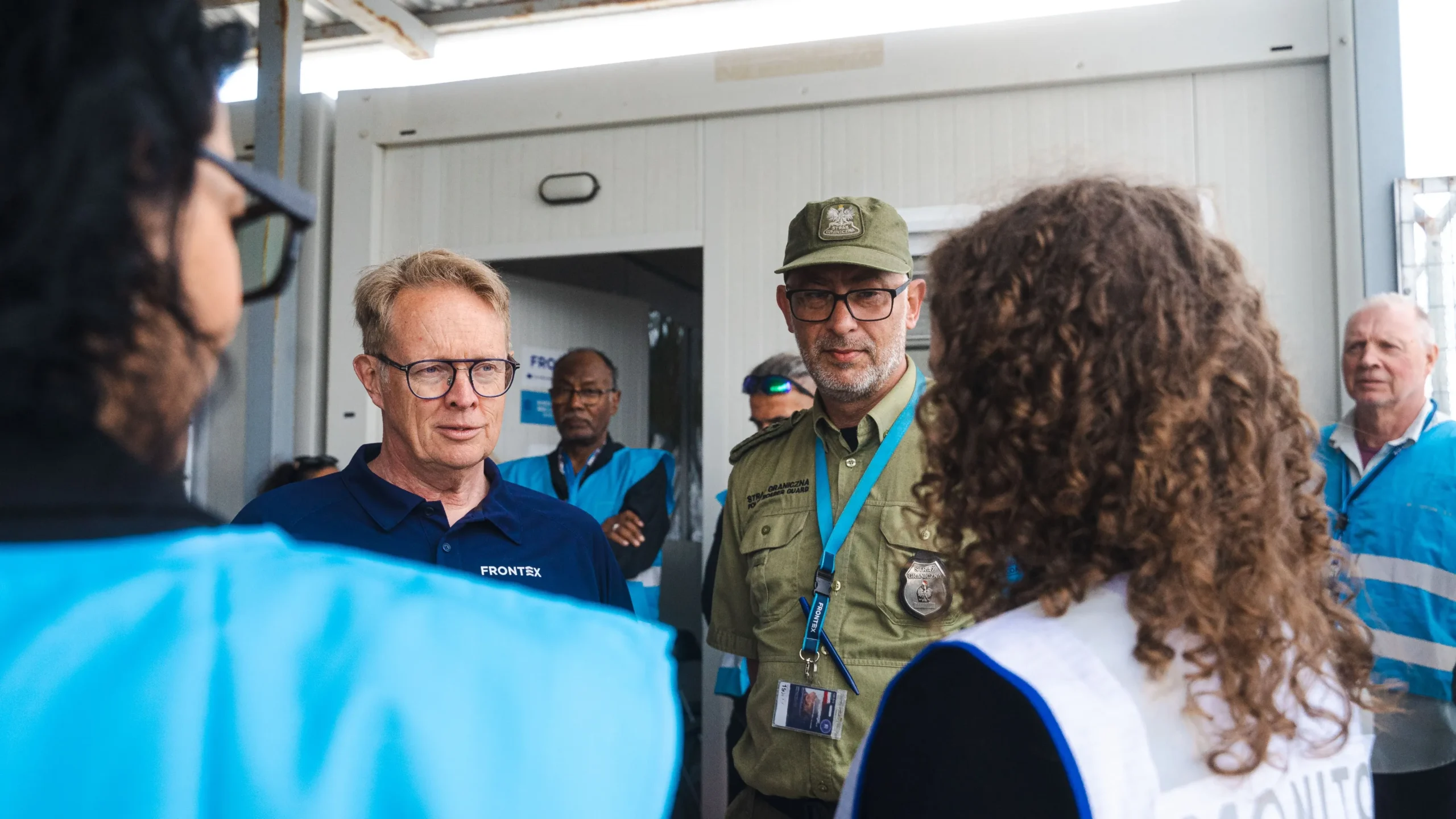
Image: Frontex Director Hans Leijtens during a visit to Greece last week. This country provides by far the largest number of applicants for the new border force (Frontex/Bluesky).