At the Hertie School in Berlin, students have forced their representation out of office. The trigger was a resolution supporting the non-violent Israel boycott campaign BDS. New elections are to be held as early as March.
With a narrow majority of 52 percent, students at the Berlin private university Hertie School have withdrawn their confidence from their representation. The three-day vote ended at midnight on Friday; turnout was high, with around 70 percent of the 855 enrolled students participating. The previous Hertie Student Representation (HSR) is thus dissolved – 47 percent voted against. According to the university, new elections for the student representation are to be completed by the end of March.
The trigger for the vote of no confidence was a resolution adopted by the student body on 4 March with the votes of eleven of its 16 members. In it, the HSR declared its support for the 21-year-long boycott, divestment and sanctions campaign against Israel (BDS). The movement, which is also supported by Jewish individuals, is controversial: in 2019, the Bundestag classified it as antisemitic, and in 2024 the domestic intelligence service designated it a suspected extremist case.
The vote was initiated after a general assembly of students and staff on 11 March. At that point, eight of the 16 elected members of the HSR had already resigned from office.
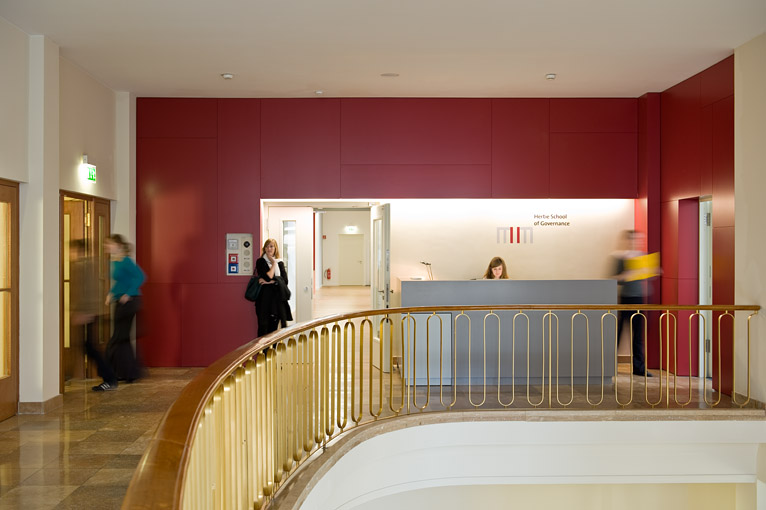
The Hertie School, located on Friedrichstraße in Berlin, is considered a training ground for leadership in government, business and civil society. Since the beginning of the Gaza war, there have been repeated pro-Palestinian protests at the university, some of which were also endorsed by the president.
Following the resolution, however, the university leadership and private donors quickly distanced themselves, spoke of antisemitism and called for consequences. After the vote of no confidence, the student representation was urged to withdraw its support for the BDS campaign and to remove it from its publications.
“We welcome the very high voter turnout and of course accept the result,” a former member of the HSR told “nd”. However, the vote of no confidence does not automatically nullify the resolution, said the student, who wished to remain anonymous. “How to proceed will be decided by a newly elected HSR.” This decision, he said, should “stem from the views of the student body and not from the demands of the leadership”.
A Jewish student at the Hertie School sees the accusation of antisemitism as the core problem. “Criticism of the state policy of Israel is being equated with a historical form of hatred. That delegitimises the student body and ignores the diversity of Jewish opinions – including within my own family,” said the young man, who also wishes to remain anonymous.
In a statement, the Alliance for Critical and Solidary Scholarship (Krisol) last week criticised the Hertie School and the foundation behind it for interfering in the institutional autonomy of the students. Together with other organisations, Krisol emphasised that support for the non-violent BDS movement is protected by freedom of expression. The threat of consequences endangers academic freedom and excludes marginalised voices – particularly Palestinian ones.
The motion of no confidence was introduced by a group called Hertie Students for an Open University. It stated that it had not felt sufficiently represented by the resolution, the university said on behalf of the group. The leadership described the disputes as evidence of “the diversity of our community”. Nevertheless, it is reportedly examining disciplinary measures against the eleven HSR members who voted in favour of the BDS resolution.
Published in German in „nd“.
Image: The Hertie School, located on Friedrichstraße in Berlin, is considered a training ground for future leaders. Many students express solidarity with Palestine (Zugzwang1972, Hertie School entry, CC BY 3.0).


Leave a Reply