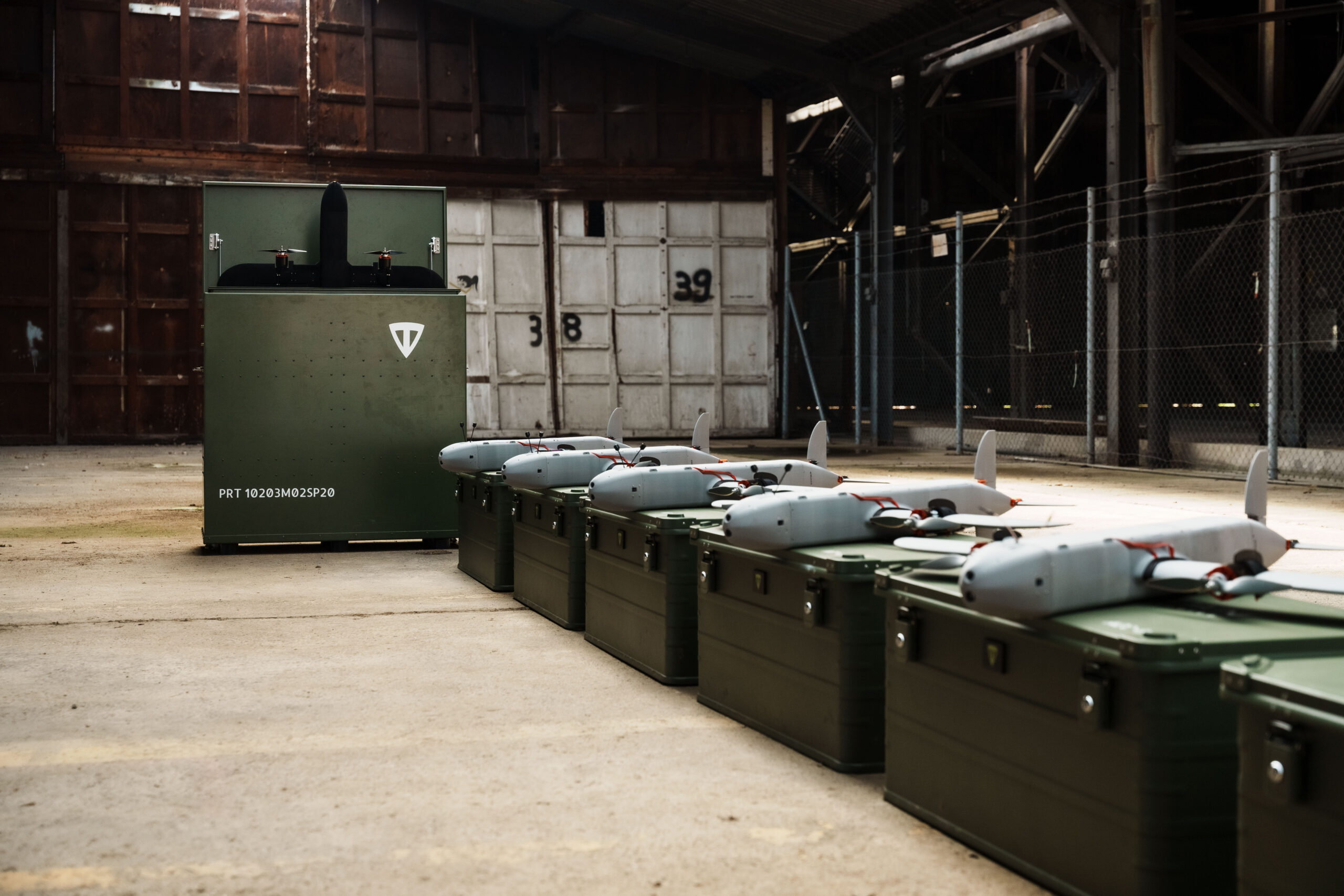
The Berlin Senate wants to make the capital a centre for drone technology. Companies such as Stark, Rheinmetall, Germandrones, and Quantum Systems have long been established there – and are now receiving local and federal backing.
Jule Meier and Matthias Monroy
Bavaria has long been regarded as the heartland of the German defence industry – above all the state capital Munich and its surroundings. A dense network of start-ups has grown up around the Technical University of Munich and the university of the Bundeswehr located there. But Berlin is increasingly establishing itself as a location for newly founded developers and manufacturers of so-called dual-use technologies – that is, devices that can be used for both civilian and military purposes.
Following a Senate resolution in December to actively recruit companies from the security and defence sector, the Governing Mayor Kai Wegner (Christian Democratic Party, CDU) spoke at an industrial policy dialogue forum of the Chamber of Commerce and Industry at the end of January about a planned “defence-tech ecosystem”. This is being led by the economic development agency Berlin Partner and the Senate Department for Economic Affairs. A dedicated staff unit has been set up in the Senate Chancellery – “as a central point of contact for the federal government and the European Union”.
According to Economics Senator Franziska Giffey (Social Democratic Party, SPD), the capital region currently hosts around 130 companies from the security and defence sector, employing 26,000 people and generating an annual turnover of €8 billion. In addition, there are around 430 companies with technologies for dual civilian-military use.
According to Giffey, no new funding is planned for the “defence-tech ecosystem” – the existing funding options are “already good”. The Investitionsbank Berlin is to accompany, advise, and network companies wishing to relocate to the city. The managing director of Berlin Partner also cited support for spin-offs from Berlin universities as a concrete goal. A key thematic focus is on satellite technologies for military reconnaissance and communications – an area in which the Bundeswehr intends to massively expand its capabilities by 2029. The focus also includes weapons and other defence materials. Numerous established companies and start-ups specialising in drone technology have long since set up in Berlin.
From Pierburg to Rheinmetall
One of the best-known military players in Berlin is Rheinmetall, whose factories were not previously based in Berlin but which has a capital city branch at the Brandenburg Gate. Since mid-2025, Germany’s largest defence company has been converting a car parts supplier in the heart of Berlin to the production of ammunition components. To this end, the subsidiary Pierburg in Berlin-Wedding was renamed Rheinmetall Waffen Munitions GmbH. Currently 350 employees work there, with plans to expand the workforce. The works council and the trade union Verdi supported the reorientation.
Pierburg had previously manufactured fuel pumps, which are also dual-use goods: research by “RBB24” shows, for example, that the parts were installed in Russian Geran-2 drones shot down over Ukraine in 2024. These pumps made by the Rheinmetall subsidiary are not subject to export control licensing requirements, but have been subject to an export ban since the tenth sanctions package imposed by the European Union against Russia in February 2023.
Until 2010, Rheinmetall was also active in the drone business and operated Israeli Heron 1 drones for the German air force, but handed this segment over to EADS (later Airbus Defence). Rheinmetall now produces kamikaze drones – also known as loitering munitions – on Sardinia together with the Israeli company Uvision. The devices are sold in various sizes, including armour-piercing models.
Quantum Systems on a spending spree
Whereas Rheinmetall relies on industrial structures that have grown over decades, Quantum Systems – originally founded for civilian applications – represents a new generation of the defence industry. The start-up from the 2010s has its headquarters in Gilching near Munich. A Berlin representative office with a showroom on the Berlin Spreebogen is intended to help facilitate further drone deliveries to Ukraine and secure financing through programmes run by the German defence ministry. The start-up also received a Bundeswehr contract for reconnaissance drones as a successor to the Aladin model. Quantum Systems is also involved in the Uranos project, which aims to monitor large areas using artificial intelligence – together with Airbus, the AI start-up Helsing, and the equally young company Arx Robotics, which manufactures ground robots.
In autumn 2025, Quantum Systems tripled its valuation to €3 billion – the European Investment Bank, the development bank KfW, and commercial banks provided a loan of €150 million. By 2026 at the latest, the company also intends to sell military interceptor drones. At the Enforce Tac 2026 trade fair this week, Quantum Systems announced its move into ground robotics: with the unmanned Mandrill and a newly established business unit, the company aims to integrate aerial and ground systems into a combined force. The small ground vehicle can be fitted with various modules – including armaments – and networked with other drone systems.
Stark emerged from Quantum
Another defence start-up called Stark was founded in February 2024 by former Bundeswehr officers Florian Seibel and Sven Kruck – both had previously built Quantum Systems, from which Stark also emerged. The company’s office is located at the Berliner Gendarmenmarkt. Production takes place in Bavaria and the United Kingdom; in Ukraine there is also a large “research and development centre”, and the country is already being supplied for the war. Stark distributes kamikaze drones such as the Virtus, which can be fitted with a warhead and is delivered primarily to Ukraine. The portfolio includes the command and mission system Minerva, which is based on artificial intelligence. The company is also developing a new warhead for its drone together with ammunition manufacturer TDW; series production is set to begin in 2027.
Stark’s investors include Sequoia Capital, US billionaire Peter Thiel, and Döpfner Capital, behind which stands Moritz Döpfner, the son of Axel Springer CEO Mathias Döpfner. Today, Berlin venture capital investor Uwe Horstmann runs the business. Stark is now considered a “unicorn” – that is, a company with a valuation of over €1 billion. The Berlin “Tagesspiegel” reported from “informed circles” that Stark had concluded supply contracts with several European states. In September 2025, the association Made in Berlin – whose partners include the “Tagesspiegel” – named the company “Newcomer of the Year”. Martin C. Wolff, managing director of the consulting firm Kritis & Cyber, praised Stark for having become market leader within a year, adding: “We live in an era of aggressive peace. For that, we need weapons.”
Germandrones delivers to Ukraine
Germandrones is based and produces in the former cargo hangars of the Urban Tech Republic on the site of the former Tegel Airport. Its vertical take-off and landing drone, the Songbird, flies for up to two hours and around 100 kilometres beyond visual line of sight, equipped with sensors for mapping, inspection, and security tasks. It is sold to police and military forces. Together with Ukrainian partner Perun, Germandrones delivered over 500 Songbird drones to the Ukrainian armed forces in 2025, including training, service, and maintenance, with further deliveries planned. In addition to the existing reconnaissance variant, Germandrones is now also equipping the Songbird with explosives to intercept enemy drones.
The Bundeswehr operates an “innovation hub“
The Bundeswehr has operated the Cyber Innovation Hub in Charlottenburg since 2017. Around 50 soldiers and civilian employees identify technological requirements there and recruit start-ups for military applications. The hub cooperates closely with the Berlin economic development agency to make it easier for companies to enter the defence market. The Budget Committee of the Bundestag decided in November 2025 to increase the budget to €40 million and to give the Cyber Innovation Hub its own budget line in the defence estimates for the first time.
Current projects include an interceptor drone developed together with the Munich company Tytan, intended to neutralise large-calibre attack drones such as the Russian Shahed – and to do so cheaply. Another project is a sensor drone that can detect anti-personnel mines using software. The Cyber Innovation Hub is also likely to be involved in the “cyber and security pact” with Israel that Federal Interior Minister Alexander Dobrindt (Christian Social Union) launched in December.
War as a computer game
The interlinking of the military and private sector is evident not only in development and production, but increasingly also in the simulation of complex combat situations. In Berlin’s Macherei quarter in Kreuzberg, the management consultancy Accenture operates a “Defence Lab”. It is led by Kevin Thiele, a former Bundeswehr officer who heads Accenture’s defence and civil protection division. The facility’s aim is to train rapid decision-making in warfare. Brought together via a shared “digital backbone”, infantry soldiers wearing augmented reality glasses are to practise defending against virtual tanks while their crews simultaneously sit in simulators at a barracks. Thiele also sees the platform as a tool for Bundeswehr procurement: instead of rigid tendering processes, requirements could be modelled and manufacturers’ product data tested in the software for its actual suitability.
Drones yes, but explosives elsewhere
In the context of the planned “defence-tech ecosystem”, Senator Giffey emphasised: “Berlin will never become a location for arms production.” What she presumably means is that the manufacture of warheads and other explosive materials should not take place in an urban conurbation. Thus Rheinmetall in Wedding also primarily produces shell casings, which are then filled with explosives at factories in Lower Saxony. Germandrones faces the same obstacle, as it is not permitted to test explosive charges at its Tegel production site. The company is therefore eyeing up sites in Strausberg in Brandenburg, in the district of Märkisch-Oderland – near a Luftwaffe barracks.
In particular, the newer manufacturers of drones can now look forward to fresh investment. According to the “Financial Times”, Chancellor Friedrich Merz (CDU) and his Finance Minister Lars Klingbeil (SPD) intend to use new oversight functions at the defence ministry to ensure that hundreds of billions of euros from the military special fund benefit not only corporations such as Rheinmetall but also reach start-ups focusing on unmanned systems and military applications of artificial intelligence.
The Berlin company Stark Defence stands to benefit in particular, receiving together with Helsing a first contract for kamikaze drones worth €1 billion each. On Wednesday, the Budget Committee and the Defence Committee of the Bundestag gave the green light. Further contracts could follow as the product matures – the originally projected total volume was €4.3 billion.
The fact that Berlin is now becoming a location for militarily usable drone systems is therefore also connected with the Federal Republic’s reorientation in foreign and security policy. This “centre of power” is examined in a new study that a research collective will present on Saturday at a peace conference at the City-Kino in Berlin-Wedding. There, too, the question of what this development means for the city from a left-wing perspective will be discussed.
Published in German in „nd“.
Image: The Bundeswehr Cyber Innovation Hub in Charlottenburg develops together with the Munich company Tytan an “an “interceptor drone” (Leopold Posch/ Tytan Technologies).

Leave a Reply