
Drones, satellites and AI – how Berlin-based companies profit from EU migration deterrence, which addresses Abolish Frontex visits for that reason, and why private sea rescuers are not permitted to use sensor technology.
Unmanned systems in the air, on land and at sea are often technologies first developed and tested for the military before transitioning to civilian use as dual-use goods. However, the regulatory approval of aerial drones took two decades to issue the first type certifications for operation in civilian airspace – which is why the loosely regulated airspace over international waters was a popular testing ground for (border) police drone operations. Since 2025, the flight of large drones procured by the air force and navy from the United States and Israel has also been permitted outside military airspace in Germany.
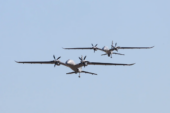
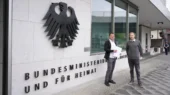
Two Israeli drones of the Heron 1 type were also the first that Frontex deployed in Europe for migration deterrence following various tests since 2021. The EU border agency signed a framework contract for this purpose with the Bremen-based military division of Airbus. For that reason, the Berlin office of the European corporation was also – after the Federal Ministry of the Interior – the first stop on a public cycling tour by the Abolish Frontex network visiting EU border profiteers in Berlin, which has already been conducted twice.
Airbus flies, maintains and repairs the drones for Frontex. The company also sells satellite imagery to support border surveillance in the Mediterranean, among other areas. In addition, Airbus has developed a laser communications technology using a constellation of satellites, referred to as a “space data highway”. The technology, which costs hundreds of millions of euros, enables fast and secure data transmission over long distances, including from drones. According to Airbus, Frontex was the system’s first customer.
The Berlin company Germandrones, which also offers its fixed-wing drones to the military and civilian authorities – or for route inspection for the railways – has likewise delivered them to the border police of the Republic of Moldova. The contract was brokered under the lead of the German Foreign Office, with the costs of around €1 million covered by the German government. The drones are equipped with a high-resolution optical and a thermal imaging camera developed specifically for surveillance and security tasks.
Germany’s leading provider of sensor solutions for the security and defence sector is considered to be Hensoldt, formerly part of Airbus, which maintains a capital city office in Berlin-Mitte. The company – then still operating as EADS – supplied, for instance, high-resolution cameras that were donated to Tunisia by the German Ministry of Defence for military border surveillance.
Hensoldt also participates in significant EU-funded research projects aimed at improving border surveillance. The same applies to the German Aerospace Centre (DLR), which is based in Oberpfaffenhofen but also has sites in Berlin-Adlershof and at the Gendarmenmarkt. The DLR was involved in the development of the EU border surveillance system Eurosur, which has been operated by Frontex in Warsaw since 2014.
Aircraft, drones, satellites and other sensors generate an unmanageable volume of data that can only be processed with the help of automated systems – and artificial intelligence. This too is being developed and tested in EU research projects. One such initiative operated under the name “Roborder”. The acronym stands for “autonomous swarm of heterogeneous robots for border surveillance.” As part of it, drones were tested on land, in the air, on water and underwater. The data streams were consolidated in a “multipurpose mission support vehicle” manufactured as “Muros” by the German subsidiary of the Italian company Elettronica – which has since become part of the Italian ELT Group.
The company has retained its capital city headquarters at the Gendarmenmarkt following the restructuring, though production continues in Meckenheim near Bonn. “Muros” is also offered with different interior equipment for police use or – as a covert vehicle – for intelligence services. In Germany, the vehicle is best known from demonstrations: the Federal Ministry of the Interior equipped all state police forces with it in the 2010s as an “evidence-gathering and documentation vehicle.”
Published in German in „nd“.
Image: The Berlin company Germandrones has also delivered its drones for border surveillance to the Republic of Moldova – the costs were covered by the Foreign Office (Ion Strungaru/ Border Police of the Republic of Moldova).
Leave a Reply