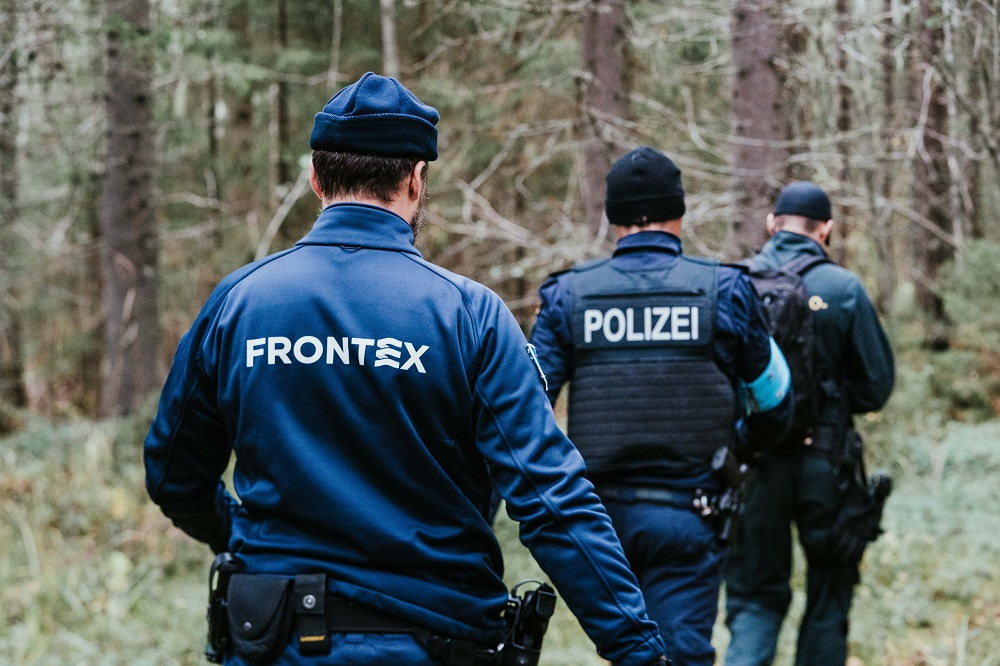
Finland held an exercise last week on the pushback of migrants at three closed border crossings with Russia – with the participation of Frontex, a paramilitary gendarmerie force and border guards from Estonia.
Finnish border troops held an exercise last week at three closed border crossings with Russia, in which the European Gendarmerie Force (EUROGENDFOR) was involved for the first time. The aim was to test a border protection law passed by parliament last summer under realistic conditions. Frontex also participated in the four-day exercise in Finland with its armed and uniformed “Standing Corps” – alongside Estonian officers, according to media reports. A spokesperson confirmed this to nd.
The Finnish border protection law empowers officers to turn back persons wishing to apply for asylum, provided they do not meet certain conditions. The authorities are also permitted to use force – though only after the government has previously declared a state of emergency. Finland has not yet made use of this provision.
The law, which must be renewed annually, applies to the entire 1,340-kilometre land border with Russia. Finland enacted it following discussions about the alleged “instrumentalisation” of migrants by the government in Moscow. EU member states and the Commission spoke of the “weaponisation” of migration and sought to pass an “Instrumentalisation Regulation”, which, however, failed in December 2022 in the Council of Justice and Home Affairs Ministers. Substantial parts of it were later adopted within the framework of the new Pact on Migration and Asylum (CEAS).
Frontex in Finland since 2023
In the exercise, the EU border agency provided “mobile surveillance” and carried out weapons and document checks, as well as providing “security cover” for Finnish medical units and escorting transports to refugee reception facilities.
In autumn 2023, EU member states dispatched Frontex on a permanent mission to Finland after the number of migrants entering via Russia had risen sharply and Helsinki’s NATO accession led to tensions with Moscow. To this end, the EU border agency deployed, by its own account, 50 border officers and additional personnel as well as equipment such as patrol vehicles. Currently, however, significantly fewer Frontex personnel are deployed in Finland as part of this “Terra” mission. The German Federal Police is involved with five “support officers.”
“It is alarming that Frontex in Finland is quite openly practising scenarios in which people seeking protection are to be systematically pushed back,” says Marcel Emmerich, interior policy spokesman for the Greens’ parliamentary group in the Bundestag. Such pushbacks are incompatible with EU law. Neither EU member states nor Frontex may participate in them – even if migration is being “instrumentalised and deployed as hybrid warfare” by Russia, Emmerich said.
EUROGENDFOR units militarily trained
The paramilitary EUROGENDFOR is designed for “robust” policing crisis operations both within and outside Europe. It is not an EU institution, but was founded in 2006 by France, Italy, Spain, Portugal, the Netherlands, and Romania as an association of European states with gendarmerie forces – that is, forces with military status. The units are militarily trained and paid, but carry out police duties domestically.
Finland has been an associated partner since this year. Membership was decided unanimously in December at a summit in Cascais, Portugal; prior to this, an international evaluation team had assessed the Finnish Border Guard, the Rajavartiolaitos, in autumn and found it suitable with “excellent results.” Other full members are Portugal, Poland, Romania, and Lithuania. Turkey, Moldova, Ukraine, and – since this year – Bulgaria hold observer status.
As a partner, Finland gains the right, even without full membership, to request contingents from EUROGENDFOR, to participate in joint exercises, and to exchange intelligence with the force. In the event of a crisis, Helsinki would have access to an additional rapid reaction force of around 800 personnel, which could be scaled up to 2,300 within 30 days.
Frontex denies direct cooperation
EUROGENDFOR is currently involved in EU missions such as in Kosovo and in Gaza at the Rafah border crossing. The force agreed on deeper cooperation with Frontex as far back as 2018, though this has had little practical effect to date. Frontex denies having worked directly with EUROGENDFOR or other gendarmerie units during the pushback exercise.
The fact that Finland is militarising its border protection with EUROGENDFOR is likely also attributable to its NATO accession in April 2023, which is explained by a changed threat environment posed by Russia. “The deployment of gendarmerie forces could, for example, cover a scenario of a difficult border situation and a military threat on the eastern border,” Major Antti Virta, deputy commander of the south-east Finnish Border Guard, is quoted as saying by Finnish media.
“The EU has long since ceased to regard refugees as people in need of protection, and instead treats them as threats to be combated by military means if necessary,” says Clara Bünger, the Left Party’s spokeswoman on refugee policy in the Bundestag, commenting on the participation of the paramilitary EUROGENDFOR in the exercise on the Finnish-Russian border. “The accompanying dehumanisation of people seeking protection is deeply troubling.”
Fence is intended to give the border guard more reaction time
In the military sphere, similar manoeuvres have already taken place: last summer, units from nine NATO countries conducted the country’s largest special forces exercise to date on Finnish soil. This month, 25,000 soldiers from 14 countries rehearsed the defence scenario at the border with Russia in the “Cold Response” exercise in Norway and Finland.
Finland also intends to have completed the construction of border fences along its eastern border by the end of the year. These do not prevent people from crossing the border, but give the authorities more reaction time, the head of the Border Guard explains.
The fence sections are equipped with cameras and further sensors, which are continuously monitored with the assistance of artificial intelligence. The system automatically raises the alarm when unusual activity is detected. Pattern recognition is also employed. “But the fence also uses a great deal of other technology,” Virta explains.
Unmanned boats for surveillance
For the coming year, Finland intends to expand the fence with AI-assisted systems for locating and analysing mobile phone signals and communications. Systems for identifying persons who approach the border without authorisation will also be installed. Frontex has already tested such a platform at various EU external borders.
For the expansion of its surveillance capacities, Finland is receiving additional funds from Brussels: the Interior Ministry in Helsinki announced last week that the EU is providing €17 million for this purpose. With the money, Finland’s Border Guard intends to deploy unmanned boats for surveillance in the Gulf of Finland – making it the first country to deploy them for migration defence in the EU.
Published in German in „nd“.
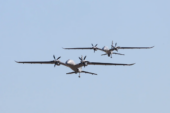
Image: Germany is also sending personnel to the Frontex “Terra” mission in Finland. This personnel was not involved in the pushback exercise. (Frontex/X)
Leave a Reply