The arms manufacturer IAI is planning production facilities in Berlin – and rival Elbit Systems is also pushing into the German market, having signed a similar partnership with Diehl Defence for kamikaze drones.
Israel Aerospace Industries (IAI) is Israel’s largest aerospace company and is state-owned. Its key products include drones, combat aircraft, missiles, space-based systems and associated sensors. IAI is now also placing increasing emphasis on artificial intelligence.
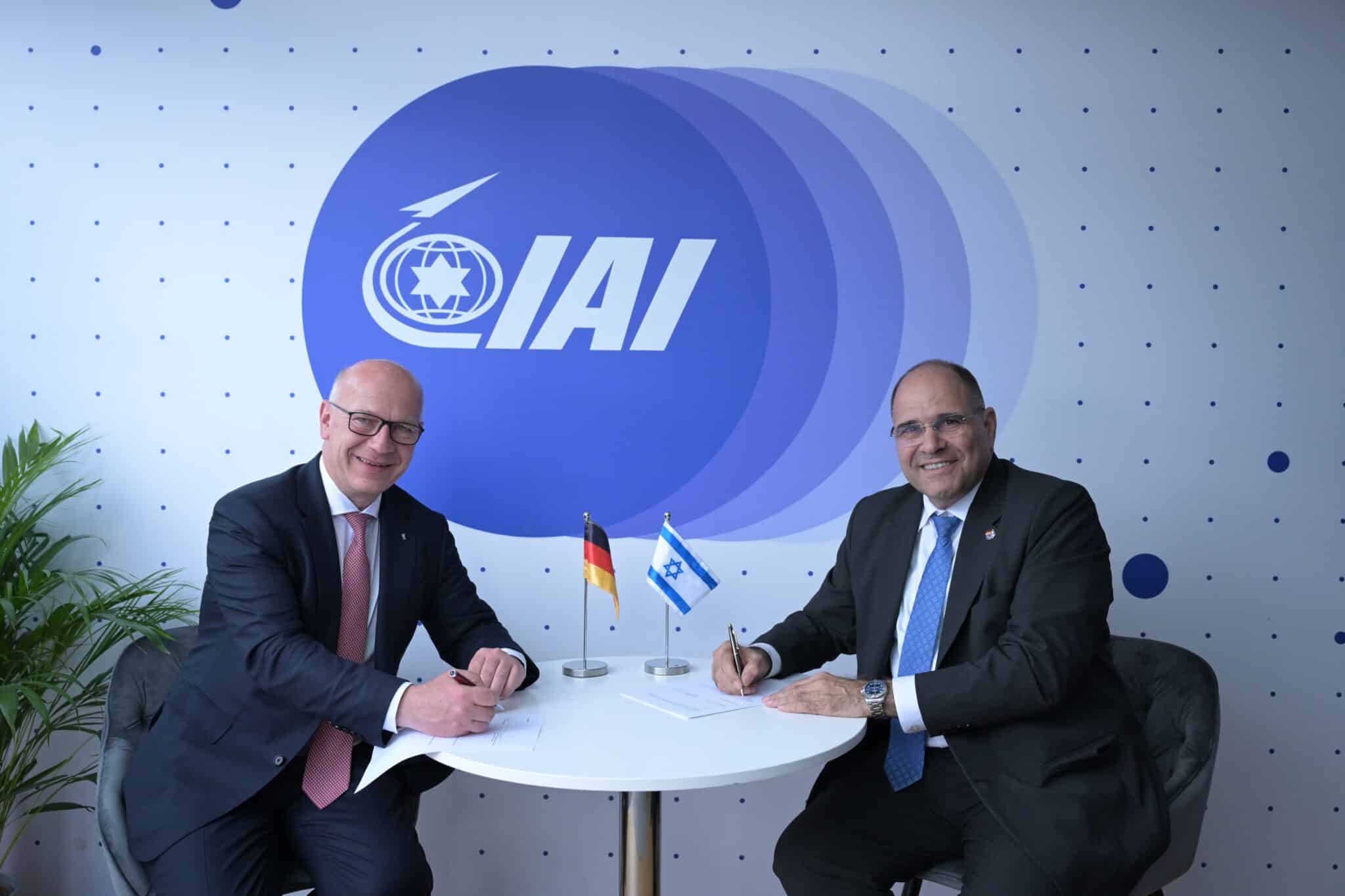
IAI is now pushing even harder into the German market: on the sidelines of the International Aerospace Exhibition (ILA), the arms company signed a strategic letter of intent with the state of Berlin to establish a new “innovation centre” for defence, aerospace and aviation. The agreement explicitly goes beyond research. Local production is also planned as part of IAI’s expanded industrial presence, according to a press release.
Supplier to the Bundeswehr for years
The agreement was signed at an official meeting between Governing Mayor Kai Wegner (Christian Democratic Party) and IAI chief executive Boaz Levy. According to the Berlin Senate, further “representatives from politics and business” also attended.
IAI has been supplying the Bundeswehr for years. In 2019, following a decade-long “drone debate”, the defence ministry awarded a contract for initially five Heron TP combat drones, which are currently being stationed in Schleswig-Holstein. The contract has since been extended to cover three additional drones. With its large drones – also deployed in the Gaza war – IAI is one of the Bundeswehr’s central suppliers in the field of unmanned systems.
IAI is also the prime contractor for Germany’s Arrow 3 missile defence system. Parts of the system have already been installed in Saxony-Anhalt and Brandenburg and are described as having reached “initial operational capability”. The German Navy has additionally ordered BlueWhale autonomous submarines from IAI.
Berlin as a location for military technology
The planned “IAI Berlin Aerospace & Defence Innovation Centre” is to be established at the Berlin-Adlershof technology park. There, start-ups, research institutions and companies from the fields of aerospace, cybersecurity and autonomous systems are to collaborate more closely. Alongside the former Tegel airport, Adlershof is considered one of Berlin’s most important science and innovation hubs.
The agreement represents a further step by the Senate in developing Berlin as a location for military technology. According to a Senate resolution from December, the capital intends to actively recruit companies from the security and defence sector. Wegner described this as a “defence-tech ecosystem”. It is being led by Berlin Partner, the city’s economic development agency, and the Senate Department for Economic Affairs. A dedicated staff unit has been set up within the Senate Chancellery.
Competition with greater Munich and Bremen
Berlin is thus entering into competition with established centres such as greater Munich and Bremen, both of which are regarded as hubs for military aerospace. In Berlin, the focus appears to be particularly on companies that have so far developed civilian technologies: Wegner announced his intention to work with IAI to support start-ups in the field of “dual-use technologies”.
The Governing Mayor stated that the aim was to “build new industrial capacities and create skilled jobs”. The agreement with IAI would bring “world-class expertise in aerospace and defence into our ecosystem”.
Wegner pointed to similar “international accelerator programmes” in the United States, India and Israel, which give start-ups and pilot projects “access to the global market”.
Protests against the expansion of arms production
The further militarisation of Berlin through strategic cooperation with Israel’s largest arms company, and the choice of Adlershof as a location, is unlikely to proceed without resistance. Protests and actions against the expansion of arms production in Berlin occur regularly – for example against the conversion of Rheinmetall’s Pierburg plant in Wedding to arms manufacturing. Last autumn, an arson attack targeted the infrastructure at and around the Adlershof site, which, according to current findings, was aimed at facilities connected to the security and defence industry based there.
Like IAI, Elbit Systems – IAI’s biggest rival in the manufacture of large armed drones – is pushing into the German market. A production facility for military technology already exists in Ulm. To expand the cooperation, Elbit appointed former defence committee chair and Free Democratic Party member of the Bundestag Marcus Faber as “Head of Political Affairs” last winter. With success: at the ILA in Berlin, Elbit Systems signed a partnership with German arms company Diehl Defence for particularly lethal kamikaze drones. This agreement also includes production in Germany – though where exactly remains unclear.
Published in German in „nd“.
Image: Kai Wegner and IAI chief executive Boaz Levy at the signing of the agreement on the sidelines of the ILA (IAI).


Leave a Reply