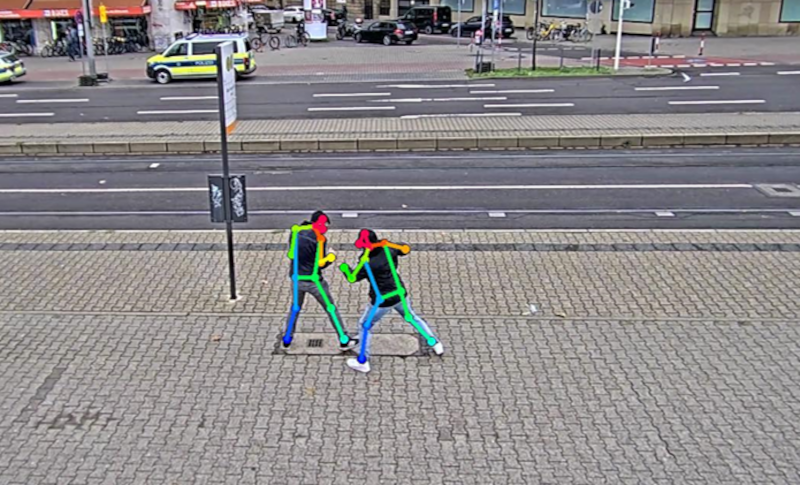
Berlin’s police plan to use AI cameras to detect “suspicious” behaviour. The Hamburg Loki research project examined what such algorithmic surveillance really means in practice – for privacy, marginalised groups and public space.
The Hamburg police say the AI cameras at Hansaplatz are not there for surveillance, but to detect dangerous situations. Would you agree with that framing?
Such phrasing is meant to avoid the negative connotations of the term “surveillance”. The police in Mannheim also speak of “video protection”. I understand surveillance as the observation of people or environments under asymmetric conditions of visibility. With conventional video surveillance, we can see the camera, but not whether officers are watching us on the monitor at that moment – this is meant to have a disciplining effect. With algorithmic surveillance, this shifts: the symbolic aspect of self-discipline recedes, but the asymmetry remains, because I cannot observe how the algorithm is functioning.
The aim of the AI cameras is to continuously capture everyone within the monitored area and analyse their behaviour – this massively increases the scope of data capture and evaluation compared with human or conventional surveillance. In my view, this applies to all algorithmic surveillance technologies, whether visual, text-based or otherwise. It is a new economy of control.
Could you briefly describe the technology? When people think of AI cameras, many think of facial recognition – but that is not what the police in Hamburg and Mannheim, and soon Berlin, are doing.
What is detected are specific movements predefined by the police and developers: lying down, falling, staggering, kicking, hitting – movements associated with criminal offences. The technology converts video data into so-called “skeletons”, i.e. vectors, analyses these for movement patterns and generates an alert to the police.
If the footage is anonymous, is this surveillance at all?
Surveillance does not just mean identification. Recognising behavioural patterns is also a purpose of surveillance. Anonymity would mean that re-identification is impossible. But the skeletons are linked to the people in the square. Officers then see any alerts in the form of normal video sequences. The videos are currently still stored for certain periods and for criminal prosecution.
This pattern recognition in video data was already tested back in 2017 at Berlin’s Südkreuz station. What is new about doing this with AI?
What’s new is how the procedure is justified: as supposedly particularly data-protection-sensitive, which legitimises a kind of “good surveillance”. This enables a new political constellation: data protection officers and the Greens gave the green light, and in Hamburg – and now also Berlin, Saxony and Baden-Württemberg – police legislation was amended so that the police are allowed to collect data for AI training and pass it on to external developers. With these laws, the police become a kind of gatekeeper for AI development in the security sector.
If you enter a square under video surveillance, are you informed that the data could be passed on to private parties?
You are informed via a sign with a QR code that the square is under AI video surveillance. But, as far as we know, you are not informed whether specific video sequences featuring you personally are extracted and passed on for AI training.
One criticism of the Südkreuz project was the large number of false alarms. What is known about Hansaplatz?
Exact figures have not been published, not even in response to our enquiry. However, through “Frag den Staat” (a German freedom-of-information platform), the Hamburg police’s evaluation report on the three-month test in 2023 came to light: there was roughly one alert per hour. Eleven of twelve situations assessed as police-relevant were detected, only one of which had criminal consequences. If you extrapolate the alerts across the three months, you get more than 1,000 alarms. One per cent of situations were “police-relevant”, 0.1 per cent “relevant to criminal proceedings”.
Your project also asked what the technology does to people in public space. What is the most important finding?
By “public” we mainly mean the political debate, less the effects on the behaviour of people on the ground – there, we only conducted a few, short interviews and found very heterogeneous positions. Some, including marginalised people, support the technology. Others no longer speak to white people at Hansaplatz, out of fear of being mistaken for dealers and checked by police. Others experience the square as a testing ground for police measures and, for example, don’t understand why four officers suddenly turn up instead of two.
But there are also clear supporters: in an NDR interview, someone said that drug users or homeless people are repeatedly found near a nursery, and that AI promises to drive these people away by detecting them lying down.
To what extent is gentrification a driver of AI-supported camera surveillance?
Hansaplatz has been caught between deprivation and gentrification for decades: increasingly upmarket restaurants on the one hand, and a meeting point for homeless people, drug users, drinkers and other marginalised groups on the other – and this naturally creates conflicts over the use of space. Shopkeepers and restaurant operators tended to be more in favour of the technology, though without any statistically robust basis. What was central to the police’s choice of location was primarily the existing infrastructure: good camera coverage and legal permission to test there, which would not have been possible elsewhere.
Hamburg’s data protection commissioner was also involved in the AI surveillance. What criticism did they raise?
That was rather formal in nature: it concerned the lack of a legal basis for passing on the data, which has since been created for the second phase. Our impression is that the data protection commissioners in Baden-Württemberg and Hamburg base their assessments on future promises made by the police and developers: the assumption that at some point no humans will be sitting in front of screens any more, and that alerts will only be triggered when there is a detection, which would then amount to data-protection-sensitive surveillance.
But these promises are vague. Even within the police, this is not seen as realistic. Many data victims are needed along the way there: in Mannheim, 2,000 videos have already been created for training purposes, with 10,000 planned.
The EU has passed an AI Act that places high-risk applications under strict conditions. Does this also apply to police software like the one in Hamburg?
I’m not a lawyer, but the police and developers argue that it is not high-risk software, because no identification takes place. The Chaos Computer Club sees it differently.
Why?
Because the technology is nonetheless biometric and potentially usable for identification or tracking.
Who developed the technology, and what is known about how it works?
In Hamburg, as in Mannheim, a Fraunhofer Institute is developing the AI. The police are closely involved, in that they extract data and pass it on to train the algorithms. Berlin uses technology from a private company.
Are you aware of other cities interested in this technology?
Baden-Württemberg wants to roll out the so-called “Mannheim approach” to algorithmic video surveillance state-wide. At Frankfurt’s main railway station, motion detection is to be tested alongside facial recognition. Saxony has already amended its police law to enable behaviour recognition, as well as the training of such systems.
Admittedly, this is a reformist question: what would a responsible approach by the police to this technology look like?
There has been hardly any serious engagement with the consequences of the technology; instead, it has been assessed on the basis of its promises. Acceptance during the trial phase was measured primarily by media coverage – coverage largely shaped by the police themselves. Our discourse analysis shows that the police and interior ministry dominate the debate, with critical voices barely heard. What’s needed is a serious ethical and social-scientific assessment that genuinely incorporates critical positions, rather than merely paying lip service to them. One should not assume the technology is the solution before the problem has even been analysed. At Hansaplatz, the police are almost permanently present anyway, so real security gains are questionable.
Your project also looked at options for action available to local initiatives. What are these?
One piece of advice is to ask: what is the technology doing now, not in the future? Does it really solve the problems on the ground? This seemingly naive question is crucial, because the justification for surveillance constantly shifts between present and future. The algorithms are potentially becoming ever more powerful, and can be modified or combined with other methods. It is therefore worth checking whether the promises are already being kept today.
What is the answer for Hansaplatz to these questions?
Our impression is that the square is monitored with AI mainly because it offers an opportunity to test and further develop the technology, and because a relevant incident occasionally occurs there. The promise of “more security” fades into the background. For the Hamburg police, Hansaplatz is a testing ground. Rising crime is not the pressing problem behind the use of AI.
In your guidance materials, you also address urban and climate-ecological effects. What are these in relation to AI cameras?
In general, AI training consumes a great deal of electricity and water. But video surveillance also requires as clear a field of view as possible. The police are constantly trying to optimise this by seeking camera positions without visual obstructions. Trees, benches or shade-providing structures are quickly seen as obstacles. This can come into conflict with heat adaptation and greening measures.
One of your tips for local initiatives is to submit enquiries to the police and authorities about the technology. Are they actually obliged to respond?
In Hamburg, it was above all the work of the parliamentary opposition and civil society initiatives that brought information to light: the government is obliged to answer parliamentary enquiries. A request via “Frag den Staat” also brought the evaluation report to light. When it comes to error rates, however, the police remain tight-lipped. We also recommend our assessment matrix as a way of making such obstacles visible.
What would you advise Berlin initiatives, for example around Kottbusser Tor, who are critically engaging with the planned AI surveillance?
One lesson from Hamburg is that it’s a marathon, not a sprint. You need to look at who you can cooperate with. The parliamentary discourse in Berlin has recently seemed somewhat more open than in Hamburg. AI tools can also give rise to new forms of resistance – in Mannheim, there were dance performances that showed how the movement patterns detected bear no relation whatsoever to criminal offences. This calls into question the basic assumption underlying motion detection.
Published in German in „nd“.
Philipp Knopp is a research associate at Chemnitz University of Technology. In the LoKI research project, he investigated the local conflicts surrounding the trial of AI surveillance in Hamburg in 2023, together with a team from the University of Hamburg.
Image: Screenshot from a video by the Fraunhofer Institute on AI cameras in Mannheim. Those filmed are “skeletonised” for movement analysis (Fraunhofer IOSB).




Leave a Reply