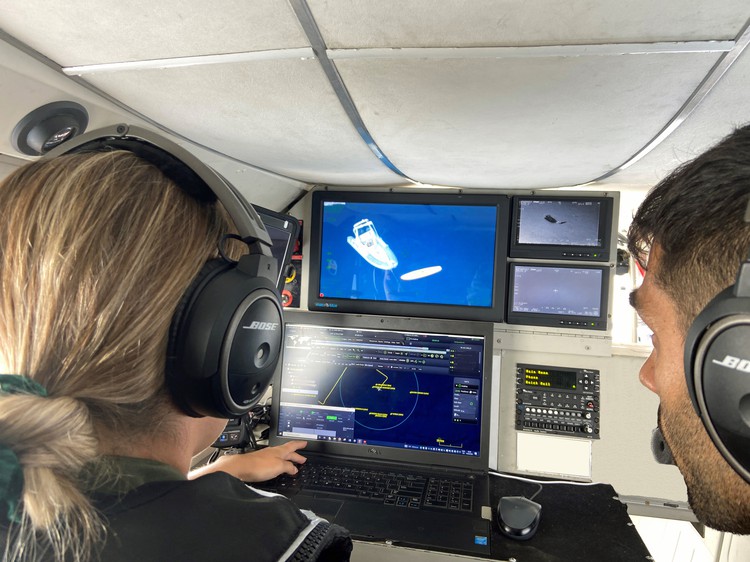
Flight tracking has revealed that Metrea, a firm tied to the US military and secret services, flies surveillance missions for Frontex under a €14.5 million contract. This is prompting criticism over transparency and the militarisation of EU borders.
Metrea, a US company known for its cooperation with the military and secret services, is operating at least one aircraft for the European Union’s migration deterrence efforts in the western Mediterranean. This came to light through the tracking of conspicuous flight patterns resembling those of coastguards or the EU border agency Frontex. The twin-engined Beechcraft King Air 200 usually takes off from Alicante in Spain and monitors the route from Algeria towards the Balearic Islands. However, missions have also taken place between Crete and Libya. “Frontex is aware of and has authorised,” the border agency told “nd”.
Metrea did not receive the contract directly from Frontex. The aircraft is being deployed under a framework contract concluded in 2023 for “aerial surveillance services” in the Mediterranean region, the agency explained. One of the main contractors for this contract, worth a total of €14.5 million, is the Luxembourg-based firm CAE-Aviation, which in turn engages subcontractors – including Metrea.
“Aerial surveillance service” since 2017
This is the first time it has become known that a company from a non-EU state is searching for boats carrying migrants in the Mediterranean on behalf of Frontex. For its “aerial surveillance service”, launched in 2017, the agency had previously contracted, among others, the British firm DEA, and more recently also European SAO from Malta.
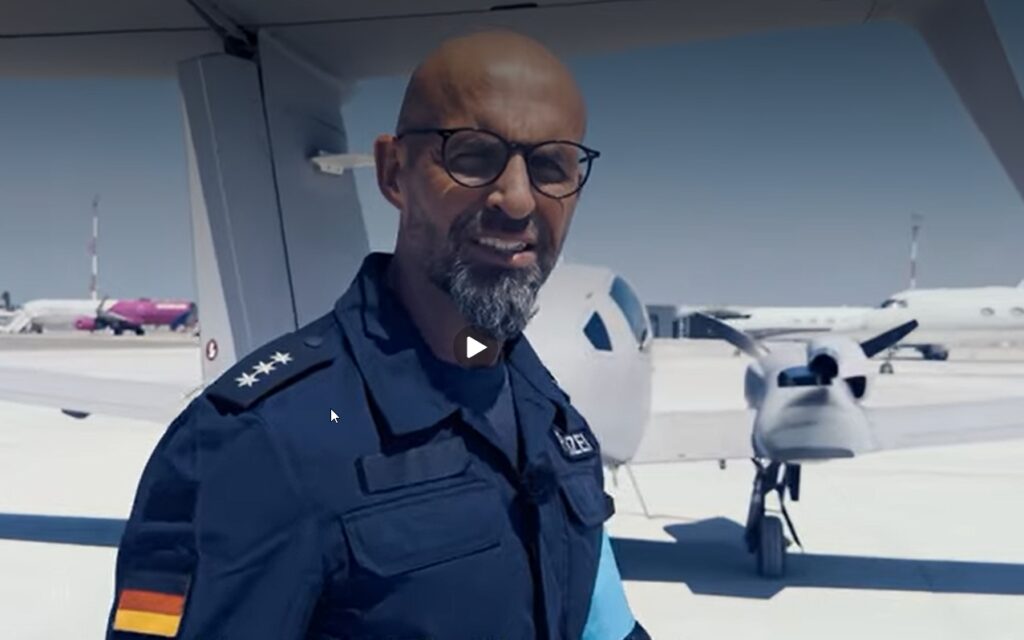
Two additional large Israeli military drones are flown for Frontex by Airbus’s defence division in Bremen. In total, Frontex has concluded framework contracts worth at least €300 million for its aerial surveillance since 2018. The aircraft deployed for Frontex in the Mediterranean are stationed in Italy, while the drones are based in Malta and on Crete.
Firm for “special flight operations”
Metrea is a security and defence service provider that works closely with the military in the US and other countries. Its activities include surveillance and reconnaissance, so-called electronic warfare to jam enemy radio systems, and “special flight operations”. Metrea is also known among insiders for operating military air tankers: according to the company, there are otherwise no commercial operators of these “Stratotankers”, which are also used by the German air force.
For Frontex, Metrea flies a spacious business and multi-purpose aircraft. The company’s website lists numerous similar contracts with other Nato partners, though not the one with the EU border agency. The firm has offices in the US, the UK and Sweden.
Criticism of Frontex service
“The EU is continuing to drive forward the militarisation of its external borders,” said MEP Özlem Demirel on the deployment of the US military firm in the Mediterranean. Migration deterrence is providing the defence industry in Europe, and now also in the US, with “handsome returns and business opportunities”, said the Left politician. “Instead of fighting refugees with ever more technology, the causes of flight and displacement should finally be tackled,” Green MEP Erik Marquardt told “nd”.
Frontex’s flight service is also regularly criticised by the Frontex Fundamental Rights Officer. This is because the border agency does not only pass on information about wooden or inflatable boats carrying migrants to the host states where the aircraft and drones are stationed. When refugee boats are unseaworthy – which is the case simply due to the overcrowding of occupants – companies such as Metrea also inform the rescue coordination centres of the neighbouring states in North Africa.
Most refugees on the Mediterranean route depart from Libya. Until 2018, the country had no corresponding coordination centre and no functioning coastguard either – one was set up in Tripoli with EU funds, in parallel with the build-up of Frontex’s aerial surveillance. The Frontex Fundamental Rights Officer regards the fact that this so-called Libyan coastguard brings refugees back on their way to Italy or Malta, acting on behalf of the EU, as a possible unlawful pushback: in camps run by Libyan militias, people are demonstrably at risk of mistreatment, torture and death.
Conspicuous flight movements led to discovery
Frontex has no problem with a US military service provider now working for the EU: “The registration of the aircraft in the United States does not change the contractual basis, which remains the aforementioned EU framework contract,” the agency said in response to enquiries. The Metrea aircraft is therefore also permitted to use Frontex’s usual “Eagle” call signs, the border agency confirmed. These are not permanently assigned but agreed “in coordination with the contractor” on a flight-by-flight basis.
The deployment of the Metrea aircraft in the Mediterranean was discovered by London-based researcher Sasha Milonova. It carries the call sign “Eagle 5”. However, every aircraft is also fitted with a hex code registered with the International Civil Aviation Organization (ICAO). In the case of “Eagle 5”, this pointed to Metrea’s Beechcraft, a 13-metre-long aircraft with seating for up to a dozen people.
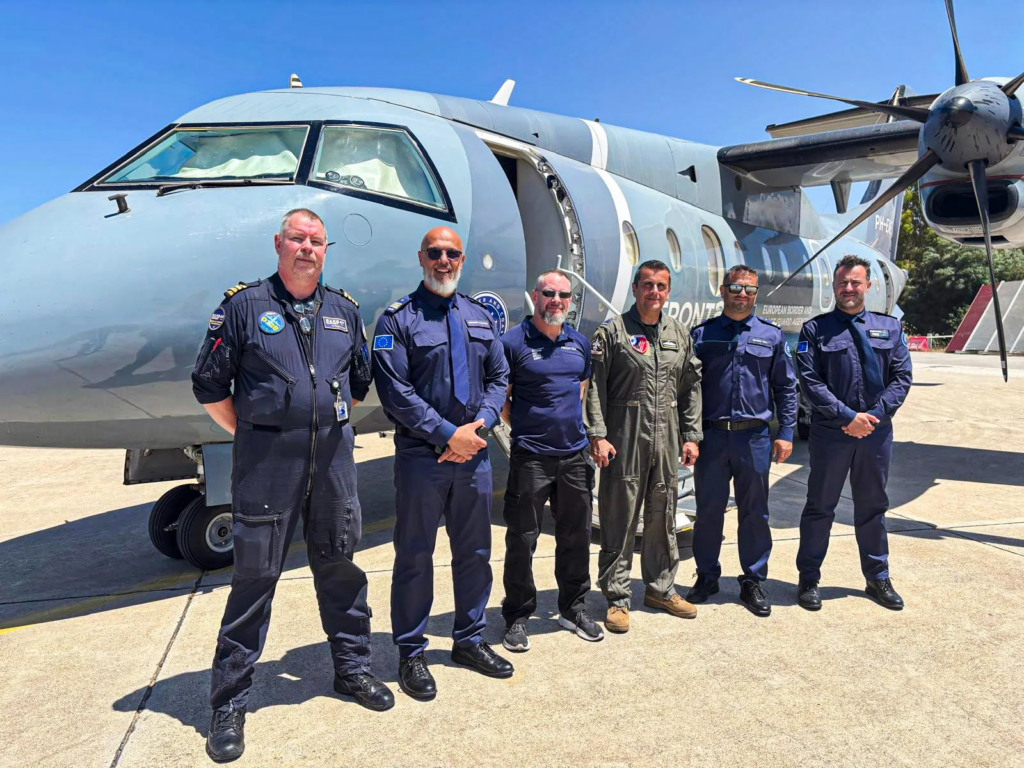
At the Centre for Research Architecture at Goldsmiths, University of London, Milonova is tracking further aircraft operating on behalf of Frontex and national coastguards. States such as Libya, meanwhile, do not operate any such aerial surveillance of their sea borders – which is why Frontex assists them with patrols off the coast.
Further militarisation of migration deterrence
“Since its founding, Frontex has been surrounded by military technology start-ups. They have significantly shaped the agency’s technical capabilities and operational decisions,” said researcher Milonova. The fact that American defence companies are now also part of this network is extremely concerning, she said. However, the Metrea contract is just one example of the increasing militarisation of European migration deterrence.
Following a change to its mandate, the EU military operation Irini is once again playing a stronger role in pursuing “people smugglers” in the Mediterranean – though it is mostly the people on the boats who are affected by this task. The German Bundeswehr also takes part in Irini, which concluded a working arrangement with Frontex in 2021.
Although this does not fall within Frontex’s mandate but rather within the remit of national militaries, the EU agency held a “challenge” on counter-drone defence with various companies last year. Metrea also took part and, according to the company, reached the final. However, other participants won the Frontex competition.
Criticism of a lack of transparency
The European Commission is currently preparing a draft for a new Frontex regulation; whether counter-drone defence will be included in it is disputed among member states. The Metrea example nevertheless shows how Frontex, ostensibly a civilian border police force, is driving forward the arming of sea and land borders through questionable means – and that this only comes to light through investigative research. Green MEP Marquardt therefore also criticises Frontex for its lack of transparency: “It seems they don’t want this brutal fight against refugees to be discussed publicly.”
This is also how the civilian rescue organisation Sea-Watch sees it: “The fact that such a deployment only becomes known through flight data analysis once again demonstrates how opaquely Frontex operates. The fact that a US military service provider is apparently behind one of the Frontex aircraft is ultimately just another piece of a larger puzzle: Frontex is acting as an extension of an EU policy that prefers to invest in deterrence rather than rescue.”
Published in German in „nd“.
Image: Footage from an aircraft monitoring the EU’s sea borders on behalf of Frontex (Frontex).

Leave a Reply