Finland is set to become the first EU country to deploy autonomous surface vehicles on its external border. The project is funded by Frontex resources but is aimed at Russia’s shadow fleet.
Finland intends to become the first EU member state to deploy a drone boat for the autonomous surveillance of its external border. The scheme is part of the European Union-funded project “Stronger Coast Guard Responses” and is to be trialled in the Gulf of Finland on the maritime border with Russia. In addition to the Finnish Border Guard, the EU border agency Frontex is also involved.
The project is financed through the Border Management and Visa Instrument, an EU funding programme. The funds are explicitly justified by the need to strengthen Frontex’s operational capabilities.

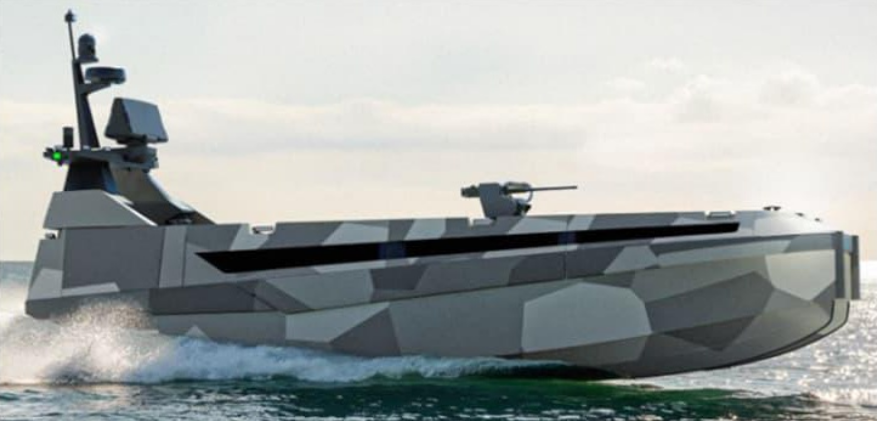
The Finnish Border Guard presented details in a presentation at a Frontex workshop on “Advancing EU Maritime Drone Capabilities” in Warsaw. I obtained the presentation through a freedom of information request. The military style drone boat shown in the presentation it is fitted with an onboard cannon.
Project targets Russian shadow fleet
Officially, the project is aimed at the so-called Russian shadow fleet. This refers to ships that frequently operate under changing flags and, in the assessment of Western governments, help to circumvent sanctions against Russia. In future, the Finnish authorities intend to monitor the movements of such ships using new unmanned systems.
The project documents justify the need by citing the security situation in the northern Baltic Sea region and in the Gulf of Finland. The authorities name further challenges including interference with satellite-based navigation systems, which is likewise blamed on Russia and is said to have already led to near-collisions in the Gulf of Finland. In addition, ships have repeatedly been travelling with faulty or missing AIS data.
Surveillance of offshore wind farms
At the heart of the project is an unmanned watercraft with a “robust capability to produce regional surveillance data”. According to this, the drone boat is to be used for tracking ships, compiling situational pictures, mapping operational areas, and for search and rescue missions. The Finnish Border Guard also counts the protection of critical infrastructure at sea, such as offshore wind farms, among its tasks.
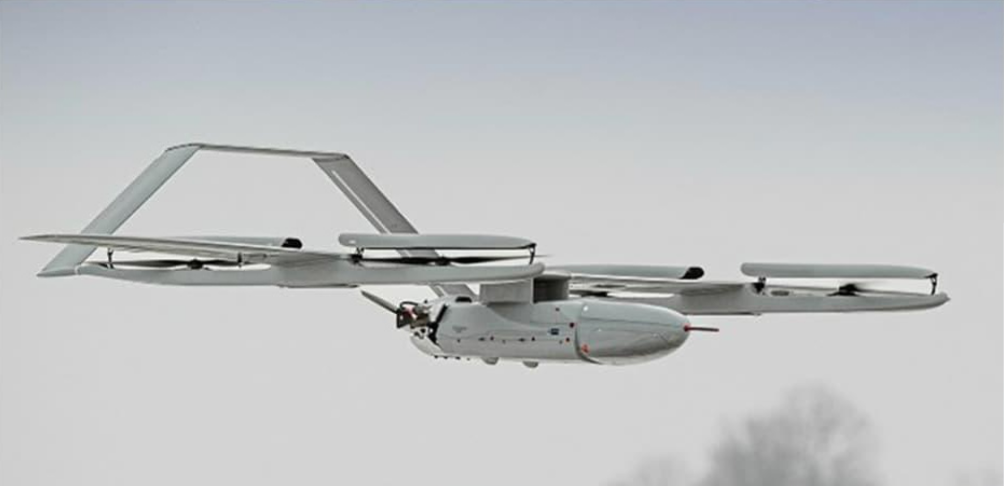
The boat is intended to reach speeds of more than 25 knots and, depending on the mission profile, to operate autonomously for between eight and 38 hours. Its range is given as around 200 nautical miles. The system will be equipped with radar, optical and thermal imaging cameras, as well as satellite-based navigation. The drone boat is to be accompanied by larger flying drones, which can also patrol over land. In another presentation held by the Italian Guardia Finanza at Frontex’ conference, this kind of drones are also equipped with IMSI catchers to locate or intercept mobile phones.
The project is still in the development and procurement phase; according to the presentation, the new capabilities being sought are “hopefully” expected to be available to Frontex by the end of 2027.
Frontex presence in Finland
Frontex has been intensifying its cooperation with authorities in Finland for years. As early as autumn 2023, Frontex deployed a small permanent mission to the Russian border, after the number of asylum-seeking migrants there had risen sharply.
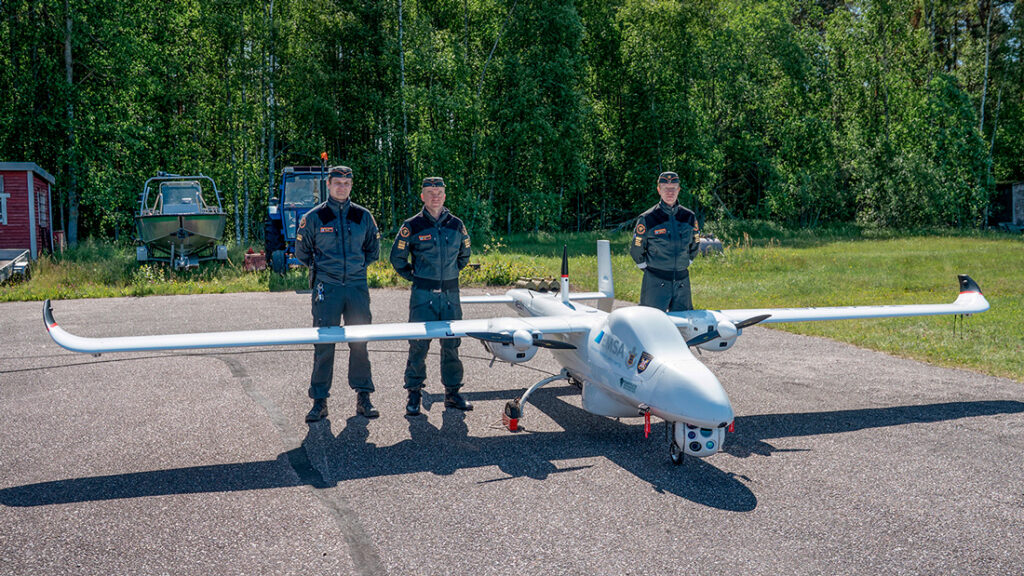
Last summer, the European Maritime Safety Agency (EMSA) also took part with a larger drone in a joint maritime operation to monitor the Finnish-Russian sea borders. Frontex supported the mission with an aircraft. EMSA also provides information to the Finnish Border Guard through the EU’s CISE information exchange environment.
The EU border agency is also involved in exercises run by the Finnish authorities. In March, Frontex took part, together with the European Gendarmerie Force Eurogendfor, in a four-day exercise in Finland. The scenario assumed a migration situation deliberately triggered by Russia, with simulated operations carried out at various locations along the 1,340-kilometre land border. Germany’s Federal Police also took part, with five officers.
New border fence with artificial intelligence
The occasion for the exercise was the testing of Finland’s new Border Guard Act, which parliament had passed last summer. It allows for the temporary suspension of the acceptance of applications for asylum or international protection. This is conditional on a determination that the threatening “migration situation” was deliberately brought about by Russia.
In response to a parliamentary question from left-wing MEP Özlem Demirel, Frontex later stated that the exercise had involved a “fictitional migration crisis scenario”. The agency said it had supported the Finnish authorities with “operational, logistical, and technical assistance”. Frontex personnel deployed had, among other things, taken on “tasks including mobile surveillance”. Finnish units had also been supported in searching for weapons, in passport and document checks, and in “information gathering”.
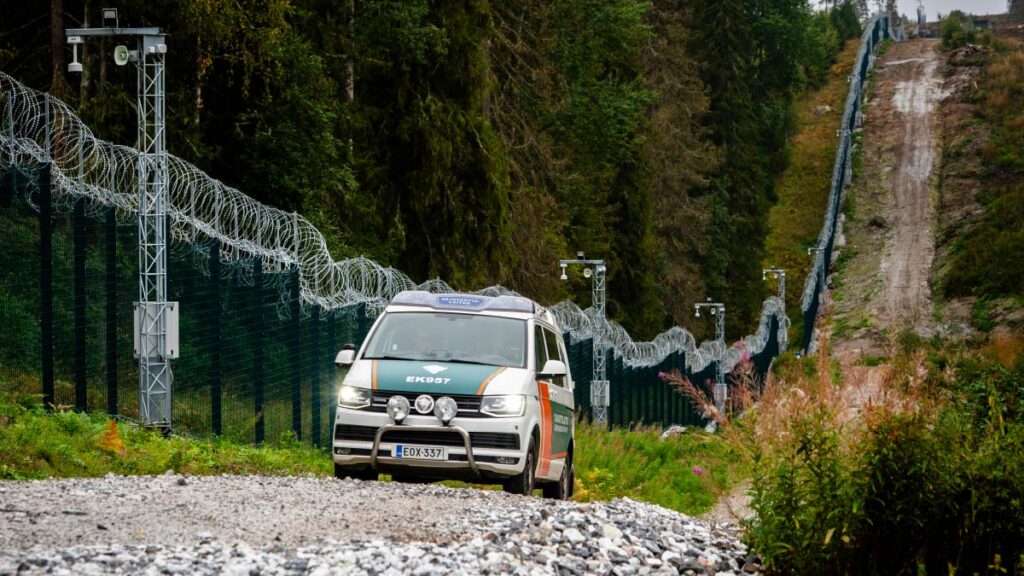
Finland is continuing to expand its border installations against Russia. New fences along the eastern border are due to be completed by the end of this year. They will be fitted with cameras and further sensors. For the coming year, the government also plans AI-supported systems for locating and analysing mobile signals in the forested Finnish-Russian border region. The EU had already developed such “through-foliage detection” systems in a security research project and trialled them on external borders in south-eastern Europe.
According to the Ministry of the Interior in Helsinki, the European Commission is providing €17 million for the Finnish project. In total the EU will spend on similar fundings in Spain, Greece, Cyprus, Lithuania, Poland and Romania €150 million. “The purpose is to strengthen the operational capacity of the European Border and Coast Guard Agency Frontex by supporting Member States’ border surveillance capabilities”, it reads.
Image: The drone boat for Finland’s border guard shown in the Frontex presentation is fitted with an onboard cannon (Frontex).

Leave a Reply