
The Gaza war is also a testing ground for increasingly automated systems. A German-Israeli ‘Cyber and Security Pact’ could ensure the transfer of technologies.
Gaza has long served Israel as a testing ground for disruptive military technologies. At the turn of the millennium, the army tested its first armed drones there. Following this came land and sea robots, kamikaze and sniper drones as well as biometric and facial recognition systems to record and control the Palestinian population. With the 2021 Operation Guardian of the Walls offensive, Israel opened a new chapter: the armed forces (IDF) described it as the world’s ‘first AI war experience’.
At the heart of this warfare are three networked systems. ‘Lavender’ generates masses of ‘kill targets’ by assessing people in Gaza for Hamas affiliation – on a scale of 1 to 100. At least 37,000 people are said to have already been marked, with an accepted error rate of around ten per cent. Human control is minimal: up to 20 civilian casualties are calculated for ‘low-value’ targets, and up to 100 for ‘high-value’ targets.
In addition, ‘Gospel’ analyses buildings and identifies them as suspected Hamas infrastructure. Similar to ‘Lavender’, it processes data from drone and satellite reconnaissance, social media, telecommunications and biometric surveillance.
The third system, ‘Where’s Daddy’, locates targets in real time. If these people return home, they can be killed there with an air strike – often wiping out entire families in the process. Decisions about life and death are often made by low-ranking officers – according to research, they largely rely on the algorithms.
Israel is now confidently presenting its AI warfare. At the first ‘DefenceTech Summit’ in Tel Aviv in 2024, the military and tech companies met to discuss autonomous drones, automated targeting systems and AI weapons technology. The US company Palantir, which specialises in forecasting software for decision support, announced that since the attack on Israel by Palestinian groups on 7 October 2023, all doors were open for cooperation with Israel’s army.
A number of other US companies benefit from the technological upgrade and can test their systems in Gaza under real conditions. IBM provides a population database whose information can also be used against Palestinians. Hewlett Packard supplies servers for Israeli control authorities such as COGAT. Microsoft operates its largest data centre outside the USA in Israel; the IT infrastructure for the military, police, prisons and illegal settlements is provided there via the Azure cloud as part of the ‘Nimbus’ project. Google and Amazon are jointly investing 1.2 billion dollars in this cloud structure – the basis for AI-supported surveillance and killing.
At the same time, Israel is building a comprehensive digital propaganda machine. AI and social media are forming a new front against dwindling Western support for Israel’s murderous Gaza policy. Since March 2025, the government has been operating a “’Media War Room”’ that monitors online content and automatically disseminates counter-narratives – for example towards European target groups or US Jews, including children. Depending on the context, Israel presents itself as a victim or as an organising power in the Middle East.
As far as is known, no German companies are yet directly involved in Israel’s military AI development. However, the government and institutions are working on a rapprochement. In February, for example, employees from the Bundeswehr University, the Helmholtz Association – Germany’s largest scientific organisation – and the Protego armaments fund discussed what Germany could learn from Israel’s ‘software war’ on the fringes of the Munich Security Conference – the pace and commercialisation were considered exemplary.
The pro-Israeli lobby organisation ELNET (European Leadership Network) plays a key role in networking military, industrial and political players. To intensify cooperation, it launched the “Security and Defence Initiative” (ESDI) – with a focus on AI, drones, space, nanotechnology and biotechnology. A joint ‘defence academy’ is also planned. ELNET sees Israel as a driver of innovation and Germany as a lucrative security market. The German companies involved are Dussmann (‘Code Blue’), Rohde & Schwarz, Lufthansa Technik Defence and the armoured gearbox manufacturer Renk.
When asked by “nd”, the Federal Ministry of Defence confirmed its involvement in the ELNET initiative. The ministry cites the purchase of the Arrow air defence system as well as ‘joint projects, exercises and innovations’ – for example in the fight against terrorism and ‘capability development of the armed forces’. The Inspector General of the Bundeswehr gave a keynote speech on cooperation at the ESDI launch on 10 July. However, the ministry ‘does not yet wish to make any more concrete statements’.
With ESDI, ELNET is also preparing the ground for a ‘Cyber and Security Pact’ that the German government wants to conclude with Israel. Federal Minister of the Interior Alexander Dobrindt (Christian Social Union, CSU) recently announced a ‘five-point plan’ for this during a visit to Tel Aviv. The aim is to expand military, intelligence and cyber cooperation – possibly also with ex-employees of the notorious ‘Unit 8200’, which is responsible for military digital operations. They occupy key positions in Israel’s tech industry, with the NSO Group and its Pegasus spyware, which is used by governments worldwide against journalists and activists, gaining international notoriety. An investigation also revealed that ‘Unit 8200’ has developed an AI-based language model that is trained with billions of intercepted conversations from Palestinians.
Dobrindt’s plan includes: Firstly, deeper cooperation in cyber defence. Secondly, the establishment of a centre for German-Israeli cyber research. Thirdly, Germany could benefit from Israeli drone defence technology. Fourthly, the aim is to reorganise German civil protection along Israeli lines. Fifthly, intelligence co-operation is to be expanded – in particular between the Federal Intelligence Service and the Mossad. According to Dobrindt, this should not only strengthen the military, but also the ‘overall social defence capability’ – probably also as a replacement for the ailing US cooperation under President Donald Trump.
The Federal Ministry of the Interior only told ‘nd’ that the timetable for the conclusion of the pact was ‘in the near future’. Left-wing MP Jan Köstering, spokesperson for civil protection, had asked for an insight into the German negotiating position in a parliamentary question. The answer: ‘As the Cyber and Security Pact has not yet been agreed, no further details can be provided at present. Köstering is irritated: Treaties with Israel without transparency towards the Bundestag are not legitimate government policy, but ‘head-through-the-wall politics’.
Published in German in ‘nd’.
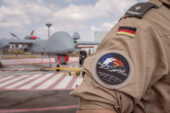
Image: The German-Israeli “’Cyber and Security Pact”’ should also include projects on drones and intelligence services (MilleniumAC, CC BY-SA 4.0).

Leave a Reply