Newspaper reconstructs controversial police operation at Nazi gathering
During protests against the sentencing of Hanna S. in the Budapest complex, police in Nuremberg deployed police horses and batons. There is now a petition against the mounted officers.
After the antifascist Hanna S. was sentenced to five years’ imprisonment by the Munich Higher Regional Court, protests took place in various cities the following day. In Nuremberg, too, on that 27th of September, according to police figures, 1,200 people gathered for a solidarity rally followed by a demonstration. It was simultaneously directed against the march of the far-right “Team Human Rights”, which was proceeding through the city centre at the same time under the motto “Together for Germany”.
The police had, amongst other things, permitted the approximately 100 far-right extremists to hold an interim rally at the Column for Freedom of Expression. There, they were to commemorate the far-right extremist Charlie Kirk, who was killed in the United States. This provoked widespread criticism in the city: “Nazis in the Street of Human Rights – that’s a low point for Nuremberg”, wrote Nasser Ahmed, chairman of the Social Democratic Party (SPD) city council faction, on social media.
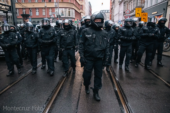
In the afternoon, a blockade then occurred in the western city centre, during which several left-wing demonstrators were injured by horses and batons of the state authorities. The “Nürnberger Nachrichten” spoke to those affected and witnesses about this, and evaluated medical reports and video footage – thereby confirming accusations raised by activists. The toll of the beating spree on the demonstrators’ side reads as follows: contusions, haematomas, concussions, a fractured upper jaw, broken teeth, and an open fracture of the hand.
An activist who calls himself Daniel when speaking to the newspaper reportedly wanted to help a woman lying on the ground when officers from the Bavarian “Support Command” (USK) ran towards him and his group with raised batons. “I raised my hands to show that I wasn’t doing anything”, he recounts. A baton then struck his left hand so violently that the bone shattered.
According to consistent statements from several people, four riders from the police horse squadron allegedly rode into the still-standing crowd without warning. This caused panic to break out, a woman fell and ended up under a horse. She sustained a contusion on her forearm and a graze. An eyewitness told the “Nürnberger Nachrichten” of an “irresponsible situation” and called the operation “disproportionate”.
The Middle Franconia Police describes it differently: a police rider was attacked with a flagpole and injured on the shoulder; the horse then “knocked over” a woman, the newspaper writes. The USK then intervened because of the attack. There were no injuries amongst the deployed forces.
Another incident occurred one street away, where USK units blocked activists’ path to prevent the leftists from encountering the right-wing demonstration. A young woman was struck in the face with a baton there: “It must have happened with such force that two of my teeth broke off and I lost consciousness shortly afterwards”, she reports. Her medical findings document a fractured upper jaw.
Several injured people report that they received help from the police only belatedly or not at all. Many did not want to file charges – due to lack of confidence in an independent review or for fear of potential counter-charges from the police.
In Nuremberg, the assaults are still causing discussion. Four days after the operation, the interior committee in the city parliament convened on the matter – with a large turnout in the gallery. Probably for this reason, the committee decided no longer to deliberate publicly on the subject in future. The first of these non-public dates has already been fixed.
The Greens, SPD, Left List and the Alliance Against Right-Wing Extremism called for clarification in an open letter to the city leadership on 7th October regarding the authorisation of the “Team Human Rights” assembly in the Street of Human Rights. In his response, the conservative Mayor Marcus König (Christian Social Union, CSU) stated that he shared concerns about the “aggression, divisive tendencies and external impact” of the march – but the city’s hands had been legally tied under assembly law. Intervention or a route change would have been legally “hopeless”.
The left-wing solidarity organisation Red Help accuses the city of promoting the emergence of an organised fascist scene in the region. Those who resist this are being prosecuted: “What we’re meant to become accustomed to here is simple: police operational forces who may proceed with any means against their enemies”, a spokesperson for the solidarity organisation told “nd”.
There is now a petition against the deployment of police horses in Nuremberg and beyond, which speaks of risks to animals and humans: horses are sensitive flight animals that could react uncontrollably in noise, confined spaces and stressful situations – such as at demonstrations. The signatories demand that a review of the riding squadrons be initiated at state level. The aim is police work that manages without animals and with de-escalating means.
Published in German in ‘nd’.
Image: The police riding squadron in Bavaria (Bavaria Police).