With new offices in seven EU member states, Frontex is decentralising its operational command. The reform is part of the expansion of the “Standing Corps”. A new regulation is intended to give the agency additional powers.
The EU border agency Frontex is reorganising its operational command structure. By setting up new regional commands, the agency is for the first time transferring parts of its mission management from the central headquarters to a regional level. These commands will be responsible for all types of operations – on land, at sea and in the air. In future, there are to be nine such geographical operational areas. The first two regional commands were opened this year in Prague and Tallinn.
The commands are intended to integrate the so-called Standing Corps, the agency’s own intervention force, with the forces of individual EU member states. Frontex describes the reform as a step towards a “hierarchical structure in the field”.
According to the European Commission, this new armed Frontex force numbered 6,757 personnel at the end of March 2025. It is to grow to 10,000 officers by 2027. In line with a political directive from Commission President Ursula von der Leyen, it is then to be expanded to as many as 30,000 staff members.
In July, the first regional headquarters of the Standing Corps was established in Tallinn, covering the seventh regional area. It focuses on the Scandinavian EU member states. A centre in Prague followed for the sixth geographical operational area; it is responsible for countries such as Germany, France, Belgium, the Netherlands, the Czech Republic, Denmark and Switzerland.
The respective command teams are responsible for personnel planning, mission authorisations and the leadership of the Standing Corps within their areas of responsibility. Operational responsibility formally remains with the national authorities, but Frontex is creating a new intermediary level between national and central command structures.
The reform is part of a broader reorganisation of responsibilities within Frontex. Since 2019, the agency has been building a “European Return Centre” in Warsaw to coordinate and facilitate deportations from EU member states. From Warsaw, travel documents are procured for those affected and contacts are maintained with the authorities of destination countries. The Return Centre is headed by former German Federal Police officer Lars Gerdes, who previously led the Federal Police training mission in Afghanistan.
Almost all deportations are carried out by air, accompanied by specially trained Frontex officers from the Standing Corps. These officers are stationed at several European airports – currently in Paris, Amsterdam, Vienna, Frankfurt, Düsseldorf and Berlin-Brandenburg. These units are also being expanded and subordinated to the new regional centres. Frontex refers to them as “return contingents” R1 and R2.
Frontex justifies the new regional structure as a means of responding more quickly to “operational needs”. With commands such as those in Prague and Tallinn, the agency aims to manage personnel, equipment and operations more directly. By the end of 2025, six of the nine geographical command areas are to be fully operational, with further locations under development.
At the same time, the European Commission is preparing a comprehensive revision of the 2019 Frontex Regulation. It is intended to provide legal backing for the agency’s expansion and to extend its mandate. A consultation process on the proposals has been under way since the summer of 2025. Among the proposals is granting Frontex greater operational autonomy, particularly in the area of forced returns.
In future, according to the Commission’s plans, Frontex could also support deportations between third countries – for example, the transfer of people from transit states to their countries of origin outside the EU.
This would extend the agency’s area of operations further beyond European borders. The planned expansion of the Standing Corps to 30,000 officers is part of this strategy. It remains unclear whether and how the European Parliament will be able to exercise oversight of this enlarged structure. It is also uncertain how the additional costs of such a far-reaching build-up of the EU border agency will be covered. Next year, the annual Frontex budget will exceed the one-billion-euro mark for the first time.
Published in German in ‘nd’.
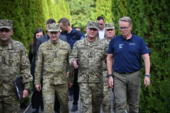
Image: German Frontex vice chief Lars Gerdes speaking in Tallinn (Frontex).