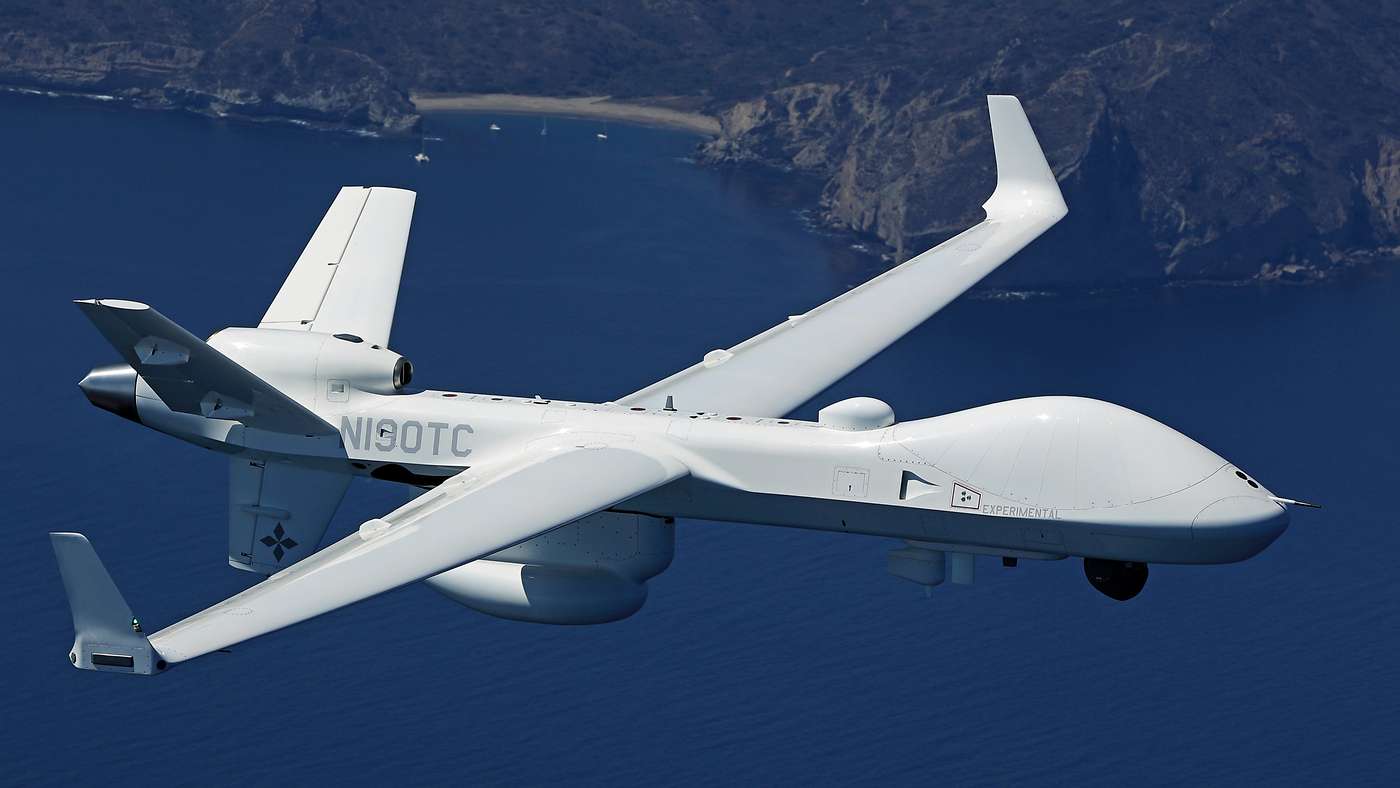
The German Navy is purchasing eight large US drones for maritime surveillance and submarine hunting at a cost of €1.9 billion. They will complement eight drones of the same size operated by the Air Force at Jagel. Both systems are authorised to fly in domestic airspace.
Germany has ordered eight unmanned aerial systems of the MQ-9B type from the US defence company General Atomics for its navy. The Bundeswehr announced this on its website on Monday. The drones, known as SeaGuardian, are intended for long-range maritime reconnaissance and anti-submarine warfare and will be delivered without weapons from 2028 onwards. At its meeting on 17 December, the Budget Committee of the German Bundestag approved around €1.9 billion for this major equipment project, entitled “Unmanned Component Maritime Airborne Warfare System” (uMAWS).
The SeaGuardian is a drone in the so-called MALE class. The acronym stands for “Medium Altitude Long Endurance”. The US drone has a wingspan of 24 metres and is 11 metres long. It is controlled via satellite and can operate in all climate zones.
Contract extension possible
The SeaGuardian is being procured via NATO’s procurement agency, which has established an “MQ-9B International Cooperation Support Partnership” for this purpose. NATO is also supporting Belgium, Denmark, Canada and the United Kingdom in acquiring and operating the MQ-9B.
The German Navy has ordered an initial two-year operational phase from General Atomics. The eight drones include four ground control stations; two MQ-9Bs and one ground station together form a reconnaissance system as part of uMAWS. The contract also includes the supply of spare parts and the provision of essential personnel. An optional extension of the contract by a further three years has been agreed.
The eight drones will be stationed at the naval aviation wing in Nordholz, Lower Saxony, and controlled from there. When the last aircraft arrive in Nordholz in 2030, additional equipment for anti-submarine warfare is to be installed. A further two years are planned for this.
The SeaGuardian’s sensors include cameras and radar, as well as two multi-purpose search radars. Equipment for anti-submarine warfare can be fitted as an option, including canisters with sonar buoys for underwater detection. The drones thus complement the capabilities of the P-8A Poseidon long-range maritime patrol aircraft currently being procured by the Bundeswehr. Unlike the MQ-9B, the P-8A Poseidon can also carry weapons.
Eight Heron TP to be completely based in Germany soon
The SeaGuardian drones are based on the Predator model and its successor, the Reaper, which the US Air Force first introduced into service a quarter of a century ago. Together with Israel, the United States long held a unique position with drones of this size capable of being armed.
The comparable Israeli model, the Heron TP, is currently being procured by the German Air Force. Two of these MALE drones have already been transferred from Israel to the Bundeswehr base at Jagel in Schleswig-Holstein. According to the latest information from the German Ministry of Defence, the remaining three Heron TP still stationed at Tel Nof in Israel, as well as three additional units that have been ordered, are to be transferred to Jagel by mid-2026.
The German Air Force intends to fly the Heron TP in civilian airspace; the relevant military type certificate was issued by the Israeli aviation authority. Only last year, the MQ-9B also received such a certificate from the United Kingdom. This allows the drone to fly over densely populated areas – a move that triggered protests on the island.
The Bundeswehr has not commented on whether its SeaGuardians will also be permitted to fly in civilian airspace. If so, the drones could also be used for domestic surveillance. The manufacturer praises this capability, stating that the MQ-9B systems are “highly versatile” for such operations in Germany.
Image: The German SeaGuardian is controlled via satellite from Lower Saxony and can operate in all climate zones (General Atomics).



Leave a Reply