
The German Armed Forces want to procure combat drones with a range of over 1000 kilometres by 2029. Airbus, Rheinmetall and the start-up Helsing are vying for the billion-euro deal.
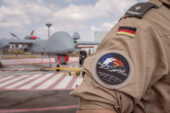
The German Armed Forces are about to embark on a new armament project: according to the German newspaper ‘Handelsblatt’, the air force wants to procure drones that can attack targets deep in the enemy’s hinterland by 2029. These so-called deep-strike drones differ from the sluggish, armed long-range drones that the German Air Force already has in its arsenal: they fly just under the speed of sound and can also be used as ‘loyal wingmen’ that accompany fighter jets or conduct aerial combat with enemy aircraft. These ‘Unmanned Combat Aerial Vehicles’ (UCAV) are said to have a range of over 1000 kilometres. So far, the German armed forces only have the crewless Taurus cruise missile with a maximum range of 500 kilometres.
According to the Handelsblatt newspaper, the potential fundamental military decision is being made against the backdrop of an allegedly growing threat from Russia. For this reason, the German Air Force has submitted ‘a corresponding request’ to leading German defence manufacturers. Three consortia are therefore in the running.
Airbus Defence, based in Bremen, has allied itself with the American defence company Kratos for deep strike drones, whose Valkyrie combat drone allegedly already accompanies fighter aircraft such as the F-35 in the US Air Force.
The Düsseldorf-based defence giant Rheinmetall has entered into a partnership with the Californian drone specialist Anduril – the most valuable venture capital-financed defence company in the world. Anduril is already developing drones for the US Air Force and on behalf of the UK for the Ukraine. Rheinmetall is also working with the US start-up Auterion on operating systems for unmanned systems.
The Munich-based AI start-up Helsing wants to develop a completely new German combat drone with the recently acquired German aircraft manufacturer Grob. However, according to a secret document obtained by Handelsblatt, the project is still in the design phase. The company, which is valued at twelve billion euros, has already developed AI systems that can control combat aircraft. The Helsing system ‘Centaur’ is said to have been in complete control during a test flight with a Swedish jet.
Defence Minister Boris Pistorius (Social Democrats) is also aiming to dominate the European ‘European Long Range Strike Approach’ (ELSA) in addition to the deep strike drones. The EU project is an armaments project agreed in July 2024 for conventional weapon systems with a range of over 2,000 kilometres. The participants are Germany, France, Italy, Poland, Sweden and the UK. The background to this is also the EU Commission’s warning that Western Europe must prepare for the real possibility of a large-scale Russian war of aggression in a few years’ time.
Last week, the German government passed a draft law for the faster implementation of defence projects. The Ministry of Defence does not want to confirm whether this also affects deep-strike drones, but there have been ‘initial informational discussions’ on the subject. For the industry, this is about more than just a billion-euro deal: whoever wins the contract could also set new standards for the militarisation of German airspace. In future, combat drones are to form the backbone of the air force alongside the Eurofighter, Tornado and F-35.
Published in German in ‘nd’.
Image: Kratos developed the Valkyrie drone, which is accordingly able to drop smaller drones (Public Domain).



Leave a Reply