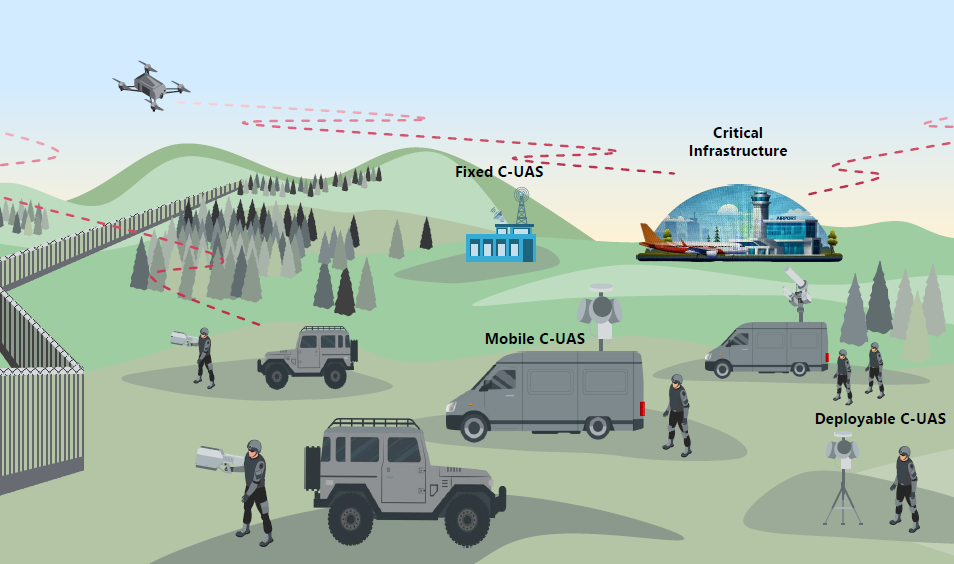
The EU is planning new structures to counter unmanned aerial vehicles. Frontex could receive an expanded mandate for this purpose. Europol warns of increasing use by organised and state actors.
At the beginning of October, EU Migration Commissioner Magnus Brunner announced that Frontex could in future play a role in drone defence. The statement was made in response to a current event: the meeting took place while Munich Airport had to suspend operations for the second time within 24 hours due to alleged drone sightings. This was only one of dozens of incidents in which so-called critical infrastructure in Europe has been disrupted by drone overflights of unknown origin.
Frontex’s anti-drone activities are not new. The border agency has been testing technologies for years to detect unwanted drones at the EU’s external borders. The aim is, for example, to prevent smuggling and unauthorised surveillance. However, Frontex systems could also be used to provide assistance to other authorities for law enforcement purposes. Another scenario is the subsequent “neutralisation” of discovered aircraft using various technologies.
In the summer, the EU border agency launched a “Counter-Unmanned Aircraft Systems (C-UAS) Prize Contest” in Estonia. The companies Adevex Soluciones, Dat-Con, Hertz Systems, MBDA France and Nordic Air Defence made it to the second phase of the competition. They were each awarded €20,000. In total, Frontex is spending €480,000 on the competition.
Competition without public control
The finale with “live tests” of the systems was to take place in October in Lisbon. Frontex did not want public access. Inquiries from netzpolitik.org regarding the date and location of the “competition” and conditions for journalistic observation went unanswered by the border agency for weeks—or only received a response after the event had already taken place on a military site in Portugal.
“Thank you for your patience. I am pleased to be able to provide you with information on the conclusion of the test phase for the Counter-UAS prize competition,” an email stated. Because it involved sensitive technology, details had to remain confidential until the end of this phase. An unusual measure, as Frontex is not an intelligence service but a border police force accountable to parliament and the public.
At the council level, EU member states are currently discussing how Frontex can provide stronger support against airspace violations by drones. A request from a member state would be required. Migration Commissioner Brunner announced that a further €250 million from the border management fund is to be spent “specifically on drones”. The money could be used for surveillance systems, anti-drone defence, and cross-border coordination. It remains unclear whether these funds will also be allocated to member states.
A Commission spokesperson clarified that the Frontex drone plans are about border surveillance. Airport security is also to form part of Frontex’s future mandate, said Brunner. However, the agency would need permission for the “neutralisation” of detected drones. The Commission is working on a reform proposal for the Frontex mandate, which is expected to be presented by the end of 2026.
New EU structures for drone defence
A council document published last week by the UK civil rights organisation Statewatch reveals how the EU is creating an institutional framework for addressing drone threats. The Commission has set up a “Counter-Drone Expert Group” including interior and defence ministries, law enforcement agencies, and national intelligence services. The group is intended to consolidate operational experience and prepare strategic recommendations. In addition, the Commission is examining the harmonisation of rules for the use of countermeasures, with the aim of presenting a unified EU regulatory framework.
Under Horizon Europe, further research programmes on anti-drone technologies exist. From 2028, additional funds could become available from the planned European Competitiveness Fund. The Commission is also considering supporting member states through the border management fund in procurements of up to €250 million, for example through joint tenders.
Police agency announces report
The EU police agency Europol plans to publish a comprehensive report on threats posed by unmanned systems later this year. Much of the content is already known, while other details have leaked. Since 2022, Europol has reportedly observed that drones are becoming a standard tool for organised crime, terrorist groups, and state actors in all operational environments. Europol is concerned that new devices have greater range, operate more autonomously, and can be used in increasingly coordinated ways.

Europol identifies artificial intelligence, the growth of the robotics industry, and military innovations as the main technological drivers of drone threats. The agency therefore recommends creating a European competence centre for unmanned systems, as well as unified standards, certifications, and procurement processes for detection and countermeasure systems. A Europe-wide database on the criminal use of drones should also be established to improve forensic analysis and countermeasures.
Europol also recommends shared testing environments, so-called physical sandboxes, and expanded training programmes for police and security authorities. For this purpose, the Commission plans to establish a drone “living lab” at one of the EU research centre sites. Standardised testing procedures, as well as training for operators of critical infrastructure and first responders, are envisaged. In addition, joint capacities in specialised police networks, including ATLAS, coordinated by Europol, are to be expanded. These units could then shoot down unwanted drones—provided national police laws permit it.
Image: Frontex prepares for various scenarios against disruptive drones, including their interception (Frontex).


Leave a Reply