Under a new three-year project, the EU Border Agency is training Ukrainian border guards, funding equipment and linking Kyiv’s border centre to Eurosur – yet it insists this is neither an operation nor a mission. Whether Frontex staff will work on Ukrainian soil remains vague.
The European Union has launched a new project to train Ukrainian border troops. With it, the EU Border Agency Frontex aims to bring the country’s border management and asylum system into line with EU standards. This is intended to make a later Schengen accession easier for Ukraine. The project is supported by the EU Asylum Agency (EUAA) and the International Organization for Migration (IOM). The Ukrainian partners are the State Border Guard Service and the State Migration Service.
The EU project, which has now begun, is called “EU4IBM and Asylum Partnership” and runs for 36 months. It is funded with €7.5 million from the “Ukraine Facility”, the EU instrument for reconstruction and reform in Ukraine, which is also meant to pave the country’s way to EU accession. The Frontex Management Board also approved a grant of €12 million to the Ukrainian Border Guard for generators, winter uniforms, vehicles and surveillance equipment.
Exercise to test Ukrainian “emergency plans”
Under EU4IBM, Ukrainian border troops will receive “access” to technology for detecting forged travel documents. 100 officers are to complete an English course. The EU Asylum Agency will “advise” the Migration Service on the new Common European Asylum System (CEAS) and train courts that rule on asylum appeals. A joint exercise to test Ukrainian “emergency plans” at the border is also planned.
According to a Frontex statement, “EU analysts” are also to cooperate more closely with Ukraine on cross-border crime. The Union’s Police Agency is actually responsible for this, but it is not named.
Officially no deployment in Ukraine – but then there is one after all
A year ago, Frontex had already confirmed Kyiv’s plans for a possible deployment in Ukraine. However, this requires the Commission in Brussels to conclude a status agreement with the government in Kyiv. That has not happened so far. Frontex therefore expressly does not present the measure that has now begun as an “operation” or “mission”.
When asked, the border agency said that no personnel would be deployed in Ukraine – and then qualified this statement: “The activities take place in EU member states, in Moldova, online and, where the security situation allows, in Ukraine.”
In neighbouring Moldova, Frontex had likewise launched a joint operation, with unusual haste, in 2022 after Russia’s attack on Ukraine; Brussels had concluded a status agreement with the government there.
Connection to the EU border surveillance system
One component of the new cooperation is a new Ukrainian “border coordination centre”, which was set up in 2024 and is likewise meant to meet EU standards. It is to be connected step by step to the European Border Surveillance System (Eurosur), which is run from the Frontex headquarters in Warsaw. Through it, EU states share information on incidents at the external borders.
The upcoming Frontex reform is expected to decide on easier connection of third countries to Eurosur. The legal basis is a working arrangement between Frontex and the Ukrainian Border Guard, which is currently being renewed, the agency told “nd”.
Even before the war in Ukraine, Frontex units were present at Ukrainian border crossings, with the status of observers. This joint operation was suspended in February 2022. Since then, Frontex has sent ever more personnel to the eastern EU land borders. Also under discussion is giving Frontex responsibility for drone defence at the EU’s external borders under the new regulation. The border agency has been preparing for this since last year.
Published in German in „nd“.
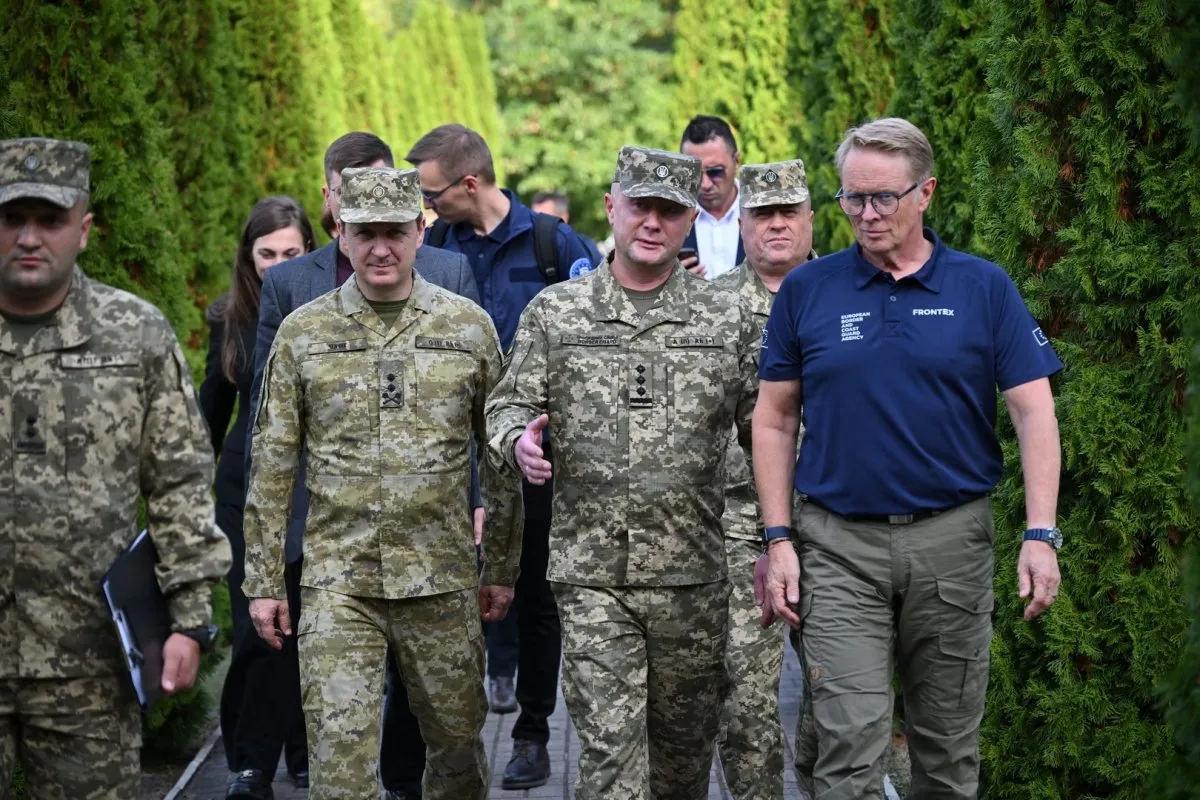
Image: Frontex chief Hans Leijtens launched the EU project with Ukrainian border troops (Frontex).



Leave a Reply