Hier ist der vollständige, korrigierte HTML-Text mit allen exakten Zitaten aus den Frontex-Dokumenten:
“`html
A series of technical problems, crashes and delayed repairs has strained Frontex’s relationships with its drone contractors. Now the EU border agency faces fresh questions over its surveillance operations in the Mediterranean. A possible switch to US technology could make its activities even harder to monitor.
In March 2026, Airbus Defence and Space announced a milestone: the “Heron 1” drone had reached 10,000 flight hours as part of a Frontex mission in Malta. The agreed services had been delivered for five years, and flights had been maintained throughout despite limited resources, according to the defence contractor based in Bremen. Even lengthy maritime missions and periods of adverse weather had not detracted from this success.
However, internal documents published on the EU border agency’s website probably following a freedom of information request reveal a long chain of technical failures lasting months, unplanned maintenance work on two drones, and a deep rift between the agency and its main contractor, Airbus. Yet even the Italian defence giant Leonardo, which was brought in because Airbus had failed to fulfil its obligations, was unable to deliver the drone services as ordered. Frontex responded by terminating contracts.
“Negative media coverage”
After being awarded the contract to provide drone services for Frontex in the Mediterranean, Airbus initially stationed a “Heron 1” in Malta, followed a year later by another on Crete. The long-range drones, with a wingspan of 16 metres, are manufactured by Israel Aerospace Industries (IAI). In EU operations, they are intended to monitor the central and eastern Mediterranean. When the pilots spot boats carrying migrants heading towards Europe, the coastguards of the countries along the coast are informed so that the people can be intercepted and taken back, primarily to Libya.
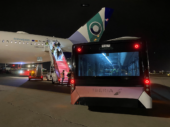
As early as 2022, Frontex complained about the poor quality of the drones’ onboard infrared cameras, which the Israeli subcontractor IAI was supposed to repair. In March 2023, the drone in Malta was taken out of service for unplanned maintenance lasting more than a month. In early October of the same year, a mission was cancelled because of a fault in the collision warning system. Four days later, another mission was aborted because of engine problems and high oil temperatures. The following week, the drone had to return to its base at Valletta International Airport once again because of engine problems. The incident prompted “negative media coverage”, as Frontex wrote angrily to Airbus: because the “Heron 1” blocked the runway for an extended period, commercial flights had to be diverted.
On Crete, the series of mishaps continued: in August 2023, the “Heron 1” stationed there crashed into the sea. Frontex eventually terminated the individual contract for operations in Greece with effect from 23 October 2023, as Airbus had failed to provide a replacement within the contract period and there was a risk of a gap of at least 3.5 months in surveillance flights. Following another crash off Malta in April 2026, Airbus fell even further behind on the required flight hours. The replacement aircraft flown in was not ready for operations until weeks later. Frontex subsequently demanded a refund of €6,929 for every day of flight disruption.
“Gesture of good will” quickly evaporated
Delayed repairs were a recurring problem. Spare parts, for example those needed to replace engines, often arrived too late, apparently because the government of the manufacturing country was slow to issue, or failed to issue altogether, export licences for military technology. The country is redacted in the Frontex documents, but it can only be Israel.
In the early years, according to the documents, Frontex was still accommodating towards Airbus and even turned a blind eye when, following a contract extension signed in June 2023, the drones did not resume flying immediately but only two months later. Frontex agreed to this delay as a “gesture of good will”, a letter states.
It is difficult to establish how much the drone flights cost Frontex. The initial framework contracts were worth €50 million in 2021. They were subsequently supplemented with additional flight hours and, in the case of Malta, extended twice by €75 million. In 2024, a new framework contract covering both drones was concluded with a budget of €184.2 million. Frontex, however, refuses to disclose the amounts actually spent, citing “commercially sensitive data”.
New contract awarded to Leonardo
It also remains unclear what the contracting parties agreed regarding the flight hours that were lost. Six weeks ago, a meeting with Airbus was due to take place at Frontex headquarters in Warsaw to discuss the matter. The Bremen-based company had repeatedly tried to replace the contractual penalties for delayed or cancelled missions with additional flight hours to be flown at a later date. Frontex rejected the deal, arguing that it would undermine the purpose of contractual penalties and put competitors at a disadvantage.
In the case of Airbus and IAI, their direct competitor is Leonardo. Although Leonardo lost out when the framework contract was re-awarded in 2024, it was named as the second beneficiary in the event that Airbus failed to provide the services as required. After Frontex actually terminated its contract with Airbus, Leonardo was awarded the contract for flights over the central Mediterranean on 12 January 2026.
The award is particularly striking because Leonardo had unsuccessfully sued Frontex before the Court of Justice of the European Union in 2022. The company had sought to have the award of the first framework contract to Airbus annulled because it considered its own bid superior.
Contract for “Falco” also terminated
However, Leonardo’s “Falco” also failed to meet the requirements guaranteed under the contract. Its operations were geographically restricted, apparently because of problems with the aviation authorities of a neighbouring country whose name has been redacted from the documents — Malta or Italy. According to Frontex, this was particularly unfortunate because there had been “an increased operational need” for drone flights in the central Mediterranean during the summer of 2026, prompting the Italian authorities to demand an expansion of the operational area.
Because Leonardo failed to comply with this request and, according to Frontex, also failed to provide evidence of the necessary overflight permits or licences, the agency terminated this individual contract under the framework agreement as well.
It remains unclear which aircraft Frontex will use for drone surveillance in the future. One possibility is an expansion of its manned flight operations, for which Frontex has paid private service providers at least a high three-digit million sum since 2017, including a US military contractor.
New US model could mean even less scrutiny of Frontex
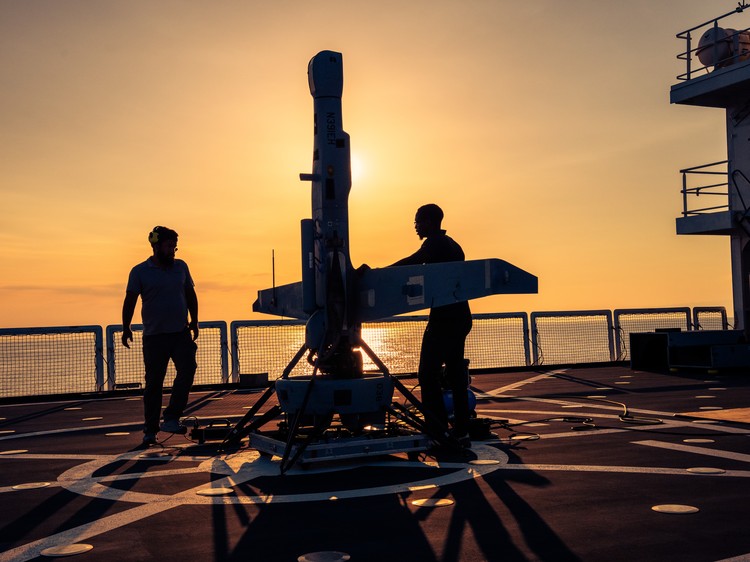
Another possibility is a switch from the large Israeli fixed-wing drones to a new model made by a US company, which Frontex recently tested successfully on a vessel belonging to the Italian coastguard. It takes off and lands vertically like a rocket before transitioning from thrust-powered flight to horizontal flight. With a flight endurance of up to 12 hours, the “V-BAT” is expected to have a range comparable to that of the “Heron 1”.
Operating the “V-BAT” would offer Frontex several advantages: deployment from ships in the Mediterranean would not require complicated authorisations for flights from civilian airports or through the civilian airspace of EU member states. The vertical take-off and landing drone weighs less than 150 kilograms and therefore does not have to be registered with the International Civil Aviation Organisation (ICAO).
This also removes the obligation to switch on a transponder for tracking purposes. The flight paths of “V-BAT” drones would therefore not be traceable via flight-tracking websites. This, in turn, would mean that Frontex could be subjected to even less scrutiny over its controversial collusion with the Libyan coastguard.
Frontex goes into hiding
The world would also benefit if Frontex stopped operating the Israeli long-range drones from Malta and Crete: the highly failure-prone machines would no longer pose a risk of crashing down on anyone’s head.
Until 2021, Airbus was also the main contractor under the German armed forces’ contract for Israeli “Heron 1” drones. The German Air Force had been using them in Afghanistan since 2010 and later in Mali as well. Four of the five drones stationed in Mazar-i-Sharif were written off following accidents. The German armed forces have since switched to the successor model and returned all “Heron 1” drones to Airbus and IAI. It is therefore entirely possible that these exact same aircraft are now flying missions for Frontex.
Frontex was asked for comment several times for this article. Its initial, terse response was that it did not disclose “details that could jeopardise the safety of its staff or the effectiveness of its operations”. This included specific information about the number, location and movements of equipment in use. However, the questions were not about the drones themselves, but about the multi-million-euro dispute with Airbus and Leonardo, and which contractors Frontex intends to use to continue its airborne drone surveillance of the Mediterranean in future. The press office, otherwise generally willing to provide information, went into hiding on these questions.
Published in German in „nd“.
Image: The US vertical take-off and landing drone “V-BAT”, recently tested by Frontex, could solve several of the agency’s drone-related problems — including the unwanted tracking of flights by NGOs (Frontex).