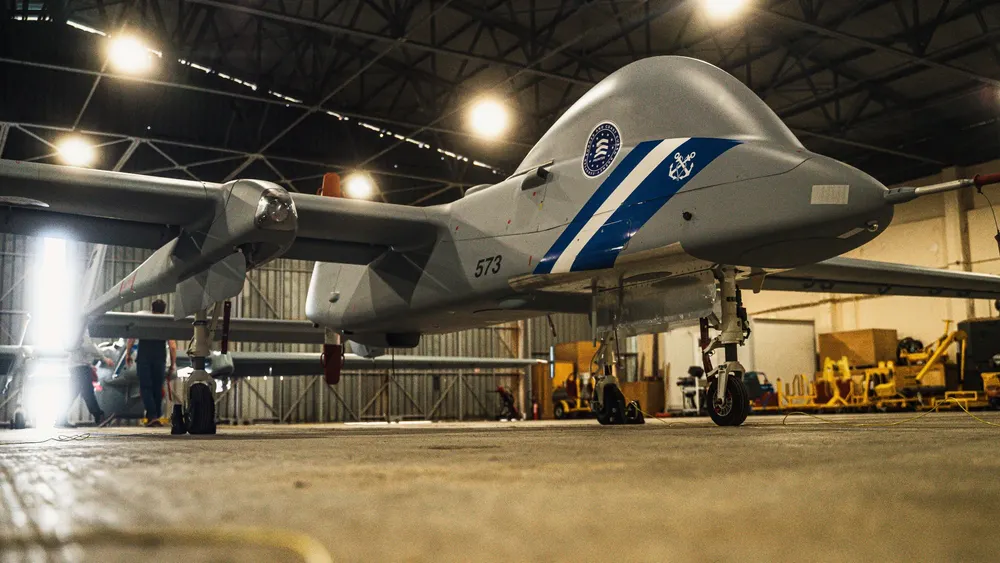
Once again, a Frontex drone has crashed into the Mediterranean – this time off Malta. Officially, the authorities speak of an emergency landing due to technical problems. Flights with a twin drone were briefly halted in Greece after the incident.
For the third time, a drone operated by the EU border agency crashed in the Mediterranean about a week ago. The incident occurred around ten nautical miles southwest of Malta. According to the Maltese armed forces, it was officially an emergency landing: the Heron 1, manufactured in Israel, had “technical difficulties and was forced to come down in the sea”, according to a statement. Frontex presents the situation in the same way.
The large drone, with a wingspan of almost 17 metres, belongs to the category “medium altitude long endurance” (MALE) and is stationed at the international airport in Valletta. It remains unclear whether it had just taken off or was approaching for landing – neither Frontex nor the Maltese military were willing to answer questions on this. However, the wreckage has reportedly been recovered and is now being examined, the military told “nd”.
Flights in support of the Libyan coast guard
The unmanned aircraft originates from Israel, where the model has been in use by the air force for a quarter of a century. In Europe, it is marketed and also operated by Airbus’s military division in Bremen. The Heron 1 stationed in Valletta since 2021 is registered to the Maltese air force.
Frontex intends to use the flights to support maritime border surveillance activities of coast guards in the central Mediterranean. Like the border agency’s surveillance aircraft, the drone effectively operates for the coast guard in Libya: boats carrying refugees detected on the high seas are reported to an EU-funded coordination centre in Tripoli, which then initiates interception operations for people on their way to Europe.
In 2022, Frontex stationed another Heron 1 at the military airfield in Tympaki on Crete. In August 2023, this drone also crashed into the sea. The wreckage could not be recovered, and the cause of the accident therefore remains unclear. Airbus assumed a “technical problem with the engine”, a Frontex spokesperson told “nd”. This had hardly any consequences for operations – the drone was replaced. Flights by the Greek military, which also operates Heron 1 drones, continued as normal.
Mediterranean becomes a testing ground for large drones
Following the latest crash in Malta, Frontex temporarily grounded the twin drone on Crete “as a precautionary measure”, but has since resumed operations, the agency said in response to an enquiry. Whether Frontex plans to resume service with a new drone in Malta as well, and when this might happen, remains secret. “We are also not in a position to reveal further operational details”, the headquarters in Warsaw stated.
The Mediterranean has become a testing ground for unmanned aerial vehicles. The certification of the two Frontex drones via the air forces in Malta and Greece significantly facilitates approval for flights. Once airborne, the Heron 1 operates in the largely unregulated international airspace over the Mediterranean.
Flights over land borders are currently only permitted for the large Heron 1 drones in Greece – and for the successor model Heron TP also in Germany. There, the air force has been a customer of the Israeli drone manufacturer IAI since 2010. Airbus also acts as the main contractor for these agreements; in Afghanistan and Mali, the defence company also handled the take-off and landing of drones for the Bundeswehr.
Framework contract worth €50 million extended
The forced crash off Malta is embarrassing for Airbus. Just four weeks earlier, the defence company had announced as a “milestone” that the Heron 1 in Malta had reached 10,000 flight hours. Airbus attested to itself “a high level of professionalism, coordination and operational flight precision”.
The forced emergency landing at sea is also not the first incident involving the Frontex drone in Malta: in 2023, a technical defect in the Heron 1 on the runway brought Valletta airport to a standstill, forcing incoming passenger flights to be diverted. Nevertheless, Frontex extended its €50 million framework contract with Airbus for a second time last year, for a further four years – it also covers the operation of the second drone on Crete.
De facto, this is also the third crash of a drone deployed on behalf of Frontex: in 2019, Frontex had leased a Hermes 900 from the EU Maritime Safety Agency (EMSA) for border surveillance from Crete. It is similar in size to the Heron 1 and is manufactured by Elbit Systems in Israel. After a crash, the drone was written off as a total loss. Due to similar technical defects, Hermes 900 drones procured by the Swiss military are not permitted to operate in civil airspace there as originally planned.
Published in German in „nd“.
Image: Large Frontex drone on Crete one year before its crash into the sea. The same has now happened to an aircraft stationed in Malta (Hellenic Coast Guard).

Leave a Reply