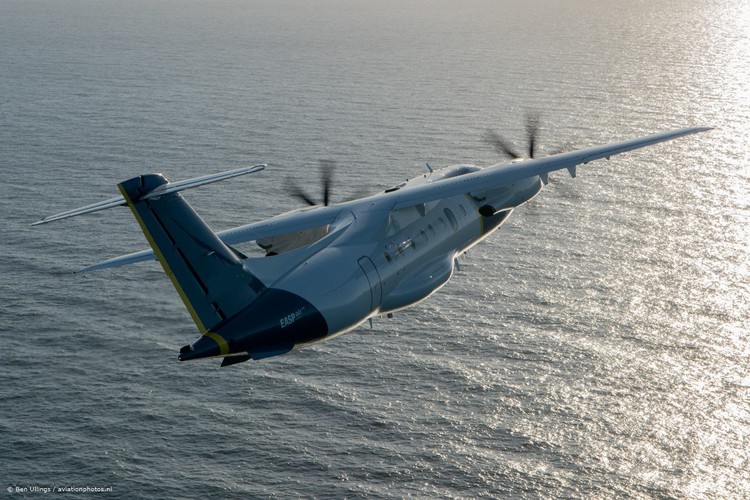
The European Commission wants Frontex to send much more assets to the Channel for the first time. The action plan also tasks Europol with mapping smuggling networks and taking down their websites. The agencies should lean on the UK as a “key partner”.
The European Commission has presented an action plan for the Channel migration route. Among other things, it sets out planned support measures by the border agency Frontex and the police agency Europol. The background is that many people continue to risk the crossing from France or Belgium to the UK in small boats. According to the International Organization for Migration, a total of 121 people died or were reported missing while making the crossing in 2024 and 2025.
The action plan, which the Commission is presenting ahead of the European Council meeting at the end of June, sets out various sets of measures with the “key partner” UK. These include so-called migration diplomacy with countries of origin and transit, intended to prevent irregular departures from the EU and to make returns to those countries easier. Law enforcement agencies are instructed to dismantle smuggling networks more systematically. In addition, border management on the coasts of the most affected member states is to be expanded. Here, the Commission is relying chiefly on Frontex.
Frontex to monitor coasts
According to the proposal, the border agency is to significantly expand its presence in the Channel and the North Sea. To this end, Frontex is also to deploy personnel from its new “standing corps” to the coasts. In addition, “maritime and aerial surveillance assets” are to be provided. The action plan specifically mentions “ships and aircraft” for detecting suspicious movements at an early stage. This is intended to improve the “coastal surveillance infrastructure” of the member states.
Frontex has already been active in the Channel since 2021 through operation “Opal Coast”, hosted by Belgium. So far, only one Frontex surveillance aircraft has been stationed there. Live video from operations is streamed to the Frontex Situation Centre and to a Belgian operations centre. An official aim of the mission is also to support the search and rescue operations of the coastal states. Frontex currently does not have any ships in “Opal Coast”.
In addition to a greater presence on the ground, Frontex is also to draw up risk analyses on the possible misuse of visas and residence permits for onward travel from the EU to the UK that is classed as “illegal”. According to the Commission, it looks forward to a “mutually beneficial increase in the exchange of targeted operational information” with the authorities of the government in London, including on the use of visas and residence permits for illegal onward travel.
Europol to take smugglers’ websites down
Responsibility for the criminal prosecution of migrant smuggling lies with Europol. At the centre of the action plan is Europol’s “European Centre Against Migrant Smuggling” (ECAMS) in The Hague, which is also to analyse intelligence information. Europol is to comprehensively “map” smuggling networks along the entire route taken by migrants.
The Commission also announces that Europol, working with the “EU Internet Forum” and the digital investigators’ network “DigiNex”, is to combat the use of the internet by smugglers. Europol is to work with operators of online platforms to identify and disrupt “the online footprint of smuggling networks”. Law enforcement agencies, service providers and non-governmental organisations should also make full use of the options under the Digital Services Act to step up efforts to “combat migrant smuggling, including its online dimension”. What these options consist of is not spelt out; they are likely to be the relevant platforms’ own policies.
Visa policy as leverage
Through so-called “migration diplomacy”, the EU also wants to intensify talks with countries of origin and transit in Asia, Africa and the Middle East, in order to prevent irregular departures at source and make it easier to return migrants who have no right to remain. Simplified “readmission” includes accelerated identification procedures and the swift issuing of travel documents.
If necessary, the Commission intends to apply pressure to this end. Visa policy is explicitly named as a lever to encourage third countries to cooperate. The action plan also provides for the EU and the UK to run joint “awareness campaigns” on the dangers of the illegal crossing.
Pact between the UK and France
To strengthen cooperation against migration on the Channel route, the UK and France signed a bilateral agreement a year ago. UK Prime Minister Keir Starmer described it at the time as a “groundbreaking returns pilot scheme” based on the principle: “one in, one out”. Migrants who arrive in the UK by boat are to be sent back to France immediately. In return, the UK takes in one refugee via a regular asylum route for every person it returns.
French authorities report that, in May 2026, they thwarted 53 of 82 attempts to cross the Channel in small boats, a success rate of 65%. In its most recent operations, the French prefecture for the Channel and the North Sea has used various watercraft as well as a jet ski to intercept migrants. This has only been permitted since a recent change in the law. Nevertheless, according to the UK Home Office, 710 migrants crossed in eleven boats last Monday.
Raids also in Germany
Germany is also involved in the joint effort to combat smuggling alongside the Channel states, and even plays a central role. In March, Germany’s Federal Police carried out raids for the second time, aiming to disrupt supply chains allegedly used to procure, store and distribute equipment for crossings. Twelve of the searches took place in Germany, two in Belgium. In the process, police seized eleven dinghies, an outboard motor, and boxes of life jackets and bicycle inner tubes.
For the investigation, police authorities from Belgium, France, the Netherlands and the UK set up a joint investigation team under the umbrella of Europol. Alongside the Federal Police, authorities from North Rhine-Westphalia, where the raids took place, were chiefly involved. The EU agency for judicial cooperation coordinated cross-border legal assistance, including European Arrest Warrants and European Investigation Orders, which can be used to order searches and surveillance abroad.
Study: more deaths despite fewer boats
The organisation Border Forensics published a new study this year. It states that the new UK policy, together with payments to France equivalent to €726 million, had led to a sharp rise in deaths in the Channel, even though the number of boats and arrivals had fallen. Geographical analysis showed that the deaths occur closer to the French coast.
The study identifies extreme overcrowding of boats and chaotic departure manoeuvres caused by violent police operations as causes. Another important reason, it says, is raids such as those in Germany, which make it harder to access boat materials and safety equipment. As a result, migrants and those who help them are forced to resort to inferior dinghies.
Image: Frontex aircraft in “OPAL Coast” (Frontex).


Leave a Reply