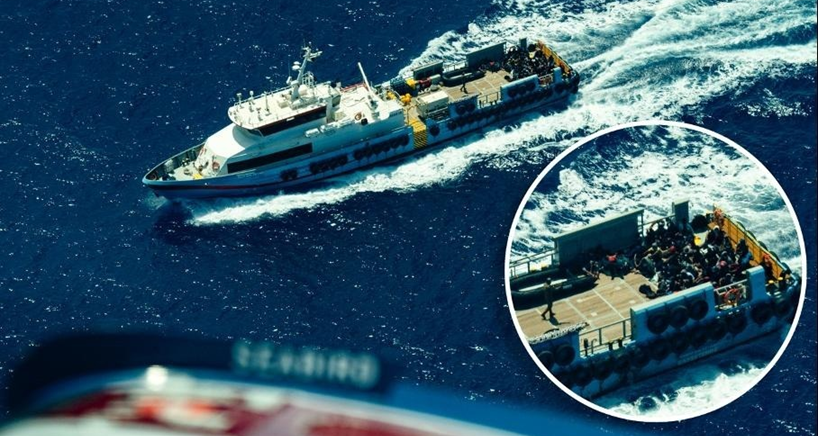
Control centre and surveillance tower: the EU is copying its backdoor model from western Libya to the east. Notorious militias are to intercept refugees on a new route to Crete.
Following a landmark ruling by the European Court of Human Rights (ECtHR) in 2012, EU member states are prohibited from pushing back to Libya people intercepted in boats in the central Mediterranean while on their way to Europe. To circumvent this obstacle, Italy and the European Commission have constructed a legal and operational backdoor: using funds from Brussels, the Italian Ministry of the Interior and the navy installed a Maritime Rescue Coordination Centre (MRCC) in Libya from 2017 onwards, which can be contacted by the coastguards of European Mediterranean states to return boat refugees to Libya – something that, according to the official interpretation, does not violate the ECtHR ruling.
The EU border agency Frontex provides aerial surveillance, as Libya itself has neither aircraft nor helicopters. Critics describe this interplay as “pullbacks”, in reference to the term “pushback”, which denotes the unlawful direct return of people to Libya by Frontex or coastguards from EU states.
The EU now intends to establish the same system in eastern Libya as well – even though the two parts of the country, with their political centres in Tripoli and Benghazi, have been embroiled in a civil war since the fall of Muammar al-Gaddafi in 2011, which repeatedly flares up. The architect of this mirrored system is the military mission Irini, through which EU states have been operating off the eastern Libyan coast since 2021. However, as in Tripoli, the concrete establishment of a maritime control centre in Benghazi will be carried out by Italy, which has applied to Irini for a “quick impact project”. The possibility of such “quick impact projects” was provided for the first time in Irini’s mandate, renewed earlier this year. The advantage is that decisions and implementation of measures take place via shorter channels.
The European External Action Service in Brussels is now expected to conclude an agreement with Italy’s Ministry of Foreign Affairs for the installation of an MRCC in Benghazi. Start-up funding of €3 million can then be drawn from the “European Peace Facility”. This was confirmed to “nd” by an EU official upon enquiry. This fund finances military and defence-related measures within the framework of the Common Foreign and Security Policy – such as the common costs of EU military operations or arms deliveries and training programmes for partner armed forces.
However, Italy is to bear the lion’s share of the costs, of an as yet unknown amount, for the 18-month implementation phase. This also includes the installation of a tower with radar and surveillance technology, which is to be erected in Tobruk in eastern Libya – a main point of departure. This and other equipment delivered is to be taken over by the responsible Libyan authorities after the end of the project.
The background to the Italian initiative is apparently the shift of the Libyan migration route from the west, where the coastguard is intercepting increasing numbers of people, to the more dangerous waters in the east. There, people from war-torn Sudan in particular are currently attempting to reach Crete – because in Libya, too, Black people are victims of hate crimes and abuse.
Arrivals from eastern Libya have increased by around 60 per cent compared with 2024, amounting to more than 5,000 people in total. Almost as many people on the Tobruk–Crete route come from Egypt, which has for years successfully prevented crossings to Europe. The third-largest group among those departing by boat from the region are Bangladeshis, followed by Pakistanis.
For Irini and its “lead nation” Italy, the shift of the migration route to eastern Libya is inconvenient. The EU military mission is primarily intended to enforce the UN arms embargo on Libya at sea, monitor illegal oil exports from the country, collect information on smuggling networks, and support the build-up of the Libyan coastguard and navy.
The government in Rome, however, saw the small EU fleet and its reconnaissance aircraft off Libyan waters as an incentive (“pull factor”) for departures of boat refugees from Libya, and insisted on renaming the mission Sophia, which ran until 2021, to Irini and restricting the area of operations to waters off eastern Libya.
This Irini area is now being crossed by the increasing flight movements. The number of distress-at-sea incidents there is reportedly over 100 this year. Although this was supposed to be excluded as far as possible under the new mandate, Irini has also had to participate in rescue missions itself – and subsequently bring the boat occupants to the European Union.
Alarm Phone, which operates a hotline for refugees in distress at sea, does not believe that the EU’s new plans are about saving lives. “From a new control centre in Benghazi, as far as search and rescue is concerned, no more can be expected than from the one in Tripoli”, a spokesperson told “nd”. When it comes to urgent cases of distress at sea, help rarely comes from there. The structures in the west and east serve to organise pullbacks.
The most recent trip by a high-level EU delegation has fuelled these concerns: at the beginning of December, the EU ambassador to Libya, Nicholas Orlando, and the Italian Irini fleet admiral met in Benghazi with the notorious General Khalifa Haftar, who had once launched the civil war against the internationally recognised government in the west. The topic was the expansion of cooperation “including strengthening border security on land and at sea” as well as combating “transnational networks of migrant smuggling and trafficking”.
A Libyan newspaper reported that the EU delegation had lavishly praised the efforts of the military “to protect its land and sea borders”. Haftar’s sons Khaled and Saddam, who hold high military ranks, are also said to have attended the reception with Ambassador Orlando.
It remains unclear which eastern Libyan authorities are to benefit from the new “quick impact project” in terms of border surveillance and the operation of control centres. Neither the European Commission nor the Council provided concrete information in response to an enquiry from nd – Italy’s Ministry of Foreign Affairs did not respond at all. An EU official did state, however, that an MRCC in Benghazi would have to be set up as a civilian centre. Presumably, however, it will be run by military structures and militias connected to them – as is also the case in western Libya in the EU-funded SIBMMIL project.
This would also mean that the eastern Libyan Tariq Bin Ziyad Brigade (TBZ) would benefit from the new MRCC. Human rights organisations accuse it of war crimes, torture and violence against migrants. The militia is said to have been responsible in mid-October for an armed attack on a boat carrying refugees – at the time when a delegation from eastern and western Libya was visiting Frontex headquarters and subsequently the Commission in Brussels. Officially, the Commission declined to comment substantively on this “technical dialogue” – unofficially, however, “nd” learned that members of the coastguard, border troops and the Department for Combating Illegal Migration (DCIM) from the east took part.
As is customary with such projects, a feasibility study must first be carried out for the maritime control centre in Benghazi and the watchtower in Tobruk, after which the procurement procedure will be prepared. Implementation then requires a contract with the authorities in Benghazi, which would probably – as already in the SIBMMIL project in western Libya – be signed by Italy. Only then can equipment be delivered and training measures officially begin.
However, a first such training course for MRCC operators already took place at the end of September 2025 at an Italian naval base in Taranto in Apulia – initially with the location and date kept confidential. It presumably conveyed knowledge of maritime IT and navigation systems as well as the associated technical terminology in English.
The German Bundeswehr is with its navy also part of Irini – currently with soldiers at the command headquarters in Rome and a reconnaissance aircraft. Germany is not currently involved in the “support for capacity-building” or the training of the Libyan coastguard or navy, according to a response to an enquiry from “nd”. Whether this will also apply in future cannot be inferred from the reply: in any case, the Bundeswehr does not intend to conduct “training on site” or train Libyan military personnel in Germany – participation in courses in Italian Taranto, however, would not be ruled out.
Published in German in „nd“.
Image: A ship of the Libyan Tarek Ben Zayed militia during a push-back in June 2023 (Tian Sthr/Sea-Watch).

Leave a Reply