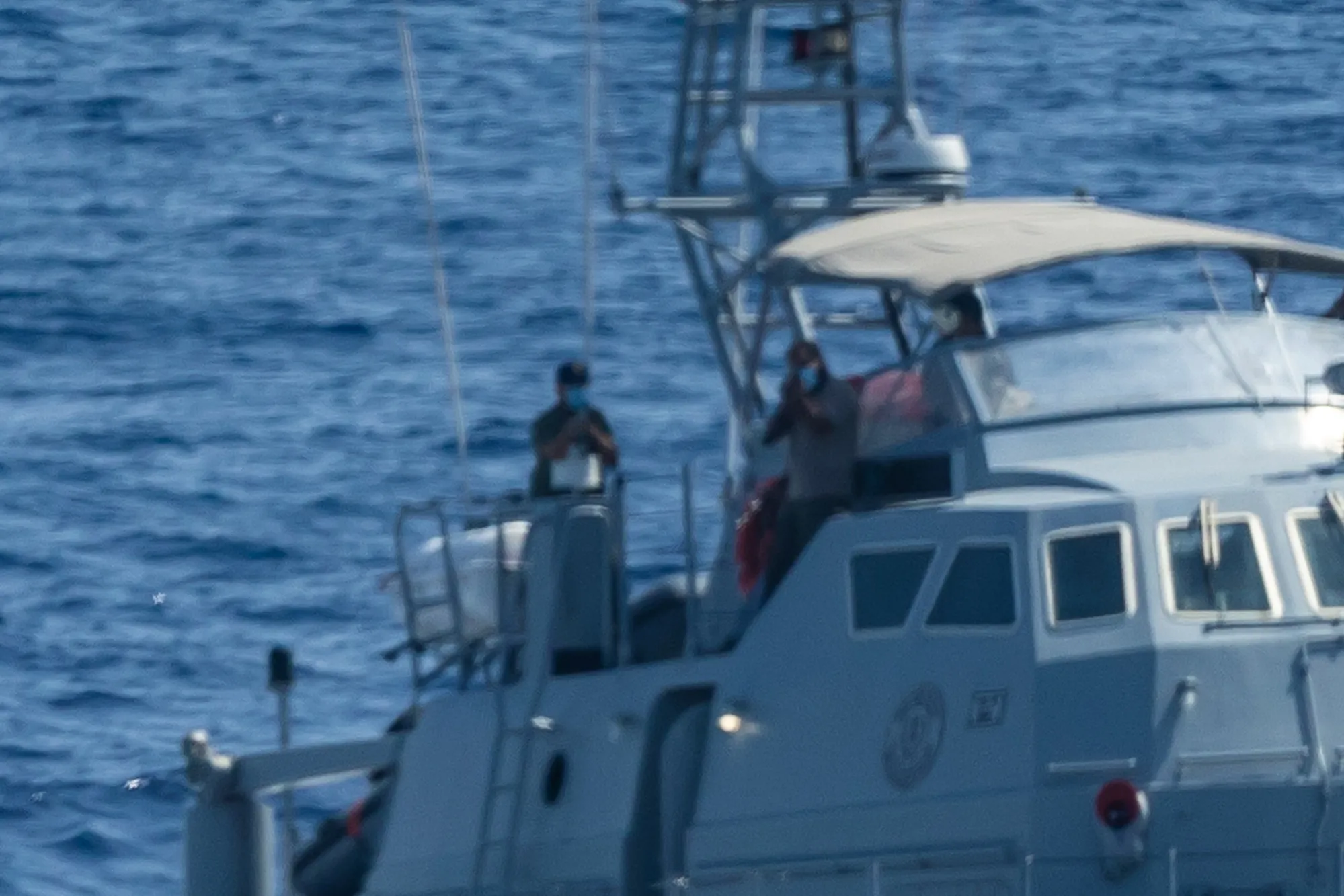
Germany has expanded its maritime risk warning for Libyan waters to the countries’ the search and rescue zone. The move comes after repeated attacks by militias linked to the so-called Libyan coastguard. NGOs are demanding concrete protection for their rescue ships.
The so-called Libyan coastguard regularly attacks civilian rescue ships or refugee boats on the high seas. On Monday, the German Interior Ministry therefore issued a warning to all ships sailing under the German flag. Under the International Convention for the Safety of Life at Sea, it imposes a “security level 2” for Libya’s exclusive economic zone as well as the country’s search and rescue zone. The warning had already previously applied to Libya’s territorial waters.
The notice applies “until further notice”; the Federal Police has also published it online. According to the statement, this means there is also a risk to commercial shipping. However, the classification applies in particular to rescue ships operated by non-governmental organisations.
The German Interior Ministry has, for example, issued such an elevated “security level 2” for waters off Venezuela – after the US government abducted President Nicholas Maduro there and is now alleged to have killed 187 supposed drug smugglers on rigid inflatable boats. The Strait of Hormuz, blockaded by Iran, carries Germany’s “security level 3”. These maritime areas should be avoided where possible or navigated with heightened vigilance.
NGOs call on German government for protection
Libya’s search and rescue zone extends far into the central Mediterranean and borders the search and rescue zones of Tunisia, Malta and Italy. In this area, Libya is responsible for maritime rescues – like all coastal states worldwide – but has no sovereign rights. Nevertheless, militias frequently instruct NGO ships not to rescue boats carrying migrants on their way to Europe, often threatening the use of weapons.
The German government now also acknowledges this. “Although it was not possible to clearly identify the aggressors, the available information suggests that in most cases, they were part of the Libyan coast guard,” the relevant statement says. Ships under the German flag are advised to take “additional protective measures or safety precautions based on the measures required under this security level” in the affected sea areas. The ministry does not provide more concrete details.
NGOs see the German government as having a responsibility: “It is now urgently necessary for this recognition to be followed by political consequences,” SOS Humanity stated. One of its demands is for “concrete protection for rescue ships”.
Criminal complaint filed by Sea-Watch
The expansion of the risk assessment to all waters off Libya follows a criminal complaint against unknown persons, which Sea-Watch recently filed with prosecutors in Rome and Hamburg over an incident in September 2025.
In Germany, the Federal Police is responsible for investigations. Over the past five years, its maritime directorate based in Neustadt in Holstein has initiated three investigations into shootings involving rescue ships registered in Germany.
The responsible German Interior Ministry refused to provide information on the affected organisations. What is known: in 2024, the Libyan coastguard fired shots into the water during a rescue operation by the “Humanity 1”; in December 2025, shots were fired at the “Louise Michel”, and in September 2025 at the “Sea-Watch 5”. In October, Libyan militias seriously injured a person in a migrant boat with a gunshot wound to the head.
Also last summer, the rescue ship “Ocean Viking” was fired upon for more than 20 minutes – it sails under the Norwegian flag. The organisations grouped together as the Justice Fleet decided, partly because of these incidents, to no longer cooperate with Libyan authorities.
NGOs criticise contradiction in German policy
The German notice also states that the security situation in Libya has been “has been volatile for years and remains tense”. In large parts of the country, functioning state control cannot be assumed, which also applies to Libyan waters, the German ministry explains.
“The German government is thereby confirming a central contradiction in its own policy,” a Sea-Watch spokesperson said. “It recognises the real danger posed by the so-called Libyan coastguard while simultaneously supporting it.” This refers to EU measures in which the German navy participates. “In doing so, the German government is tacitly complicit in the recognised security problem and the violence,” the sea rescue NGO wrote.
Lea Reisner, Left Party spokesperson for international relations in the Bundestag, takes the same view: “The German government must finally ensure that funding for the so-called Libyan coastguard is stopped. Instead of a Fortress Europe protected by criminal gangs, safe routes for escape and entry are needed.”
EU ambassador travels to eastern Libya
The EU’s policy of deterrence is continuing to drive up the annual death toll: according to current figures from the International Organization for Migration, more than 1,100 people have already died or gone missing this year while attempting to cross the Mediterranean.
The EU is responding with even closer cooperation with Libya – disregarding Germany’s own assessment that the state has no control over large parts of the country. This week, EU ambassador Nicola Orlando met in breakaway eastern Libya with Libyan general Khalifa Haftar, who rules there. Brussels’ plans include extending the cooperation with the coastguard in Tripoli, launched in 2017, to militias in the eastern capital Benghazi, which is not internationally recognised.
Published in German in „nd“.
Image: The blurry photograph shows a militia belonging to the Libyan coastguard firing shots at the “Ocean Viking” (SOS Mediterranee).
Leave a Reply