
TU Dresden’s rectorate approved a €30,000 research contract with Israeli arms manufacturer Elbit Systems — overriding its own ethics commission, which had voted almost unanimously against it. The commission was subsequently dissolved. It is not the university’s first collaboration with an Israeli weapons maker.
The rectorate of the Technical University of Dresden has approved a research project with the Israeli arms manufacturer Elbit Systems, despite the university’s internal Commission on Responsibility in Science having previously voted almost unanimously against it. Local media have been reporting on this since the beginning of May, after internal university documents were leaked to them. These reveal that the ethics commission was temporarily dissolved following the leak.
The contract is worth €30,000. The subject is the propulsion technology of the Hermes 900, an armament-capable drone made by Elbit that has been deployed in the Gaza Strip for two decades. With a wingspan of around 17 metres, it belongs to the class of high-altitude, long-range drones.
Research against crashes
The Dresden professorship for combustion engines and propulsion technology is tasked with investigating why the model’s engines lose power at certain altitudes, leading to unstable flight behaviour and crashes. The project has been under way since the beginning of 2026; engine tests in an altitude test rig were planned for early May.
Crashes of Elbit drones have by now become numerous: in 2019, a Hermes 900 was involved in an accident during a Frontex deployment on Crete; in 2020, a Hermes 900 destined for Switzerland was totally destroyed during a test flight in Israel after brake flaps generated vibrations that caused the tail unit to break off; in 2022, a Hermes 900 of the Philippine air force crashed after its communications link was severed. Due to similar problems, the Swiss military is not permitted to fly its Hermes 900 drones in general airspace as originally planned.
Committee votes against the project
TU Dresden has not commented on the research, as its chancellor Jan Gerken reportedly signed a confidentiality agreement with Elbit Systems last October — two years after the start of Israel’s war on Gaza, and thus at a point when tens of thousands of Palestinians had already been killed, including by Elbit drones.
This is precisely what the Commission on Responsibility in Science at TU Dresden had flagged as problematic. In its deliberations, members also discussed the outstanding arrest warrants issued by the International Criminal Court in connection with that war, including against Prime Minister Benjamin Netanyahu. Nearly all members therefore voted against the project.
The ethics commission has an advisory, not a decision-making function. The rectorate was therefore not formally bound by the vote and ultimately approved the contract regardless. Several members publicly distanced themselves from this decision at a subsequent meeting. Then came the escalation: after internal documents about the vote were passed to Dresden media, the university leadership temporarily dissolved the commission and filed a criminal complaint.
TU Dresden has not officially confirmed any direct connection to the leak. In response to enquiries, the university stated that it has no civil clause excluding military research, and that the procedure had been coordinated with the relevant federal export authority.
Criticism from the SDS, praise from the RCDS
The Socialist Democratic Students’ Association (SDS) condemned the process in strong terms, declaring that the university was “conducting research on weapons of murder.” Together with other university groups, it is demanding a public statement from the rectorate, the withdrawal of complaints against commission members, the reinstatement of the body, and the disclosure of all dual-use research relating to armaments. The student council of TU Dresden joined in this criticism. The Christian Democratic Students’ Ring (RCDS), affiliated with the Christian Democratic Party, welcomed the project.
Predecessor project with a different Israeli manufacturer
What Saxon media have not reported: this is not the first research contract in which TU Dresden has collaborated with an Israeli arms manufacturer within a European-funded consortium. From 2015 to 2019, the university participated in the Horizon 2020 project “Extreme”, which concerned composite materials under extreme dynamic loading — a key technology for fuselage and wing structures of large aircraft.
A partner in this consortium was Israel Aerospace Industries (IAI), the state-owned arms manufacturer and producer of the Heron TP, a combat drone in the same class as the Hermes 900. IAI received approximately €225,790 in EU funding from the project; TU Dresden received €409,375; the total budget was just under €5.3 million. The Elbit project follows on thematically: where the earlier project dealt with structural materials for drone frames, the current one addresses propulsion technology.
The Heron drones also crash regularly. In 2010, the Bundeswehr lost two Heron 1s in Afghanistan — the predecessor model of the Heron TP, both operated by Airbus Defence. A further drone flew into a mountain in 2013 due to a connection problem with its ground station. In the same year, Israel was forced to ground its entire Heron fleet after one aircraft came down over the Mediterranean. Shortly afterwards, a Heron TP crashed near the Egyptian border. In 2020, another Bundeswehr Heron drone crashed following an engine failure. The series continued after Frontex took on two Heron 1s from 2021 onwards; these also recorded two crashes while being operated by Airbus.
FDP politician becomes “senior political executive”
Elbit is under pressure in several European countries due to campaigns and actions by pro-Palestinian groups. Meanwhile, the arms manufacturer is entering into further partnerships with German firms. The shipbuilding group ThyssenKrupp Marine Systems recently inaugurated a factory in Israel with Elbit Systems for the production of components for submarines delivered from Germany. Elbit and the Franco-German consortium KNDS are also setting up a production facility for the PULS rocket launcher system in Kassel.
Assisting with these activities since this year is the German Liberal Democrat politician Marcus Faber, who until 2025 was a member of the Bundestag and most recently chaired its defence committee. Faber is now a senior executive for “political affairs” at Elbit.
New database of similar projects
Criticism of TU Dresden’s Elbit drone research was voiced last week by Nicole Gohlke, the higher education policy spokesperson of the Left Party group in the Bundestag. “While Israel destroys Gaza and Lebanon, Dresden University apparently thinks that participating in these crimes is a good idea,” Gohlke said. “A university that dissolves its own ethics commission for speaking uncomfortable truths, while at the same time optimising drones for a genocide, has abandoned every principle it once held.”
In the same week, a website on “Academic Complicity” went online, listing similar research involving companies, universities or institutes from Israel that received funding from the European Commission. It documents hundreds of ongoing and former cooperation projects across Europe. The basis is the EU Commission’s CORDIS database covering the “Horizon 2020” and “Horizon Europe” research programmes, supplemented by further research from Students for Palestine and students and staff at various German universities and higher education institutions.

The database also points to documented links between Israeli academic institutions, companies and state bodies and human rights violations, war crimes and breaches of international law. Its creators aim to prompt further investigation into these partnerships.
Published in German in „nd“.
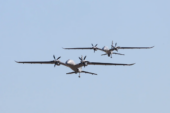
Image: Hermes 450 and Hermes 900 in formation (Nehemia Gershuni-Aylho www.ngphoto.biz,CC BY-SA 3.0)


Leave a Reply