While EU governments present falling migration figures as a political success, people continue to die in the Mediterranean. New figures from Frontex reveal a sharp increase in information-sharing with Libya, which hinders NGOs in rescuing people seeking protection.
The crew of the Sea-Watch rescue vessel Aurora recovered 28 people following a shipwreck in the Mediterranean and took two bodies on board, including that of a child. At least six people remain missing. Meanwhile, new figures reveal that the EU border agency Frontex is increasingly sharing information with the so-called Libyan Coast Guard, resulting in more people being intercepted and returned to Libya.
The crew of the rescue vessel “Aurora”, operated by the organisation Sea-Watch, rescued 28 people from international waters between Tunisia and Italy on Tuesday morning following a shipwreck. It also took two bodies on board, including that of a child. According to survivors, at least six more people are missing, including three children from one family.
The boat was brought to the attention of the crew by Alarm Phone, the non-governmental organisation’s civilian emergency hotline. The remaining 23 survivors had managed to reach the “Hasdrubal” gas platform off the Tunisian coast following the shipwreck. According to Sea-Watch, the “Aurora” sailed there under the coordination of the Tunisian Maritime Rescue Coordination Centre. In response to a request from the “Aurora”, the Italian authorities designated Lampedusa as a safe port for the rescued people. The vessel is currently heading there.
Sea-Watch intercepts Frontex radio transmission
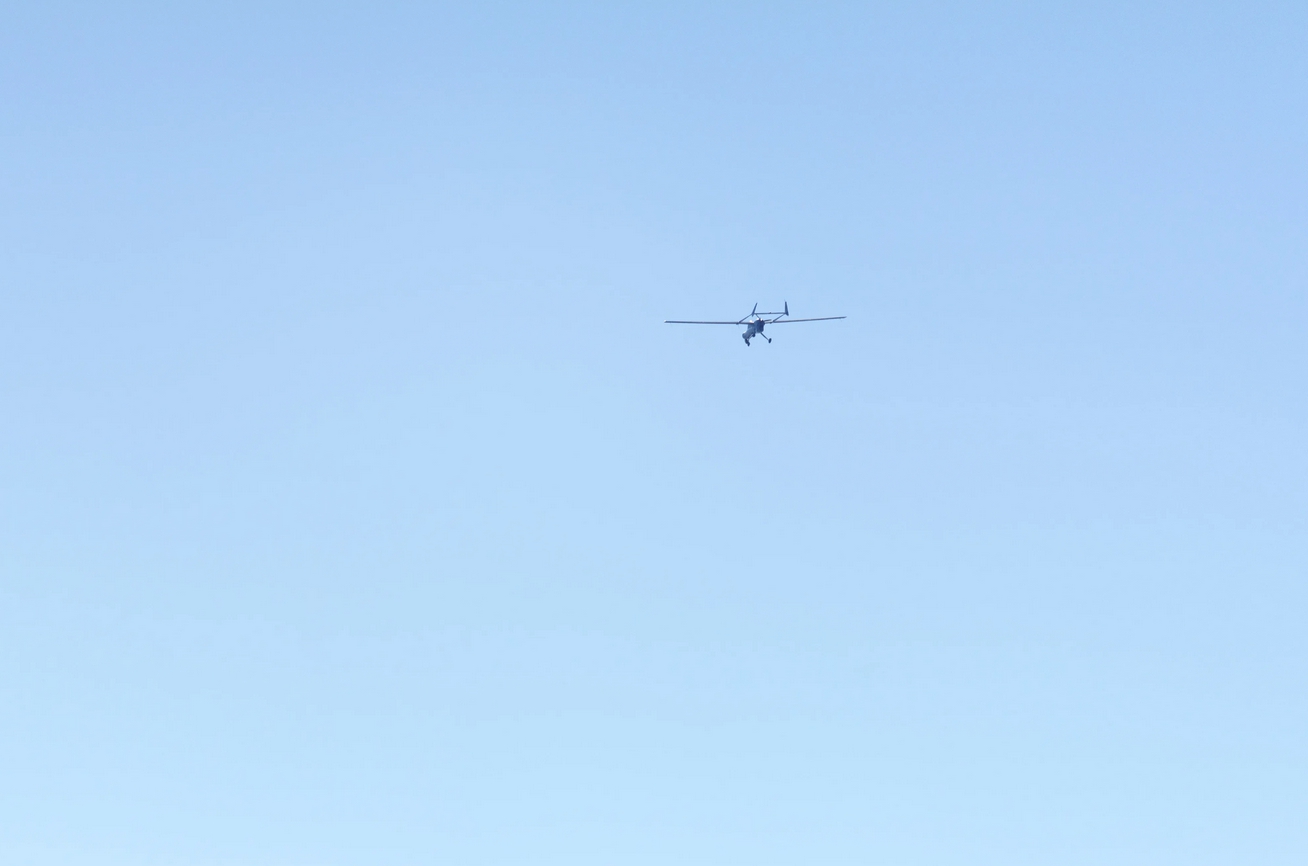
Although the EU border agency Frontex is also active in the central Mediterranean with aircraft and drones, search and rescue operations are not its primary focus. An incident on Saturday, reported by Sea-Watch on social media, provides evidence of this. According to the organisation, its reconnaissance aircraft “Seabird” was able to intercept a radio transmission from the Italian drone “Falcon01”, which was operating on behalf of Frontex.
In the uploaded recording, the Frontex pilot confirms having passed on the position of an inflatable boat to the so-called Libyan Coast Guard. The approximately 65 people in distress at sea were subsequently intercepted by a Libyan patrol boat and taken to Libya. Sea-Watch describes the incident as abduction.
This is not a new pattern. As “nd” reported in January, after sighting a boat, Frontex informs the maritime rescue coordination centres of the coastal states concerned. In the central Mediterranean, these are Italy, Malta, Tunisia and Libya. Only when a Frontex crew considers a boat to be unseaworthy does the pilot additionally issue a distress call on VHF channel 16, which can be heard by all vessels in the vicinity. Civilian rescue organisations are excluded from the distribution lists used for communication with the state-run coordination centres and therefore depend on these radio transmissions.
New response provides evidence of systematic pushbacks
Investigations by “nd” and Sea-Watch revealed that, in several cases, Frontex radio transmissions on the emergency channel omitted the boats’ course and speed. On several occasions, Sea-Watch aircraft explicitly requested this information, but without success. In these cases, the Libyan Coast Guard reached the people before the civilian rescue vessels and returned them to Libya.
In a follow-up response to a parliamentary question submitted by Left Party MEP Özlem Demirel, Frontex has provided up-to-date figures on its cooperation with the Libyan Coast Guard. In 2025, the agency issued 484 such notifications to the coordination centre in Tripoli, almost twice as many as in the previous year. By August this year, Libya had already been informed of 158 sightings.
The response also includes figures on interception operations. According to the data, many sightings reported in the central Mediterranean result in Libyan patrol boats retrieving the people on board. In 2021, this was the case in almost half of all 450 sightings. Between 2022 and 2024, the proportion fell to between 16 and 23 per cent, but it has been rising again since 2025. Last year, Libyan units intercepted the occupants of boats in around one-third of 704 cases. By 10 August 2026, the Libyan side had followed up on 106 of the 158 sightings, bringing the people’s journeys to an end. This represents an increase to almost half of all cases.
“Search and rescue is not a favour”
On Tuesday, Sea-Watch spokesperson Julia Winkler criticised governments for currently celebrating declining numbers of migrants arriving in Europe as a success. The implications of this approach were made clear by incidents such as Tuesday’s shipwreck in the Mediterranean, she said. The organisation is calling for a European state-run maritime search and rescue programme. “Search and rescue is not a favour that Europe grants, but an obligation that Europe is failing to fulfil,” the organisation stated.
More than 1,970 people have already died or gone missing in the Mediterranean this year while seeking protection. Anyone who makes deterrence a priority is knowingly accepting such deaths, Winkler explained.
“Frontex must not turn a blind eye when people are drowning, and it must certainly not contribute to people seeking protection being illegally pushed back by the Libyan Coast Guard,” said Demirel, the Left Party politician who also serves as her parliamentary group’s spokesperson on migration policy in the European Parliament. The border agency needs “oversight and transparency instead of even more power and an expansion of its mandate”. The European Commission is due to present its proposal for such an expansion on 28 October.
Published in German in „nd“.
Image: Sea-Watch’s reconnaissance aircraft “Seabird” was able to intercept a radio transmission from the Italian drone “Falcon01”, which was operating on behalf of Frontex (Sea-Watch).

Leave a Reply